


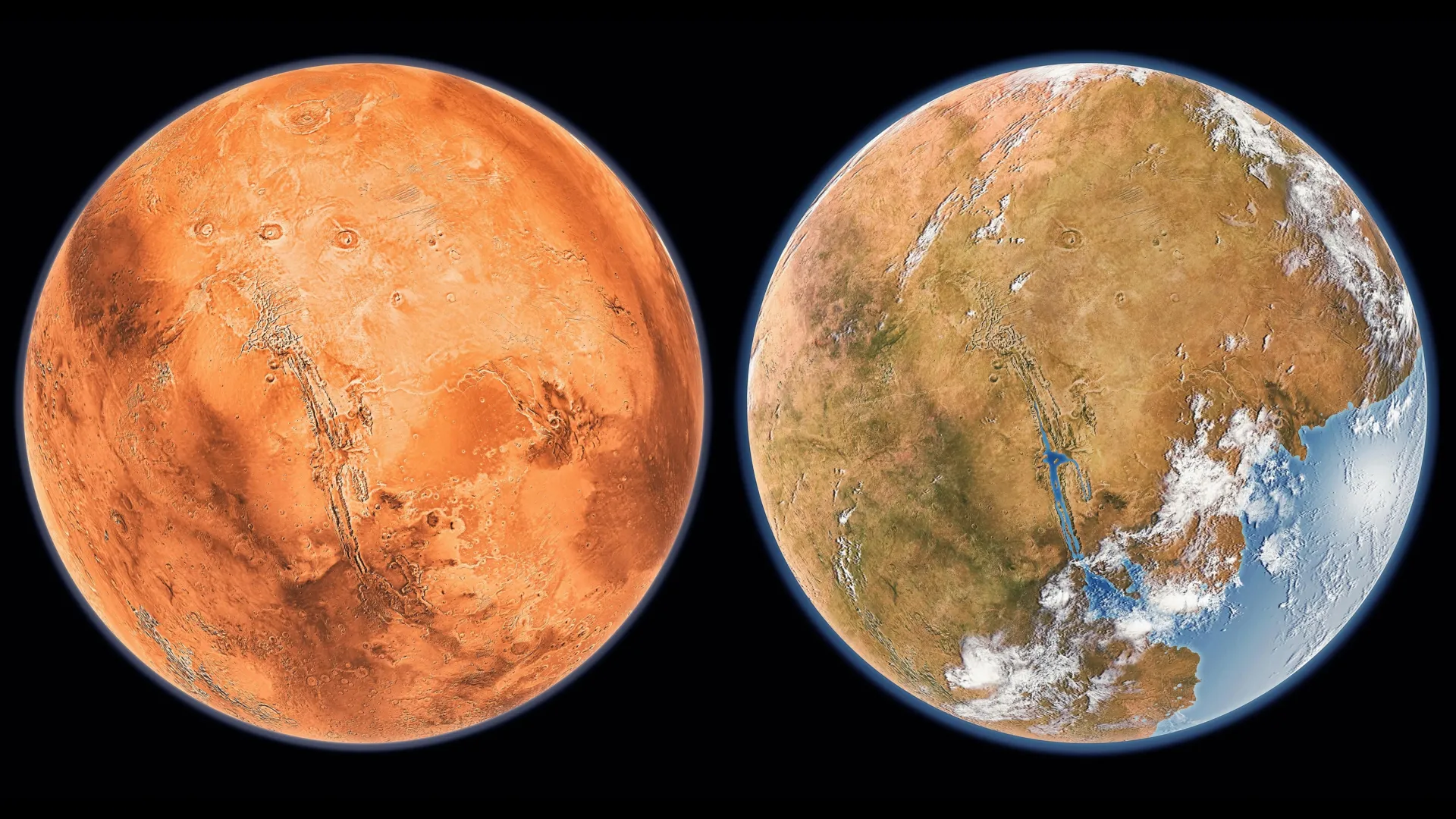
Terraforming refers to the groundbreaking process of reshaping planets and moons to support human life and other Earth-like organisms. Theoretically, this involves modifying an extraterrestrial atmosphere, climate, and surface to resemble that of Earth by introducing oxygen, establishing a stable mass of liquid water, and maintaining temperatures conducive to life. Mars stands out as a prime candidate for terraforming, with proposals that include releasing greenhouse gases to elevate the planet’s temperature and employing microbes capable of generating oxygen over centuries.
For decades, the idea of terraforming Mars was largely confined to the realm of science fiction. The dream of transforming a barren planet into a thriving habitat has captivated countless individuals, yet many scientists believed it was beyond our technological capabilities. However, a recent workshop brief advocates for the recognition of terraforming as a legitimate domain of scientific inquiry, even as actual attempts remain a distant prospect.
Dr. Erica DeBenedictis, CEO of Pioneer Labs, authored the brief prepared for the 2025 Green Mars Workshop. She posits that, while terraforming Mars once seemed impractical, significant technological advancements have shifted this perspective. Reduced launch costs attributable to SpaceX’s Starship and breakthroughs in synthetic biology and climate modeling have fueled a new dialogue. Researchers now emphasize the importance of exploring whether humans should pursue terraforming and determining the safest course of action.
Mars Terraforming Roadmap
Instead of starting with current technology, the workshop brief envisions a habitable Mars and traces backwards to outline the key steps necessary to achieve that vision.
The initial phase will focus on global warming strategies. Researchers propose using artificial aerosols and greenhouse gases to elevate Mars’ average temperature by several degrees Celsius over several decades. Data indicates that ample frozen water exists on Mars, potentially allowing for the formation of an ocean covering approximately 4 million square kilometers with an average depth of around 300 meters. If temperatures increase by about 30 degrees, these ice reserves could melt, facilitating the emergence of stable liquid water.
Role of Genetically Engineered Microorganisms
As conditions improve, the next step will involve introducing microbial life.
Scientists suggest engineering extremophiles—microorganisms that thrive in harsh environments—by fusing characteristics such as resistance to extreme temperatures, high radiation, and low pressure. These specially designed organisms could spread across Mars in algae-like formations within a few decades, initiating the gradual transformation of the Martian atmosphere through photosynthesis.
Creating a Breathable Atmosphere
Establishing an oxygen-rich atmosphere capable of sustaining complex life is projected to take centuries, if not longer.
The plan includes the development of a massive dome-shaped habitat approximately 100 meters tall. Within these controlled environments, breathable oxygen can be generated through photosynthesis or water electrolysis. Over time, vegetation could extend beyond the dome, gradually enriching the atmosphere with oxygen, although researchers estimate that natural production alone may require around 1,000 years. Ultimately, successful terraforming could enable future explorers to inhabit Mars without reliance on protective structures.
Scientific Unknowns Persist
This proposal raises fundamental questions that must be addressed before embarking on large-scale terraforming initiatives.
Scientists still lack a comprehensive understanding of what lies beneath Mars’ expansive ice sheets. Additionally, the impact of warming and wetting on Martian sandstorms remains uncertain. It is also essential to determine whether there are sufficient resources on Mars for large-scale water electrolysis, or if these materials must be transported from Earth at significant expense.
Ethical Considerations in Terraforming Mars
The scientific challenges are only part of the equation. The endeavor of terraforming Mars presents serious ethical dilemmas.
Drastic modifications to Earth could obliterate elements of its natural history, limiting future research opportunities on Mars in its pristine condition. Should indigenous Martian life exist, even at microscopic levels, the introduction of terrestrial life could jeopardize its survival before it is thoroughly understood.
Conversely, proponents argue that research into terraforming could yield vital benefits for Earth. Technologies developed for sustaining life on Mars—such as drought-resistant crops and efficient closed-loop life support systems—could enhance sustainability practices on our planet. Innovations intended for space exploration may also find valuable applications here on Earth.
As a passionate space enthusiast, I find this evolution in thinking particularly compelling. The workshop brief does not advocate for immediate action on terraforming Mars. Instead, it emphasizes the necessity for careful laboratory studies, advanced climate modeling, and potentially small-scale experiments during future Mars missions.
Before we embark on a journey to reshape an entire world, it is crucial to deepen our understanding of Mars and the scientific, environmental, and ethical ramifications of such changes. The dialogue is gradually shifting from the question of “Can we do this?” to “Should we do this? And if so, how?” This transition may represent one of the most meaningful advancements in our exploration of Mars yet.
Source: www.sciencedaily.com