


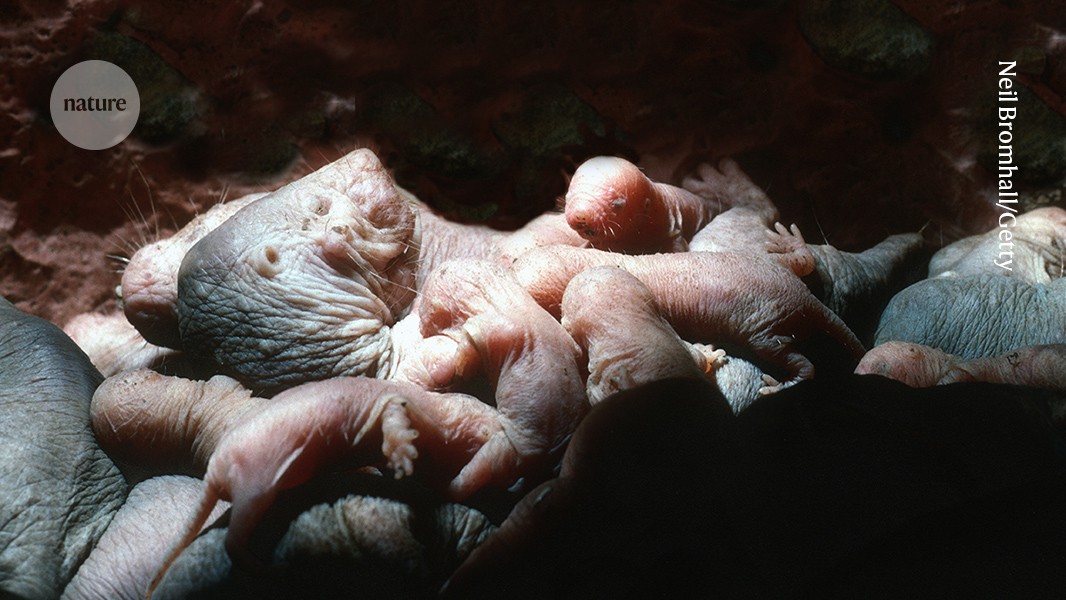
Naked mole rat queens secrete chemicals that inhibit reproduction among other females.
Credit: Neil Bromhall/Getty
The naked mole rat (Heterocephalus gruber) queens produce unique chemicals to prevent other females within the colony from reproducing.
A groundbreaking study published in Nature reveals that these compounds play a crucial role in maintaining a strict social structure centered around a single queen.1 The scent of this chemical influences hormone production in other females, inhibiting their reproductive capabilities.
Melissa Holmes, a behavioral neuroscientist at the University of Toronto, labeled the study a “game changer,” as it clarifies the longstanding question of why only one female breeds in naked mole rat colonies.
All for One Purpose
Famed for their resilience and remarkable lifespan, naked mole rats are eusocial—a rare trait among mammals. Within this social framework, the queen is solely responsible for reproduction, while other non-breeding members undertake laborious tasks like raising young and foraging for food.
Unlike other eusocial species, such as honey bees, all female naked mole rats have the potential to become queens. However, many remain in a “developmental standstill,” explained neuroscientist Lisa Stowers from Scripps Research in San Diego, California. These individuals exhibit underdeveloped reproductive systems and elevated prolactin levels, but the reason one female dominates and curtails the reproductive capacity of others remained elusive.
To investigate, neuroscientist Mohammed Khalaf from the Max Delbrück Center for Molecular Medicine in Berlin, along with his team, analyzed the scent profiles of naked mole rats across various social ranks. They identified a specific compound, isopropyl myristate (IPM), present in queens but nearly undetectable in non-breeding members. The production of IPM varied with the queen’s reproductive phases, peaking during ovulation.
“Our primary goal was to determine the chemical profile of the naked mole rat,” Khalaf stated. “The discovery of this queen-exclusive compound excited us immensely.”
Brain imaging indicated that olfactory neurons in non-breeding females were activated by exposure to IPM, suggesting a direct response to this chemical’s scent.
To examine the chemicals’ effects, the researchers removed some non-breeding females from the colony and administered a drug to block their sense of smell. In both instances, the prolactin levels of the mole rats dropped, enabling them to mate with males. Subsequent experiments demonstrated that the mere presence of IPM was enough to prevent reproduction and uphold the colony’s hierarchy, even in the queen’s absence.
“Heroic” Endeavors
Source: www.nature.com