


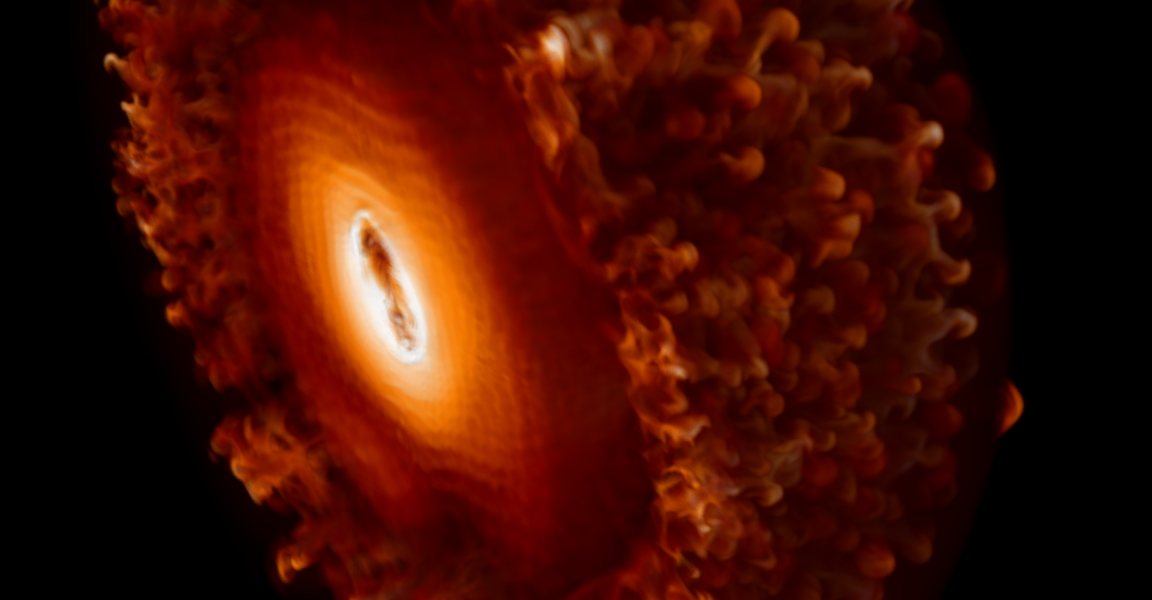
How Neutrinos Can Decide Whether a Star Explodes or Collapses Into a Black Hole
On the theoretical side, the picture is less settled. As researchers have added increasingly sophisticated physics to supernova models, they have gone through periods when either every model produced an explosion or none did. It is becoming increasingly difficult to create models that explain why some stars explode while others fail.
Why neutrinos are essential to supernova explosions
Despite these challenges, the best current models agree that neutrinos are essential to the process. Huge numbers of neutrinos are produced by the complex fusion reactions associated with supernova explosions and by the formation of neutron-star material at the core of the collapse. The latter also occurs when the collapse continues until a black hole forms.
These neutrinos play a crucial role in determining the fate of matter outside the dying star’s core.
As fewer photons emerge from the star’s center, the surrounding matter loses the energy needed to resist gravity and begins rushing inward. On its way, the matter encounters a shock wave produced by the formation of a neutron star or black hole, which moves in the opposite direction.
Left alone, these forces nearly balance each other. The shock wave stalls, and gravity takes over.
How neutrinos revive the stalled shock wave
Neutrinos change the equation. They rarely interact with matter, but their enormous numbers ensure that enough of them collide with material around the stalled shock wave.
Those interactions transfer energy and heat the surrounding matter enough to overcome gravity. The shock wave can then escape outward and destroy the star in a supernova explosion.
If this process fails, almost the entire contents of the star can collapse into a black hole. In that case, the star disappears without producing an explosion.
Neutrino flavors and flavor oscillation
One challenge for models that include neutrino heating is that they often treat neutrinos as a single factor. Neutrinos are more complicated than that.
There are three types, or flavors, of neutrinos: electron, muon, and tau neutrinos. However, each particle exists as a superposition of all three flavors and can move between them through a process called flavor oscillation.
As a result, even if an event inside a supernova produces only electron neutrinos, those particles can oscillate between the three flavors multiple times before reaching the star’s surface.
Source: arstechnica.com