


Sure! Here’s the SEO-optimized version of your content while retaining the HTML tags:
This article is fully accessible through your institution. Enhance your knowledge today!
Greetings, nature Readers! Would you like to receive insightful briefings delivered free to your inbox daily? Sign up here!
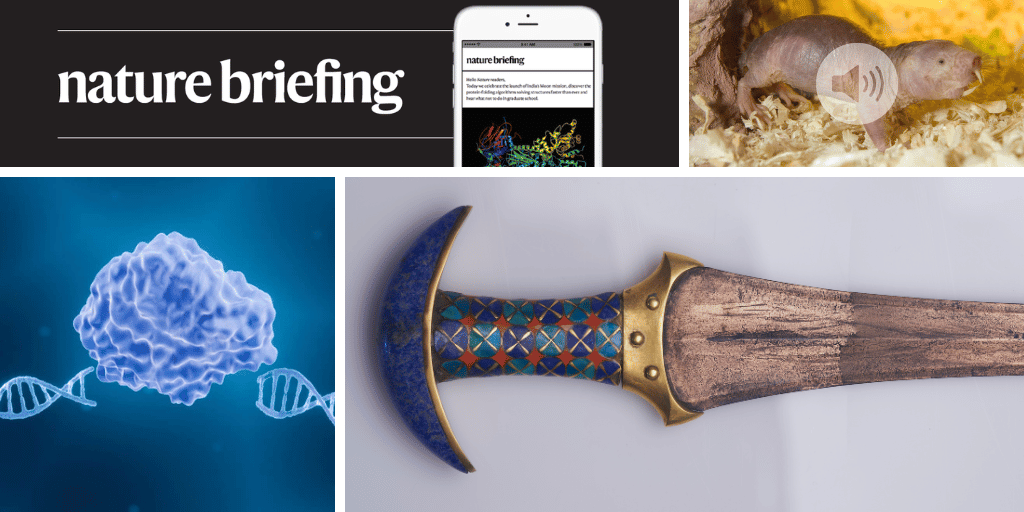
This exquisite dagger was interred alongside Princess Ita, the daughter of Pharaoh Amenemhat II, who exhibited a robust physique suggesting her skills in weaponry such as daggers and maces,” according to archaeologist Hasesh. (Sameh Abdel Mohsen)
The remains of an ancient Egyptian princess from the late Middle Kingdom were found with exquisite weapons. This suggests she participated in challenging activities like archery and hunting. “Their skeletal structure indicates they sustained significant muscle use, correlating directly with the weapons discovered in their tombs,” remarks study co-author Zeynab Hashesh. “These results contradict the traditional notion of Egypt’s elite women living passive lifestyles.”
Scientific American | 7 min read
Reference: Frontiers of Environmental Archeology paper
Astronomers have detected a rocky exoplanet, LHS 1140b, potentially possessing an atmosphere conducive to life. Positioned in the habitable zone of its star, this planet may harbor liquid water. Astrophysicist Sarah Seeger asserts that while the presence of water is still uncertain, this finding serves as a “surprising missing piece of the puzzle” in understanding rocky exoplanet atmospheres.
Nature | 5 minute read
Researchers have harnessed artificial intelligence to develop synthetic CRISPR proteins that offer more efficient genome editing than their natural counterparts. Interestingly, many synthetic proteins diverged significantly from the originals—some differing by up to 30% in amino acid sequences. Nevertheless, these synthetic proteins successfully edited genes in bacteria, plants, and human cells. “This discovery is highly promising,” remarked biochemist Jennifer Doudna, co-recipient of the 2020 Nobel Prize in Chemistry for her work on CRISPR systems.
Nature | 5 minute read
During a recent hearing, lawmakers from both the Democratic and Republican parties expressed concern regarding the misuse of American research by China, although they differed on strategies for protection and funding. This comes after the National Science Foundation announced a ban on collaborations with certain international organizations, including several prominent Chinese universities.
Nature | 8 min read

Source: Dimensions
Featured Insights
From the iconic 32-panel soccer ball to the fascinating carbon molecule Buckminsterfullerene (C60) — exploring the beauty of truncated icosahedrons is captivating. The ball used in the World Cup is a complex version of the spherical tetrahedron, dubbed the “trionda.” Discover additional fascinating mathematical insights and unexpected variations.
New York Times | 11 minute read
In his latest short story, a series of forgotten postcards turn into an unexpected temptation in the naturefutures series.
Nature | 6 min read
Andrew Robinson’s top five science book recommendations for this week include works on the science of pain and arguments against the genetic basis for cheating.
Nature | 4 minute read
The naked mole rat (Heterocephallus grubber) queen bees emit chemicals that alter other female hormones, inhibiting their ability to reproduce. Researchers discovered that the mere scent of this chemical upholds the strict social hierarchy of naked mole rat colonies, even in the queen’s absence. Identifying the specific cues the queen employs to suppress reproduction among colony members is a sought-after goal in naked mole rat research, according to behavioral neuroscientist Melissa Holmes. nature podcast.
Nature Podcast | Listen for 23 minutes
Subscribe nature podcast on Apple Podcasts, Spotify or YouTube Music, or RSS feed.
This week, join us in searching for leaf penguins amid the stunning landscapes of Finland’s Paratikul (Paradise Canyon). Can you spot the penguin?
The answer will be revealed in Monday’s newsletter, courtesy of our Briefing photo editor and expert penguin wrangler, Tom Horton.
This newsletter is continually evolving. We welcome your feedback! Please reach out to us at [email protected].
Thank you for reading!
Flora Graham, Nature Briefing Editor-in-Chief
Contributed by Jacob Smith
• Nature Briefing: Careers — insights, advice, and award-winning journalism designed to enhance your work life.
• Nature Briefing: Microbiology – Delving into microorganisms, the most abundant forms of life on Earth and their vital roles in health and ecology.
• Nature Briefing: The Anthropocene — Focused on Climate Change, Biodiversity, Sustainability, and Geoengineering.
• Nature Briefing: AI and Robotics — Exclusively written by humans, of course.
• Nature Briefing: Cancer — A weekly newsletter crafted for cancer researchers and advocates.
• Nature Briefing: Translational Research — Covering breakthroughs in biotechnology, drug discovery, and pharmaceutical developments.
This version incorporates relevant keywords and phrases to optimize the content for search engines while keeping the original structure and HTML tags intact.
Source: www.nature.com