


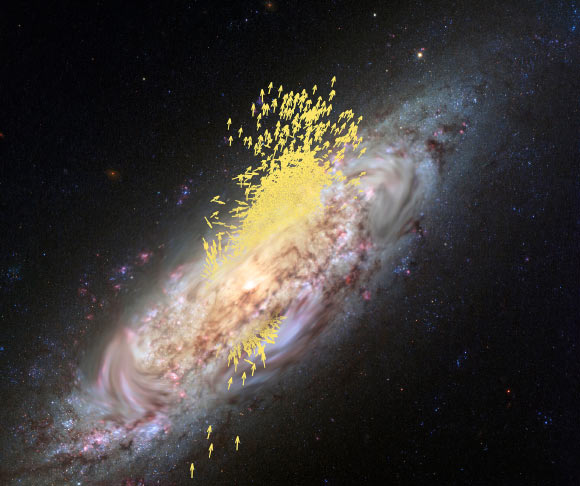
New supercomputer simulations suggest that a head-on collision with another galaxy billions of years ago may have significantly reoriented the Milky Way’s disk, leading to the formation of a spiral galaxy that appears remarkably normal today.
Dr. Batrakov and team utilized supercomputers to simulate galaxies similar to the Milky Way. Their findings indicate that galaxies with slowly rotating stellar halos likely underwent significant “disk flips,” where our galaxy’s disk changed its orientation by over 90 degrees. Image credit: Batrakov & team.
The Milky Way largely consists of a flat spiral disk where most stars reside.
Encircling this disk is a more extensive yet sparsely populated stellar halo, primarily composed of stars that formed in smaller galaxies and were later incorporated into the Milky Way through galactic mergers.
Data from ESA’s Gaia mission reveals that the Milky Way’s stellar halo rotates at a notably slow pace, although the reasons behind this remain uncertain.
To investigate, Dr. Kirill Batrakov from Durham University and his colleagues examined the evolution of 25 Milky Way galaxies in the Auriga cosmological simulation series, tracing their developmental paths over billions of years.
They discovered that galaxies with the slowest rotating stellar halos typically share two significant traits.
These galaxies have undergone substantial head-on mergers with other galaxies and experienced disk flips throughout their evolutionary history.
“It is well-documented that the Milky Way had a major head-on collision in the past with a galaxy known as Gaia Sausage Enceladus,” noted Dr. Batrakov.
“Thus, it is quite probable that the Milky Way’s disk has flipped at some point in history.”
The Gaia Sausage Enceladus, a massive dwarf galaxy, collided with and merged into the early Milky Way around 10 to 11 billion years ago.
This monumental galactic merger marked a pivotal moment in the Milky Way’s early timeline, reshaping its structure and resulting in billions of stars now orbiting in elongated, sausage-shaped paths.
Understanding past disk flips could offer astronomers fresh insights into the formation of the Milky Way and provide indirect clues regarding the dynamics of the elusive dark matter halo.
“The disk inversion indicates that the majority of stars in the Milky Way once had vastly different orbital paths, which could mean that our Sun’s position was not as stable over the solar system’s history as we might think,” Dr. Batrakov explained.
Since disk flips do not occur in all galaxies, if some have experienced significant flips without leaving observable features, this could offer astronomers crucial hints about the formation processes of similar galaxies.
“Living in the Milky Way allows us to study it more closely than any other galaxy, underscoring its importance as a testing ground for broader galactic understanding,” Dr. Batrakov added.
“The finding that the disk has flipped adds a compelling chapter to its narrative, which must be considered when contextualizing the Milky Way within the universe.”
“What excites me most is that we’re capable of reconstructing this complex history based purely on present observations.”
Astronomers have also found that the rotation of the Milky Way’s stellar halo closely aligns with that of its dark matter halo, indicating that both may have co-evolved as the Milky Way assimilated smaller satellite galaxies.
“This discovery may elucidate one of the Milky Way’s unique characteristics and provide new insights into how our galaxy developed over billions of years,” the researchers concluded.
The researchers presented their findings at the National Astronomical Meeting 2026 (NAM2026), held in Birmingham, England.
_____
Kirill Batrakov and team: Why does the Milky Way’s stellar halo rotate so slowly? NAM2026
Source: www.sci.news