


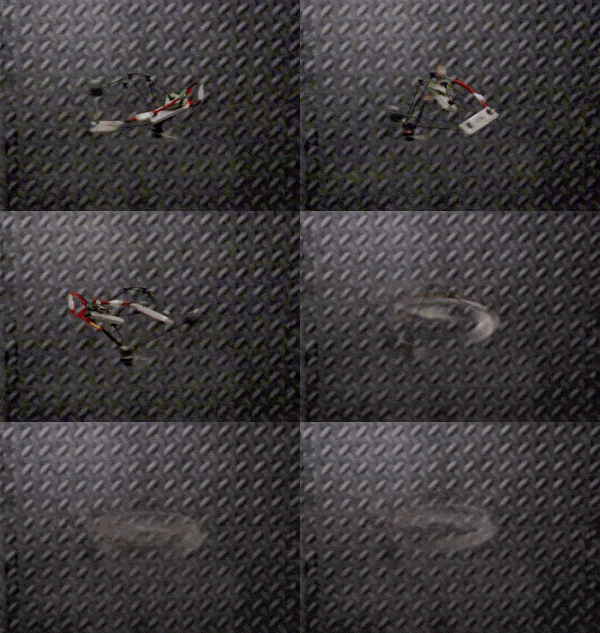
Engineers have successfully designed a revolutionary drone that camouflages itself as a haze while soaring through the sky.
The innovative Phantom Twist prototype drone employs advanced motion blur technology, allowing it to remain hidden in plain sight, a breakthrough for low-visibility drone flights. Researchers assert that this cutting-edge drone could significantly impact wildlife monitoring, ecosystem surveys, and infrastructure assessments.
Conventional stealth drones typically aim to disguise themselves by altering their appearance with camouflage paint, transparent materials, or complex optical techniques. In contrast, Phantom Twist employs a novel strategy: it harnesses the unique way humans and animals perceive motion.
Latest Videos From

The research team behind this groundbreaking drone presented their findings at a conference on July 16, titled Robotics: Science and Systems in Sydney, Australia.
“Most attempts to conceal drones involve making them mimic their surroundings,” explained the lead author of the study, Michael Rubenstein, Associate Professor of Computing and Mechanical Engineering at Northwestern University. He added, “We wanted to know if we could design a drone based on how humans perceive motion.”

(Image credit: Michael Rubenstein/Northwestern University)
The drone operates more like a spinning fan than a traditional quadcopter. While typical drones feature four fixed rotors, the Phantom Twist utilizes a single motor and a unique propeller system. The body rotates in an opposite direction to the propeller, achieving a rotation speed of 25 times per second, far exceeding human visual perception.
The team has engineered the Phantom Twist to be perceived as a translucent blur rather than a distinct aircraft, achieving a visual stealth level that is reportedly one-tenth less detectable than standard drones.
For development, the researchers deployed algorithms to explore thousands of design configurations. By using a computational model, they generated approximately 20,000 drone designs, reshuffling the motor, propeller, battery, and other essential components to meet flight stability requirements.
Subsequently, artificial intelligence (AI) was applied to optimize these designs, minimizing visibility across various angles while maintaining aerodynamic integrity.
The team thoroughly simulated each prototype against 100 real-world backdrops—including skies, forests, and urban environments—to assess which design blended seamlessly into the surroundings.
Employing a perceptual model that mimics human eyesight, they identified designs that blended effectively, lowering visibility scores. The next step involved refining the 500 least visible designs through additional optimization iterations.

(Image credit: Michael Rubenstein/Northwestern University)
Distinct from traditional drones, Phantom Twist features an expanded three-dimensional design with components arranged at various heights and angles. This innovative layout ensures that the drone’s parts do not overlap visually during rotation, enhancing its disguise.
The research emphasizes the importance of geometry since human perception accumulates visual signals similarly to camera exposure times.
“Rapid spinning causes sharp edges to blur, making it difficult to discern shapes,” explained co-author Emma Alexander, a computer vision expert.
Potential applications for Phantom Twist include monitoring bird nesting behaviors without disturbance, surveying wetlands without alarming waterfowl, and inspecting aging infrastructures discreetly.
While Phantom Twist isn’t a flawless “ghost,” as it produces noticeable noise and some structural elements remain visible, the research team is already exploring next-gen models that will incorporate more transparent materials and quieter propulsion systems.
Source: www.livescience.com