


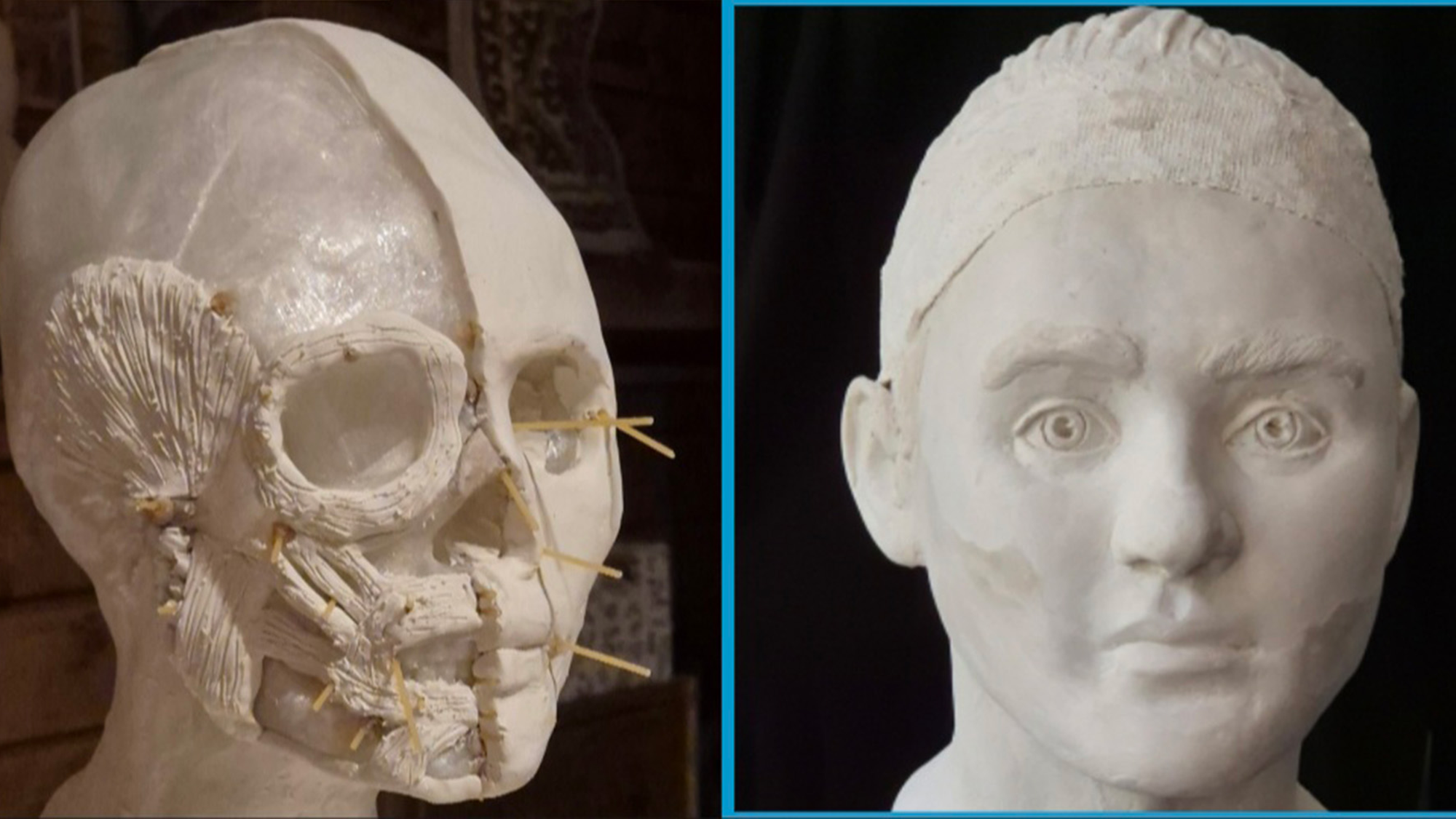
Nearly 1,700 years after her passing, the face of a young woman adorned with a laurel wreath, buried in exquisite clothing and unique cork sandals, has been revealed.
This woman is among 16 individuals from the Roman city of Aquincum, located in modern-day Hungary, whose faces have been meticulously reconstructed for the new exhibition at the Aquincum Museum in Budapest. This innovative exhibit pairs excavated skulls from the ancient city with scientifically-backed reconstructions of their original appearances in life.


The Process of Reconstructing Roman Faces
Aquincum was situated on the Danube’s border in present-day Budapest. The city was home to a diverse population from the 1st to 4th centuries. Genetic and archaeological studies reveal connections to modern regions including Italy, Scotland, and Syria, as well as influences from the Sarmatian and Celtic communities.
The remains of these ancient inhabitants continue to be excavated from the city’s cemetery. According to a statement from the museum, ongoing excavations reveal more about the lives of these individuals.
The reconstruction process begins with high-resolution 3D CT scans of original skulls, followed by the creation of precise 3D-printed replicas. This allows experts like Gabor to work with ancient remains without risking damage.
“We utilize the latest scientific advancements, including 3D scanning, CT imaging, ancient DNA analysis, and facial approximation methodologies,” Gabor remarked.
“For hyper-realistic restorations, we create molds, cast faces with colored silicone, and finish with real human hair, eyebrows, and eyelashes, even adding beards if needed,” she added.

Image credit: ARC-heo art-REKO Studio
Gabor uses several techniques to bring the faces of Aquincum to life, beginning with preserved skulls.

Image credit: ARC-heo art-REKO Studio
Gabor employs over 60 anatomical landmarks to accurately recreate faces from human skulls.

Image credit: ARC-heo art-REKO Studio
Using 3D scanning technology, Gabor is able to bring these faces back to life.

Image credit: ARC-heo art-REKO Studio
Ancient DNA analysis has helped determine characteristics seen in the reconstructions, such as hair and skin color.

Image credit: ARC-heo art-REKO Studio
This realistic reconstruction incorporates real human hair, eyebrows, and eyelashes.
Ancient DNA may also provide insights into pigmentation characteristics such as eye, hair, and skin color. However, these results remain approximations, not exact portraits. Details like hairstyles and facial expressions are largely speculative.
The Woman in the Laurel Wreath
Among the reconstructions, Gabor was particularly moved by “The Raspberry,” widely known for her burial including a laurel wreath. This young woman’s skeleton, while well-preserved, left only her skull, as her soft tissues had decayed. Her burial artifacts included fine clothing, a weaving spindle, cork sandals shaped like birds, and a portrait of a man positioned near her feet. Archaeologists speculate that this portrait may depict her husband or father, though his identity remains unknown.

“Based on these artifacts, archaeological context, and anthropological insights, we reconstructed her narrative and brought her face to life,” Gabor shared. “It was a profound experience.”
Additional figures in the exhibition include a child who died young and a female interpreted as a nurse or healer, buried in a children’s cemetery. Others include construction workers, military personnel, and blacksmiths.
Two women, who appeared to have met violent ends, were buried face down with their feet bound. The exhibition associates one with accusations of witchcraft and the other with poison. However, these interpretations are speculative and based on historical contexts.

“Each recovery feels like a journey,” Gabor reflected. “As you bring each face to life, you begin to relive their stories, and they transform from mere artifacts into real people.”
Analyses show many skeletons belonged to individuals who endured physical labor, malnutrition, and chronic diseases. This discovery led museum curators to conclude that many represented the lower classes of Roman society—whose stories are often absent from historical accounts.
For Gabor, physical reconstructions transcend digital images. Visitors can engage face-to-face with lifelike figures, experiencing them from varying perspectives. She hopes this interaction invites visitors to think beyond mere data and contemplate the vibrant lives once lived.
“When you observe a face, you’re perceiving history—not just bone. These were individuals who loved, fought, struggled, and ultimately, died,” Gabor expressed. “This shared humanity cultivates empathy.”
Source: www.livescience.com