Ancient Shark “Graveyard” Discovered Beneath Egypt’s Desert
Scientists have discovered an ancient shark “graveyard” in the middle of Egypt’s Western Desert, revealing that the region was once covered by a thriving prehistoric ocean.
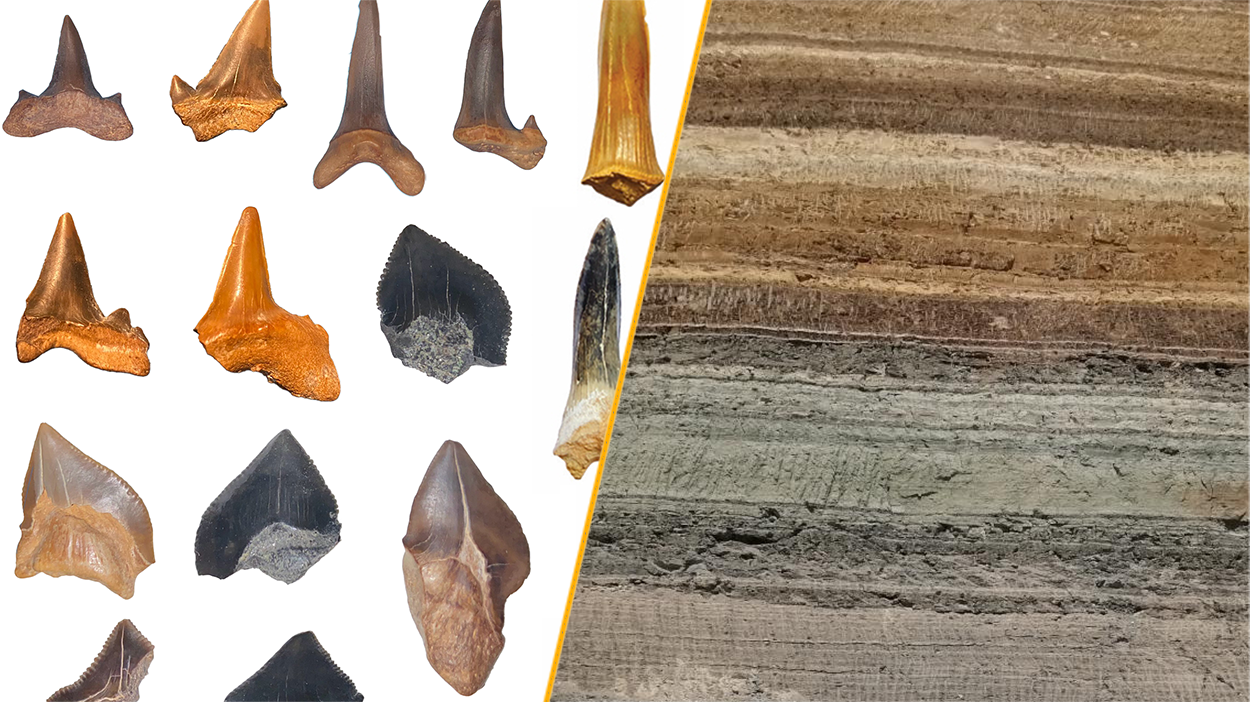
Fossilized teeth from at least seven shark species were uncovered between 2020 and 2022 on the Abu Tartur Plateau. The fossils date to the Late Cretaceous Period, millions of years before the Egyptian desert formed. The findings offer new evidence about the area’s marine past and were detailed in a study published in Cretaceous Research.
“This study provides evidence that the area now occupied by the plateau was once an ocean where marine life thrived,” lead author Tarek Yassin, a paleontologist at Cairo University in Egypt, told Live Science by email. The environment likely had suitable temperatures, sunlight and oxygen levels to support a diverse marine ecosystem.
Latest videos fromLive Science
During the Cretaceous Period, which lasted from about 145 million to 66 million years ago, global temperatures were generally warmer than today. Sea levels may also have been as much as 558 feet (170 meters) higher, according to the Natural History Museum in London. As a result, shallow seas covered areas that are now dry land, including parts of Egypt’s deserts.
The Abu Tartur Plateau lies within the Dwi Formation, a Late Cretaceous rock formation extending across Egypt’s Eastern and Western Deserts. Earlier studies had identified fossils belonging to fish, sea turtles and other marine reptiles in the region, indicating that a productive marine ecosystem once existed there. The formation is also rich in phosphate rock, a sedimentary material commonly associated with deposits of marine shells and bones.
“Before the expedition, we knew that phosphate-rich areas could contain fossils from marine vertebrates,” Yassin said. “Finding shark fossils was an exciting surprise.”
Yassin and his colleagues had previously identified fossilized teeth from two types of mackerel sharks. Additional fieldwork carried out between 2020 and 2022 uncovered 14 more teeth representing at least five other species.
Among the fossils was Scapanorhynchus raphiodon, an extinct relative of the modern goblin shark. The species had not previously been reported in Africa. Two other sharks, Cretoxyrhina serrata and Squalicorax bassani, had not previously been documented in Egypt.
“The discovery of teeth from seven different shark species in the same area was particularly noteworthy,” Yassin said. “This finding represents more than simply a large collection of shark fossils.”
The concentration of shark fossils suggests that the area may once have supported a nutrient-rich ecosystem filled with small fish. Those fish could have provided food for several large predatory sharks. However, the fossils do not prove that all seven species lived there at the same time. Their remains may have accumulated in the same sediment over thousands or millions of years.
The researchers plan to continue exploring the Abu Tartur Plateau and nearby regions in search of additional fossils. “We believe there is still much to discover,” Yassin said.
Yassin, T., Carrillo-Briceño, J.D., Kindlimann, R., Ibrahim, A., and AbdelGawad, M.K. (2026). Egypt’s Shark Graveyard: A new assemblage of Late Cretaceous sharks from the Dwi Formation of the Abu Tartur area in the desert of southwestern Egypt. Cretaceous Research, 106476.
How much do you know about sharks? Test your knowledge with our shark quiz!