


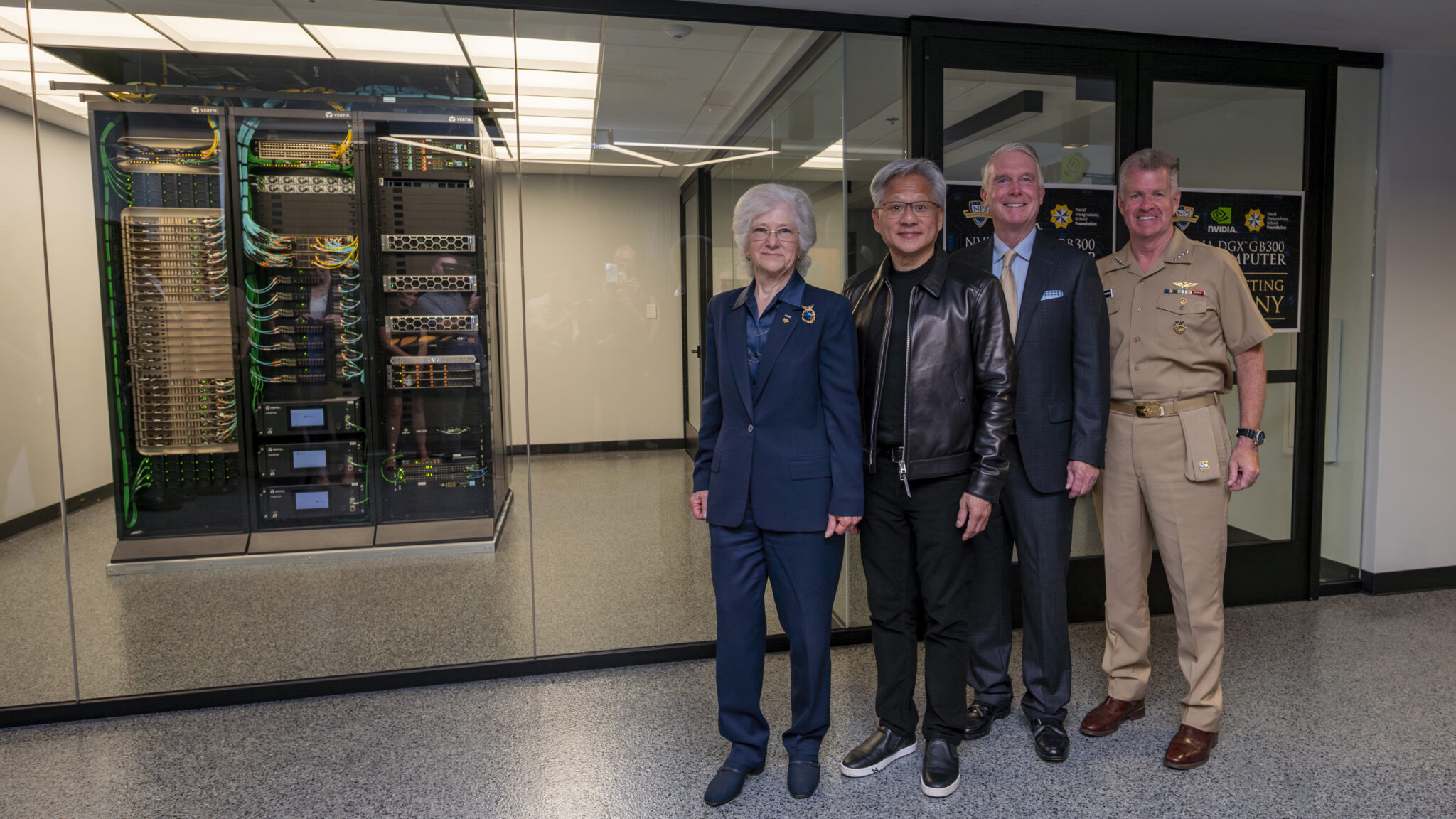
NVIDIA’s Founder and CEO, Jensen Huang, announced today that the Naval Postgraduate School in Monterey, California, is now equipped with the NVIDIA DGX GB300 System. This system delivers one of the most powerful AI platforms available, providing students, researchers, and faculty at the U.S. military’s premier graduate institution with unmatched access.
“Our nation relies on service members at the front lines, and having timely information and insights is crucial,” Huang emphasized during the event. “I can’t think of anything more vital.”
The DGX GB300 supercomputer comes equipped with NVIDIA Mission Control, which will grant over 1,500 resident students and 600 faculty members at NPS access to powerful large-scale AI computing capabilities. This encompasses model training and inference for applications in weather forecasting, cybersecurity, and disaster management.
The commissioning of this system was highlighted during the school’s three-day event, Converge @ NPS, marking a significant stride in their collaboration to harness AI for educational and practical applications.
Situated within the NVIDIA AI Technology Center on the Monterey campus, this facility is dedicated to enhancing AI research and mentoring students in graduate studies, focusing primarily on the DGX GB300.
“As we advance our technology, it’s crucial to modernize how we train our leaders,” stated Adm. Samuel Paparo, commander of U.S. Pacific Command. “Access to advanced computing empowers NPS students and faculty to grasp the opportunities and responsibilities that such technologies present.”
Empowering Leaders through AI Education
NPS educates both active-duty officers and international partners across various disciplines, from space operations to marine science, granting graduate degrees with applied research that directly addresses real-world challenges.
“Leadership is about serving something greater than yourself—your team, your country, your mission,” Huang told attendees. “All these technologies are tools to facilitate that.”
The DGX GB300 enriches these programs by enabling foundational model training on-site, running high-fidelity simulations at scale, and swiftly developing effective AI tools.
Huang noted that even those without a computer science background can harness AI technologies today.
“The best advice I can offer is to take advantage of technology,” Huang stated. “It isn’t as complex as it seems. Technology is designed to become smarter and more user-friendly over time.”
NVIDIA is also empowering NPS faculty through the Deep Learning Institute, which provides the Instructor Toolkit to seamlessly integrate AI into graduate curricula across various departments.
“Many of you will lead in an AI-augmented environment, where information travels at incredible speeds and response times shrink,” Paparo mentioned. “Our edge comes from leaders like you who can analyze, understand, decide, and act promptly, using technology to deliver insights and leadership that machines cannot replicate. This essential education is all happening right here at NPS.”
Innovations from Ocean Models to Digital Twins
NPS frequently organizes hackathons to drive advancements in autonomy, ocean research, and operational planning—endeavors that necessitate substantial computing resources.
Researchers are utilizing AI to simulate ocean conditions, forecast atmospheric shifts, and create digital twins of intricate environments. This research is integrally linked to NPS’s extensive expertise in various scientific domains.
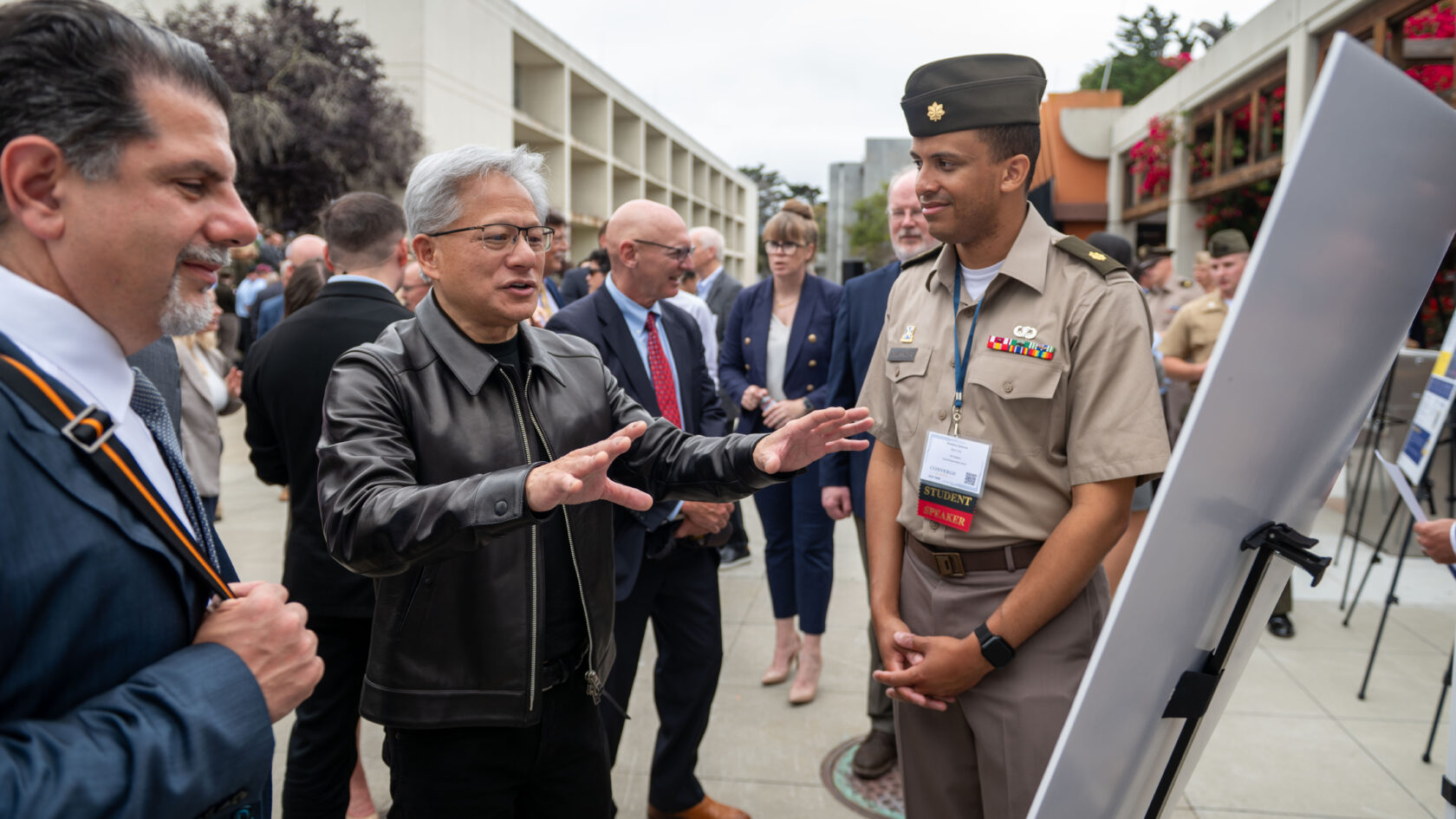
Powered by the DGX GB300, these innovative projects take center stage on campus.
In collaboration with organizations like Maitre, a nonprofit, a framework has been developed based on NVIDIA Omniverse, offering a detailed digital twin environment for simulating complex navigation and decision-making in uncertain contexts.
For more insights, please watch NPS and NVIDIA researchers discussing AI modeling and simulation at NVIDIA GTC Washington DC.
NVIDIA’s Partner Ecosystem: Building AI Infrastructure
The completion of NPS’s DGX GB300 was a collaborative effort, with DDN, VAST, and Vertiv playing pivotal roles as hardware and systems integration partners.
DDN contributed to creating a high-performance data infrastructure, enabling researchers to efficiently access, manage, and safeguard data for demanding AI tasks.
VAST Data provided a unified data platform for secure data handling across edge, core, and cloud environments.
Vertiv delivered the necessary racking, cooling, and power infrastructure to operationalize the system, as well as installation, testing, and monitoring support.
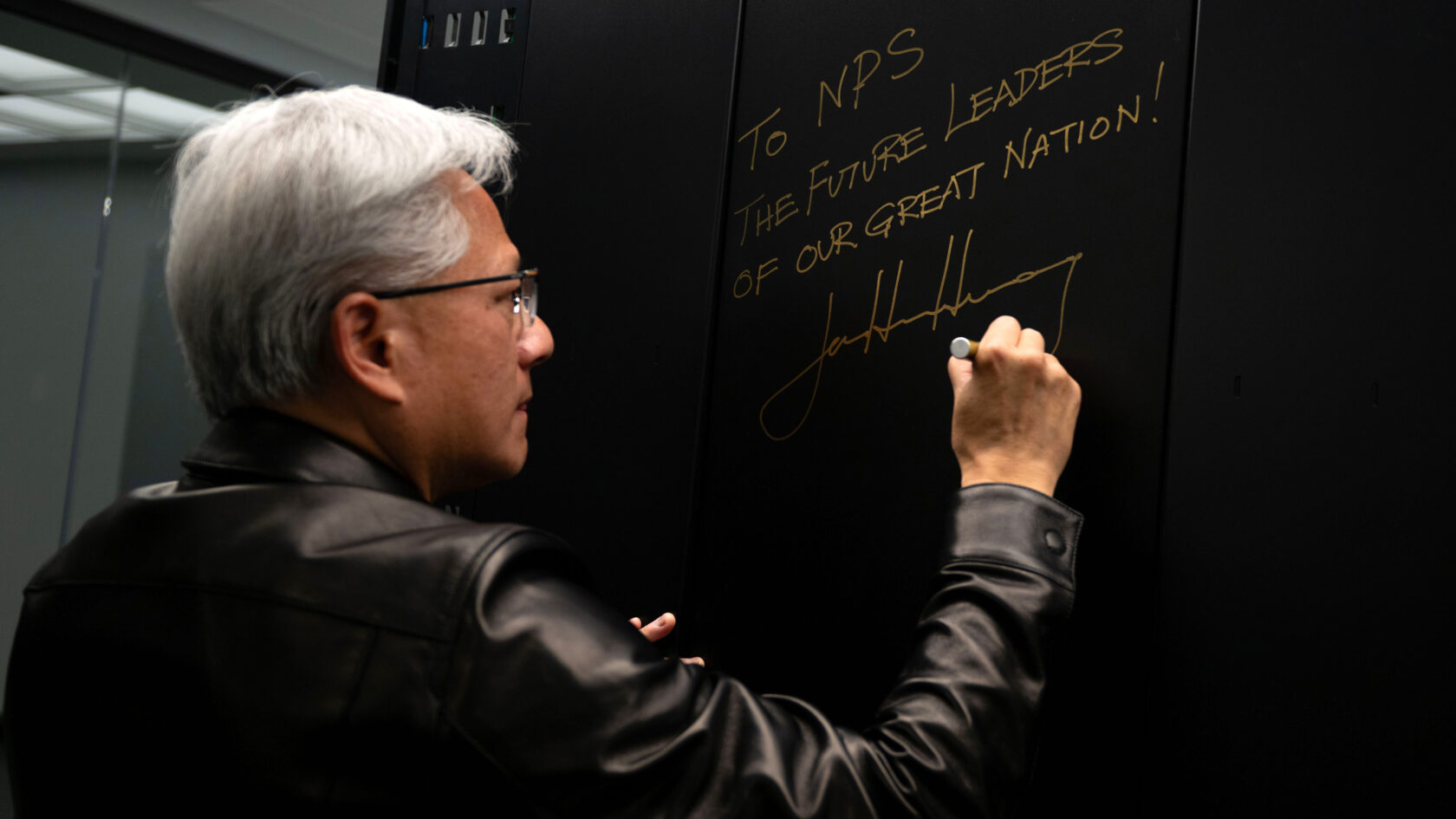
Click here for more details on the NVIDIA and NPS collaboration and explore the NVIDIA DGX GB300.
Source: blogs.nvidia.com