


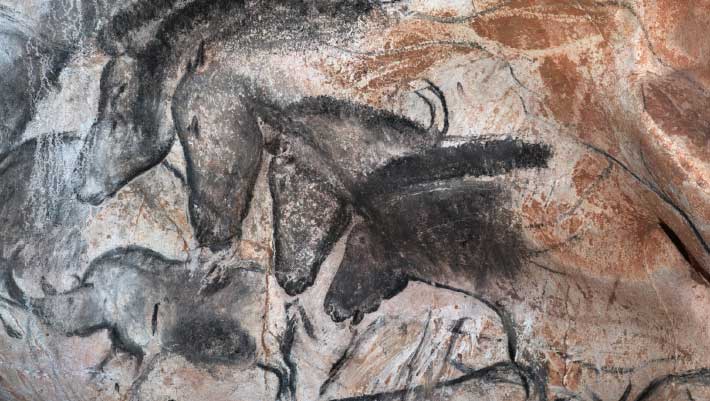
Scientists from Sorbonne University and France’s National Center for Scientific Research (CNRS) have developed a non-contact method for detecting an extremely thin, translucent calcite coating on paintings made around 37,000 years ago in France’s Chauvet Cave. Using ultraviolet fluorescence spectroscopy, the team examined the cave art from a distance and found evidence that mineral deposits may have both protected some drawings and obscured others.
Analyzing fragile cave art from a distance
Multiple collapses sealed Chauvet Cave during the Upper Paleolithic, helping preserve hundreds of paintings and sculptures of rhinos, mammoths, lions, horses, bison and other animals. With decorations dating back 37,000 years, the site offers a rare view of the beginnings of human art.
However, artworks in underground environments remain highly fragile. Their condition depends on a delicate balance of environmental factors, creating significant challenges for the management of famous archaeological sites and decisions about public access.
“Our methodology is very similar to a forensic investigation,” said the study’s lead author, Dr. Philip Walter.
“We will examine all the evidence to decipher the techniques of prehistoric artists and understand how paintings have been preserved through time.”
The researchers’ method uses ultraviolet (UV) fluorescence: a UV beam is directed at a cave wall and the weak light that returns is analyzed. Chauvet Cave’s floor contains exceptionally well-preserved human and animal footprints, so visitors are restricted to narrow passageways. As a result, scientists may need to work between 1 and 6 meters from a decorated panel, a distance that is too great for many conventional analytical instruments.
To address this problem, the team built a spectroscopic device around a 3-meter bundle of optical fibers mounted on a carbon-fiber pole, a 365-nanometer ultraviolet LED and a battery pack. In the humid cave, at a temperature of 13 degrees Celsius, the device collected measurements from distances of up to 2.5 meters.
Calcite layers over prehistoric drawings
The technique works because the limestone bedrock and calcite deposits that form on its surface fluoresce differently under UV light, despite being nearly chemically identical. Organic impurities trapped in the two materials give them distinct spectral characteristics.
The charcoal pigment used in the drawings absorbs UV light and does not emit it. On the black lines of the horse panels, the researchers found that most of the detected light came from calcite rather than limestone. They interpret this as evidence that a thin calcite layer covers the drawings.
Such a layer could act as a natural varnish, the researchers suggest, but a thicker, opaque deposit could also conceal the artwork.
In the lion alcove, water entered the cave after people stopped occupying it and produced calcite flows. Several charcoal lines coincided with the boundaries of these flows. In some areas, calcite formed on bare rock but not on pigmented surfaces, suggesting that the drawings affected how the mineral crystallized.
Clues about the artists’ materials
Dr. Walter and his colleagues also observed an unexpected orange glow beneath some charcoal marks and around torch marks. In laboratory tests, only heated limestone and heated calcite produced a similar orange signal; tar and degraded charcoal did not.
The researchers therefore believe that some lines may have been made with hot or even burning charcoal, which altered the underlying rock. They emphasize that this remains an interpretation based on the fluorescence results.
“These results demonstrate that careful interaction between humans and geology has enabled these works of art to be preserved for tens of thousands of years,” the researchers said.
“We expect this technology to have applications ranging from forensics to monitoring biofilms on the International Space Station. This project is already underway.”
The study was published in ACS Omega, volume 11, issue 40, on pages 60980–60990. The paper is available under the DOI 10.1021/acsomega.6c05061.
Johan Boulard et al., 2026. “On-site ultraviolet fluorescence spectroscopy for characterization of translucent calcite coatings on prehistoric cave art.” ACS Omega 11 (40): 60980–60990.
Source: www.sci.news