


This article is fully accessible through your institution.
Hello Nature readers! Would you like to receive this daily briefing for free in your inbox? Sign up here.
This body-slamming behavior requires remarkable cognitive sophistication, as noted by study authors. (Kathryn Ayers)
Killer whales (Orcinus orca) were observed ramming a sunfish (Mastrus orchiolatus) with such intensity that it exploded. In this brutal display, a female killer whale held a dead sunfish for the male to lunge at. Subsequently, juvenile killer whales feasted on pieces of the fish, while the adult pair nibbled on the carcass. “This could provide easier access to food for young killer whales,” explained marine ecologist Kathryn Ayers, a co-author of the study. “Or perhaps they’re simply enjoying a game. Killer whales are known for their playful nature.”
Guardian | 3 min read or Nature | 2-minute video
Reference: Frontiers of Animal Behavior
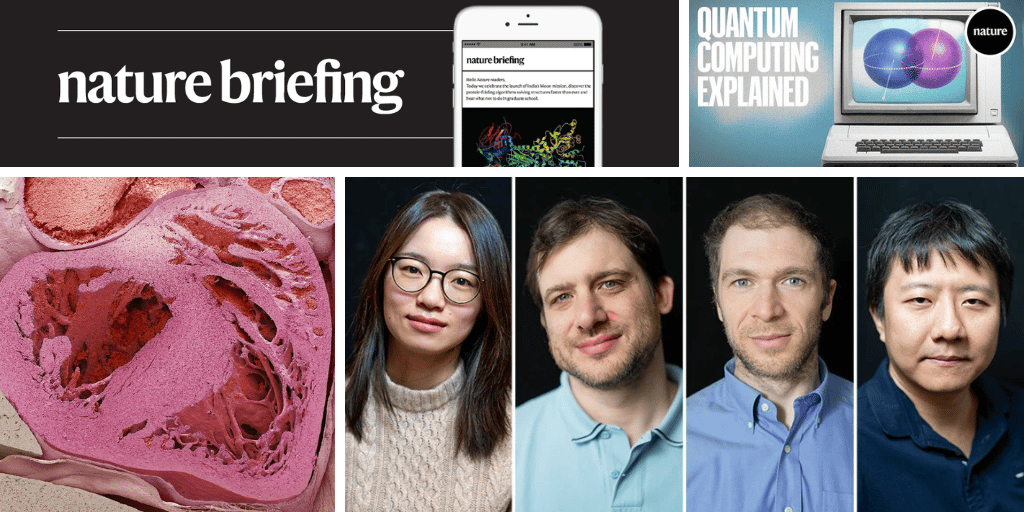
Recent studies reveal the heart’s “mini-brain,” a network of neurons surrounded by adipose tissue. Researchers identified two neuron subtypes in mice: one, MP+, inhibits heartbeats while ensuring they continue; the other, Ddah1+, appears to enhance cardiac stress management. This groundbreaking study indicates these neurons play an active role beyond merely relaying signals from the brain, according to chemical physiologist Beth Habecker.
Nature | 5-minute read
Reference: Cell
The 2026 Fields Medal, one of mathematics’ premier accolades, has been awarded to Yu Deng, John Purdon, Jacob Zimmerman, and Hong Wang, celebrating their diverse contributions across various mathematical fields. Notably, Deng and Wang represent significant milestones as Chinese nationals—Wang being the third woman in the award’s 90-year history.
Nature | 6 min read
The rise in extreme heatwaves has led to a need for effective cooling solutions. While air conditioning is a common choice, it comes with drawbacks. Scientists advocate for passive cooling materials that can lower building temperatures without energy use. Architectural researcher Mataios Santamoris emphasizes that innovative materials incorporating air pockets or combining radiative cooling with evaporation could replicate the cooling effects of air conditioning in sustainable ways. However, many of these solutions are still in the prototype phase and will require supportive policies to gain traction.
Nature | 5-minute read
Reference: Nature Review Clean Technology
Researchers have uncovered vulnerabilities in online datasets, allowing fraudsters to contaminate data, thus hindering AI agents’ analysis capabilities. “Such attacks are nearly unavoidable, enabling users to filter false information through credible channels,” warns computer scientist Vitaly Shumachikov. To safeguard against these threats, it’s crucial to conduct thorough provenance checks by including verified files in data sharing.
Nature | 6 min read
Reference: arXiv preprint 1 & Preprint 2 (Not peer-reviewed)
Featured Insights

(Richard Tibbits/Nature)
Five scientific illustrators share their insights on creating engaging visuals that communicate complex scientific concepts and their vision for the future of scientific illustration amid technological advances like artificial intelligence. Illustrators argue that effective design requires not only technical skills but also the ability to grapple with unresolved questions in research. In some instances, illustrations may serve as a vehicle for knowledge production rather than merely a means of communication.
Nature | Visually packed scroll
The Artemis II mission generated significant global interest as four astronauts orbited the far side of the moon. However, what awaits them upon return to Earth when the excitement fades? Former astronaut Susan Kilrane notes that while many astronauts transition to fruitful careers post-spaceflight, others face challenges in finding new roles. “Successful post-flight careers often belong to those who do not solely identify as astronauts,” Kilrane, one of the few women and youngest individual to pilot the space shuttle, remarks.
Nature | 8 min read
The field of quantum computing is evolving rapidly, with some scientists believing that practical quantum devices capable of solving previously insurmountable problems could emerge within the next decade. But how do quantum systems outperform classical computers? To clarify these concepts, Nature reporter Davide Castelvecchi provides detailed explanations in an accompanying video.
Nature | 5-minute video
Today, I was reminded of the unexpected utility of mathematics. Screenwriter Ken Keeler found himself in a dilemma while scripting an episode of the 2010 animated series Futurama.
After a series of body-swapping pranks, the episode’s nine characters, along with Keeler, faced the challenge of returning to their original bodies without repeating swaps.
Luckily, Keeler could lean on his Ph.D. in mathematics to devise a unique proof to unravel the situation. This solution required the involvement of two additional characters, both fictitious math experts, who facilitated comprehension for the rest of the cast—and the audience.
What is the most challenging math problem you’ve ever solved? Please share your thoughts about this newsletter at [email protected].
Thank you for reading,
Jacob Smith, Associate Editor, Nature Briefing
Contributions by Flora Graham and Gemma Conroy
• Nature Briefing: Careers — Expert insights, advice, and award-winning journalism to enhance your work life.
• Nature Briefing: Microbiology — Exploring microorganisms, the most abundant life forms on Earth, and their roles in health, environment, and food systems.
• Nature Briefing: The Anthropocene — Analyzing Climate Change, Biodiversity, Sustainability, and Geoengineering.
• Nature Briefing: AI and Robotics — Insights generated entirely by human authors.
• Nature Briefing: Cancer — A specialized newsletter designed for cancer researchers.
• Nature Briefing: Translational Research — Highlighting advances in biotechnology, drug discovery, and pharmaceuticals.
Source: www.nature.com