


Flammability Testing of Commercial-Off-the-Shelf Webbing for Lunar and Mars Missions
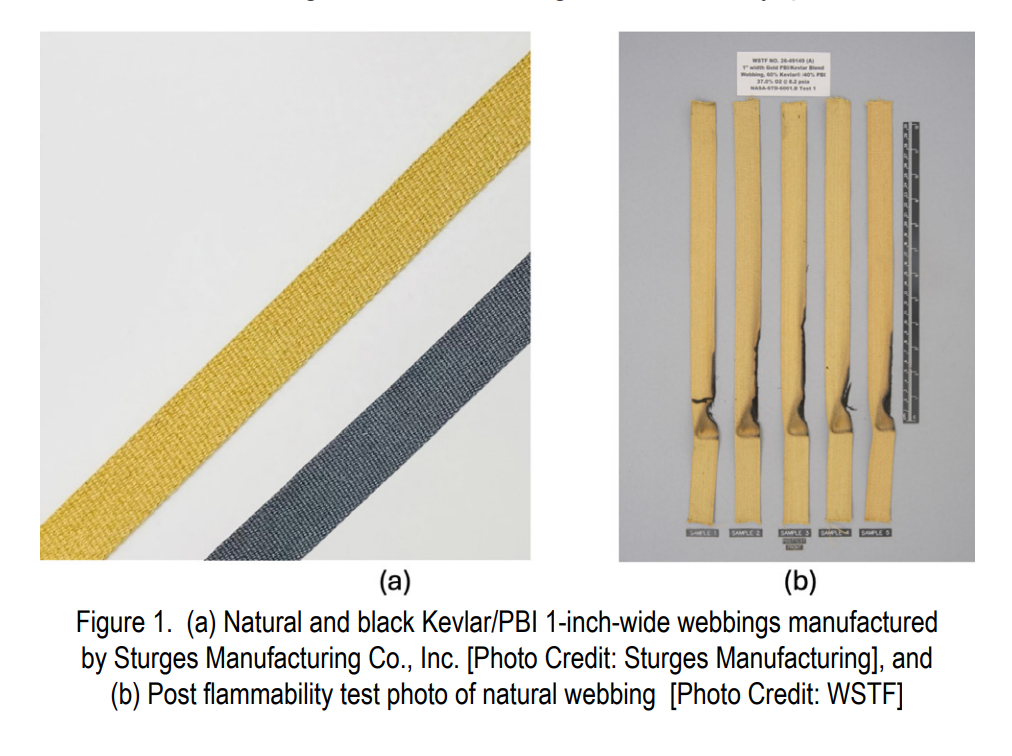
Flammability test results are reported for commercial-off-the-shelf (COTS) webbings that may meet NASA flammability requirements for elevated-oxygen environments anticipated during future crewed missions to the Moon and Mars. Testing showed that a natural-colored webbing composed of 60% Kevlar® and 40% polybenzimidazole (PBI), manufactured by Sturges Manufacturing Company, Inc., passed NASA-STD-6001B Test 1 using surface ignition in an unshielded J-configuration at 37% oxygen and 8.2 psia.
Offgassing data were also collected for the natural, gold-colored webbing. These results indicate that the material may be suitable for softgoods applications in spacecraft and exploration systems. However, final flammability performance, durability, and wear characteristics must be validated using the complete end-item configuration.
Background: Elevated-Oxygen Environments for Lunar and Mars Exploration
An elevated-oxygen atmosphere is being considered for future crewed missions to the Moon and Mars to reduce prebreathe time before extravehicular activities (EVAs). As part of this approach, materials are being evaluated for use in an atmosphere containing 37% oxygen at 8.2 psia.
Oxygen-enriched environments increase the risk of ignition and flame propagation, creating a need for improved fire-resistant materials. The NASA Engineering and Safety Center (NESC) developed a strategy to identify textile materials that meet NASA flammability requirements under these conditions and make them available to the aerospace community as potential building blocks for softgoods flight hardware.
This strategy is being implemented by the Mars Campaign Office and NASA Johnson Space Center with support from the NESC. The initial phase focuses on evaluating commercial-off-the-shelf textiles with a high potential to meet spacecraft flammability requirements.
Webbing Applications and Flammability Challenges
Narrow woven fabrics, commonly called webbing or woven tape, are used in numerous softgoods applications, including:
- Crew mobility aids
- Restraint nets
- Storage bag handles
- Equipment retention systems
- Other flexible spacecraft hardware
Conventional meta-aramid and nylon webbings generally do not meet flammability requirements in elevated-oxygen environments. High-performance fiber blends, such as Kevlar/PBI, may provide improved fire resistance for these applications.
Test Methods and Data Collection
NASA-STD-6001B Test 1 was performed at the White Sands Test Facility (WSTF) to determine the maximum oxygen concentration (MOC) of candidate webbings at a pressure of 8.2 psia.
The testing used an unshielded J-configuration. In this configuration, the cut edge of the webbing was not directly exposed to the flame. Instead, the igniter impinged on the front surface of the material, including the lateral free edge of the webbing.
The MOC is defined as the maximum oxygen concentration at which at least five tested specimens meet the NASA-STD-6001B acceptance criteria at a fixed pressure.
One-inch-wide natural and black webbings composed of 60% Kevlar and 40% PBI were tested. The material was produced by Sturges Manufacturing Company, Inc. Available webbing widths range from approximately 1/4 inch to 8 inches.
Testing did not evaluate flammability performance after wear, abrasion, or other forms of service-related damage. Offgassing testing was also performed on the natural-colored webbing in accordance with NASA-STD-6001B requirements.
Flammability Test Results
| Webbing Color | Fiber Composition | Test Width | Maximum Oxygen Concentration at 8.2 psia | Offgassing Data |
|---|---|---|---|---|
| Natural | 60% Kevlar / 40% PBI | 1 inch | 37% oxygen | Collected |
| Black | 60% Kevlar / 40% PBI | 1 inch | 35% oxygen | Not reported |
The natural webbing achieved an MOC of 37% oxygen at 8.2 psia, while the black webbing achieved an MOC of 35% oxygen at the same pressure. The natural webbing is gold colored and passed flammability testing at the planned elevated-oxygen condition of 37% oxygen and 8.2 psia.
Detailed test results are available through the MAPTIS links listed in the references.
Application Considerations for Aerospace Softgoods
These test results may support the selection of 60% Kevlar/40% PBI webbing for softgoods used in elevated-oxygen spacecraft environments. However, material-level test results do not guarantee the performance of a completed assembly.
The final flammability performance will depend on the full configuration of the softgoods product, including other fabrics, hardware, coatings, fasteners, and attachment methods. The complete end item must be tested in its intended configuration to verify compliance with applicable NASA requirements.
Variations in the webbing may also affect flammability and should be evaluated before use. Relevant variables include, but are not limited to:
- Webbing dimensions
- Weave type
- Yarn size and density
- Fiber blend
- Color
- Surface treatments or finishes
- Edge-finishing techniques
- Added features, such as hook-and-loop fasteners
- Wear, abrasion, contamination, and other service-related damage
Additional qualification testing is recommended whenever the production material, design, manufacturing process, or intended application differs from the tested configuration.
References and Manufacturer Information
- Black webbing: Flammability Report WSTF 26-49145
- Natural webbing: Flammability and Offgassing Report WSTF 26-49149
- Exploration atmospheres: HEO-DM-1006, Updated Exploration Atmospheres
- Applicable standard: NASA-STD-6001B, Flammability, Offgassing, and Compatibility Requirements and Test Procedures
- Manufacturer: Sturges Manufacturing Company, Inc.
- Manufacturer contact: Mike Allen, [email protected], 315-880-0937
Source: www.nasa.gov