


A 224,000-year-old fossilized skull fragment discovered in central Spain is providing new insights into the evolution of ancient humans in Europe during the Middle Pleistocene.
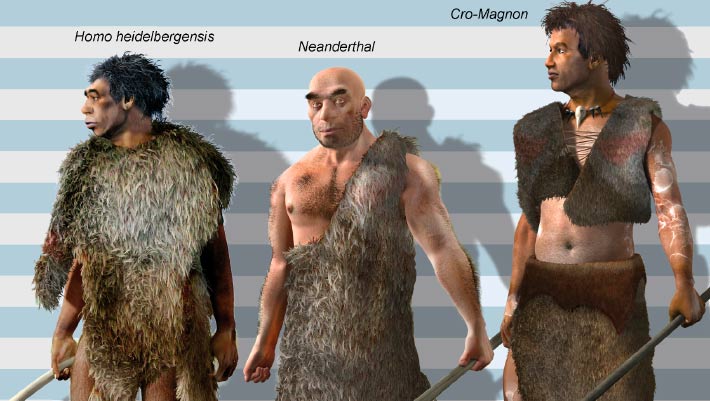
A Homo heidelbergensis, a Neanderthal and a Cro-Magnon. Image credit: SINC / José Antonio Peñas.
The fossil consists of part of a parietal bone, a skull bone that forms part of the upper sides and roof of the head.
Researchers discovered the specimen within rock breccia during excavations at the Middle Pleistocene Ruidera site in Ruidera Lakes Natural Park, Castilla-La Mancha, Spain.
Designated RVH-1, the fragment is the first human fossil ever identified at the archaeological site.
“It was an incredible and fortunate surprise,” said Dr. Mario Modesto-Mata, a paleoanthropologist at the Centro Nacional de Investigación sobre la Evolución Humana (CENIEH) and the International University of La Rioja.
“We experienced everything from skepticism and disbelief at first to immense joy when the analysis confirmed that the fossil could only be human.”
By combining uranium-series dating with optically stimulated luminescence, the scientists determined that the sediment layer containing RVH-1 may be as much as 224,000 years old.
“This fossil is only the tip of the iceberg,” said Dr. Sara Díaz Pérez, a paleoanthropologist at the University of Wrocław.
“The Ruidera site has enormous potential to improve our understanding of human evolution in Europe, and future excavations may produce discoveries of major scientific importance.”
The anatomy of RVH-1 is notable for its considerable thickness and the pronounced angle of the temporal line, a bony ridge along the side of the skull.
Both characteristics place the Spanish fossil at the upper end of the variation documented in other Middle Pleistocene human fossils from Europe.
“RVH-1 displays a thick cranial structure comparable to the morphology found in other archaic crania, including the Ceprano fossil from Italy and specimens from Caune de l’Arago in the French Pyrenees,” said Dr. Daniel García Martínez, a paleoanthropologist at the Complutense University of Madrid.
“Its unusual anatomy shows that hominin populations — the group that includes modern humans and their closest fossil relatives — with distinctive physical characteristics continued to inhabit the Iberian Peninsula during this period.”
“These features were inherited from earlier ancestral populations and remained present until relatively late in the Middle Pleistocene.”
However, the researchers emphasize that a single, incomplete skull fragment cannot support broad conclusions about the identity or evolution of an entire population.
For that reason, they classified RVH-1 conservatively as Homo sp. rather than assigning it to a particular species, while acknowledging its similarities to fossils commonly attributed to Homo heidelbergensis.
“The discovery supports the view that human evolution in Europe was not a straightforward, linear process,” said Dr. Carlos Palancar, a paleoanthropologist at the National Museum of Natural Sciences.
“Instead, Europe was home to multiple hominin populations with different evolutionary histories that may have coexisted.”
“RVH-1 provides valuable evidence of the populations living in the interior of the Iberian Peninsula and establishes Ruidera as an important European location for investigating Middle Pleistocene human evolution,” Dr. García Martínez added.
The team’s paper was published in the Journal of Human Evolution.
_____
D. García-Martínez et al. The first human fossil from the Ruidera site (Castilla-La Mancha, Spain): A partial parietal and its implications for Middle Pleistocene hominin variability in Southern Europe. Journal of Human Evolution, published online July 30, 2026; doi: 10.1016/j.jhevol.2026.103866
Source: www.sci.news