


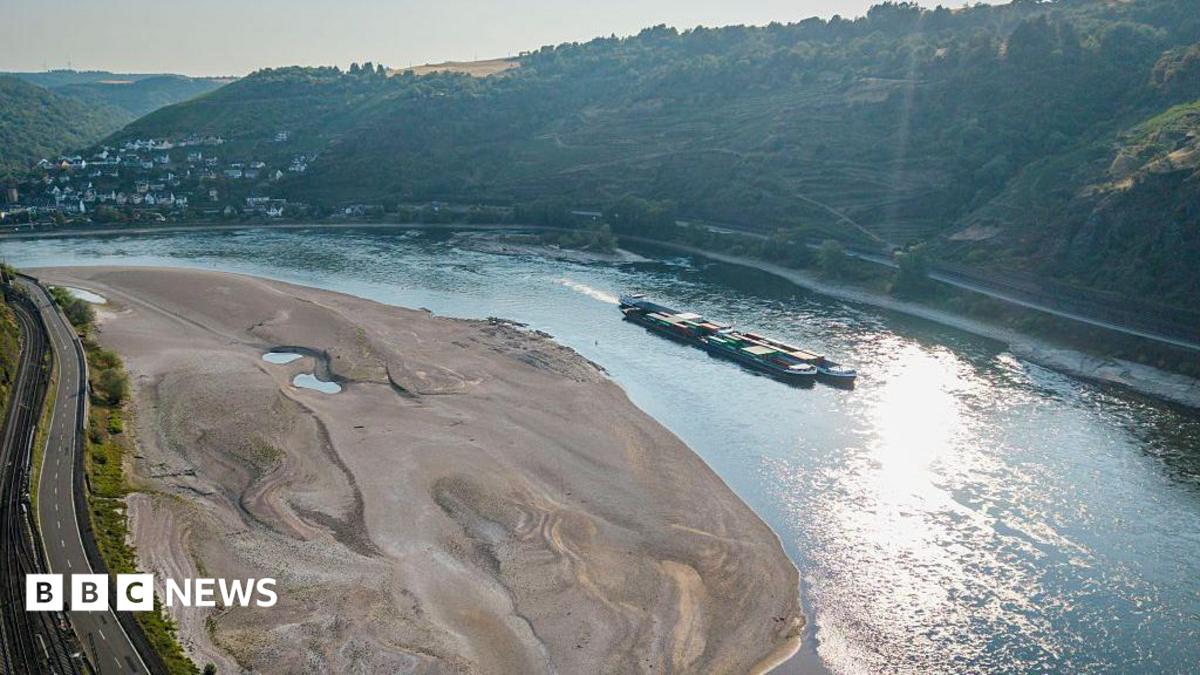
The River Rhine has reached record-low water levels in parts of Germany and the Netherlands as prolonged European heatwaves intensify drought conditions and threaten river transport.
Water levels recorded last week in Cologne, western Germany, and Lobith, near the German-Dutch border, were lower than at any point since measurements began.
Other major European rivers, including the Danube and Italy’s Po, have also recorded exceptionally low levels. These waterways are vital for cargo transport, industry, agriculture and energy production.
The European Union’s Drought Observatories reported that drought conditions remained stable but critical across much of Europe, while the situation deteriorated in central and western Europe in mid-July.
Another heatwave is expected to continue for at least a week, with temperatures forecast to exceed 40C in several central and southern European countries.
Germany’s Low Water Information System (NIWIS) said 44% of Rhine measuring stations and 78% of Danube stations recorded extremely low water levels at the end of July.
The Rhine begins in the Swiss Alps and flows into the North Sea, making it one of Europe’s busiest commercial waterways. Falling water levels have raised concerns about shipping restrictions, supply chain disruption and wider economic costs.
On Friday, navigable water depth at the Rhine’s Kaub chokepoint near Koblenz fell to 25cm, matching the record low set in 2018, before rising slightly on Monday.
The Kaub gauge is a key measure of Rhine navigability because it determines how much cargo vessels can safely carry. Extremely low water levels can significantly restrict inland shipping.
Martin Wolters of the Rhine Waterways and Shipping Authority told German broadcaster WDR that shipping was unlikely to stop completely. However, operators may need to distribute cargo across more vessels to reduce their weight.
Over time, these measures could increase transportation costs and create supply bottlenecks, Wolters said.
“There comes a time when loads are too small to be worthwhile or vessel owners are worried about damaging their ships,” one commodity trader told Reuters.
The Danube also fell to its lowest levels in 30 years in several countries, including Serbia and Romania. In Hungary, the low water supply forced the closure of the country’s only nuclear power plant.
“We don’t know when we will be able to restart [the plant],” Prime Minister Peter Magyar said on Monday. “We hope that it will happen as soon as possible and we hope that the cooling, liberating rain that the forecasters do not yet see coming will arrive.”
Low Danube water levels are also disrupting power supplies in Serbia and Romania.
Serbia reduced output from coal-fired power stations because insufficient water was affecting cooling systems. In Romania, authorities carried out a controlled explosion to remove a large rock from the Danube and improve water flow to the Cernavoda nuclear power plant.
Italy’s longest river, the Po, reached a historic low near Cremona in the north in late July. Authorities raised the drought alert to “high” across the entire Po Valley, while experts warned that drinking water supplies could be affected.
Reduced flows near the mouth of the Po have allowed seawater to move inland along the riverbed. The resulting saltwater intrusion is damaging the ecosystem and creating serious problems for farmers who depend on the river to irrigate crops.
A recent study by scientists from the World Weather Attribution group found no clear long-term trend toward reduced rainfall across much of Europe.
However, researchers said human-caused climate change is increasing evaporation as temperatures rise, making severe drought conditions more likely.
Hot and dry weather is also increasing demand for water from households, farms and industry.
Extended droughts can reduce lake levels and threaten the availability of freshwater resources across Europe.
The EU’s Copernicus Climate Change Service said drought in Europe during 2022 contributed to increased wildfire activity, which drove carbon emissions above average.
Additional reporting by Mark Poynting
Source: www.bbc.co.uk