


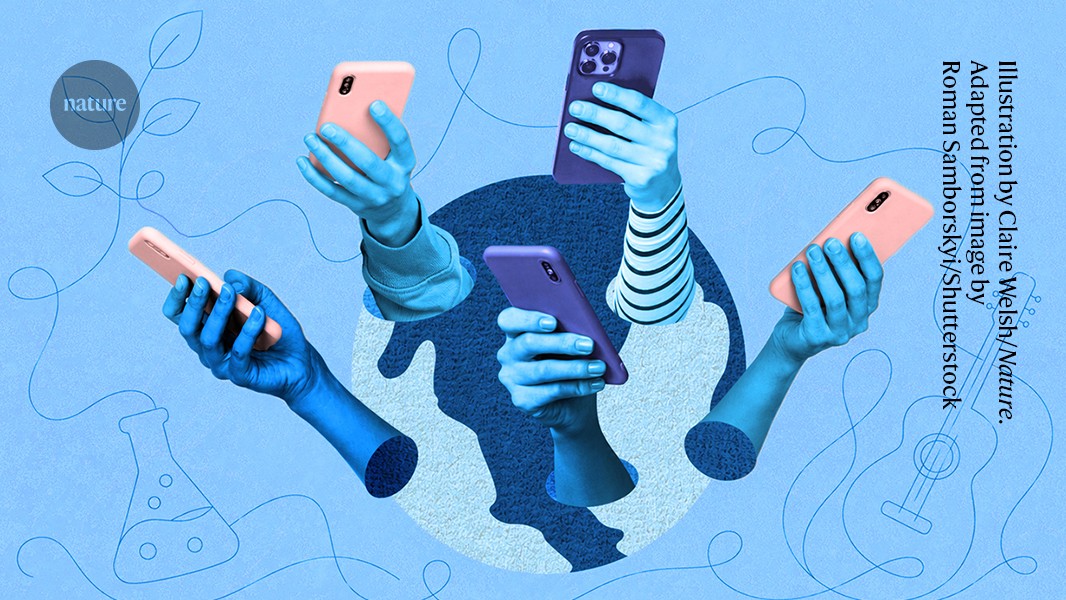
Smartphones and other digital devices are a constant source of potential distraction. According to a 2025 survey by Reviews.org, an online resource that reviews mobile services and internet providers, adults in the United States check their phones an average of 186 times a day — roughly once every five minutes (see go.nature.com/4b4zgje). They spend around five hours a day using smartphones, equivalent to 76 days of screen time each year. Generation Z, born between 1997 and 2012, and Millennials, born between 1981 and 1996, spend the most time scrolling.
Over the past two decades, researchers have shown growing interest in whether people’s ability to focus on a single task has declined. Many people say they feel their attention span has shortened (see go.nature.com/4dfz8yc). However, conclusive evidence of a widespread decline in attention remains limited.
LINK Should I use AI to help draft my science job application?
“Every year that passed, things that are so important to me, like reading books, having proper long conversations, even watching films, were getting harder and harder to do,” says Johann Hari. His 2022 book Stolen Focus explores 12 reasons why attention spans may be declining and offers advice for regaining concentration. “I felt like I was running up a down escalator that was going faster and faster every year,” Hari says of his diminishing ability to focus.
Maintaining focus is essential for short-term memory, problem-solving and creativity. Frequent interruptions, by contrast, can increase errors, stress and frustration. “Attention is at the heart of all human achievement,” says Hari, who lives in London and Los Angeles, California. “Anything you’ve ever achieved in your life that you’re proud of, whether it’s starting a business, getting a PhD, being a good parent or learning to play the guitar, required a huge amount of sustained focus and attention.”
Nature’s careers team asked six attention researchers and educators to share practical strategies for reducing distractions, improving concentration and staying focused at work.
Understanding how attention works
“There are two rather separate attention systems,” says Michael Posner, a psychologist at the University of Oregon in Eugene. During a research career spanning more than 50 years, Posner helped demonstrate that different forms of attention are linked to different regions of the brain. One system is executive attention, which allows people to concentrate on a specific task. The other is the orienting system, which responds to interruptions such as changes in lighting, unexpected sounds and other environmental signals.
My relationship with my PhD supervisor has become toxic — what do I do?
“Powerful external stimuli are pretty hard to resist,” Posner says. “That’s because orienting is important for being aware of potential predators.” Even when someone is deeply absorbed in a task, he explains, it is useful to know if a tiger is approaching.
Today, distractions commonly arrive as text messages, e-mails, requests from colleagues, meetings and sudden noises. People also interrupt themselves by switching between tasks or checking digital devices. “The problem is not that we get distracted,” says Gloria Mark, a psychologist and attention researcher at the University of California, Irvine. “The problem is: what do we do about it?”
The human brain cannot consciously focus on multiple things at once, Mark says. Instead, it rapidly switches between tasks, creating a cognitive cost. “A lot of people think that multitasking is this badge of honour — it’s not,” she says. Multitasking can lead to more mistakes and slower completion times because people must reconstruct their mental plan whenever their attention shifts.
Practical ways to improve focus
People have individual peaks and dips in concentration, Mark says. These patterns are influenced by factors such as a person’s natural sleep schedule and the amount of sleep they get. In general, attention tends to peak during the mid-morning, decline around lunchtime and rise again during the afternoon. “That’s on average,” Mark adds. Some people focus best early in the morning, while others reach peak concentration later in the day or during the evening.
“For scientists, it’s really important for them to understand that they have these limited cognitive resources,” Mark says. “They should understand when their peak periods are and use those times to do their most important work.” Instead of using their most productive hours to check e-mail or attend meetings, researchers could reserve them for analysing data, writing manuscripts or preparing grant proposals. Anyone unsure of their personal attention pattern can keep a diary, recording their concentration levels every 30 or 60 minutes.
How to vibe code in science: early adopters share their tips
One of the most effective ways to protect concentration during peak working hours is to remove the main source of distraction: the smartphone. People in the United States spend about 10 seconds looking at their phone during each of the roughly 200 times they check it daily1. Each interruption can break concentration and make it harder to finish a task. “People find it difficult to work with their smartphone sitting next to them,” says Stefan van der Stigchel, a cognitive psychologist at Utrecht University in the Netherlands. “You won’t go on a diet with a pack of cookies next to your laptop, right? There’s one moment where you’re bored or when your will is not as strong, and all of the sudden you’re picking up your phone or you’re eating that cookie.”
Researchers can put their phones in a drawer, leave them in another room or use a timed safe to keep them inaccessible for a set period. Built-in digital-well-being tools can also limit screen time. Apps such as Freedom and Cold Turkey Blocker allow users to block selected websites, applications or internet access. Nova Corciega, a science instructor and education researcher at Negros Oriental State University Mabinay Campus in the Philippines, uses her phone’s digital-well-being settings to limit Instagram to 35 minutes a day and YouTube to one hour. “This gets me to think that I only have 35 minutes for this application per day, so I need to use it wisely,” she says.
In the moment, it can be tempting to dismiss a screen-time warning. Over time, however, digital limits can help establish routines that support sustained attention and encourage people to become more aware of their habits. “We do so many things automatically and unconsciously, like picking up our phones, swiping them open, going to check e-mail,” Mark says. When researchers notice the urge to check their phone or inbox, they can pause and ask whether the action is truly necessary. “It’s a way of counteracting habits and being intentional about what we do,” she adds.
Careers advice from scientists in industry
When concentration begins to fade, it is time to take a break. “We prefer not to have lunch meetings because those are times when you can recharge your battery,” says van der Stigchel, who often walks outside without his phone during the working day. Taking breaks can be difficult, particularly when colleagues interrupt with questions, but van der Stigchel says protecting time to recover is essential. “I always say I’m never late for a meeting, including a meeting with myself,” he says. “Not working is part of what allows me to focus and be productive.”
Setting clear goals can also improve attention. A 2023 study2 of 108 university students in the United States found that participants who set specific, challenging but achievable goals experienced shorter lapses in attention and remained engaged with tasks for longer than those who set vague goals.
Goal setting is most effective when people are already committed to the objective; simply writing down a target is not enough. Mark recommends that researchers identify their goals the night before work and review them again the following morning. “Create a visualization of where you want to be at the end of the day,” she says. “I want to be sitting on my couch. I want to be reading. I want to be relaxing. I don’t want to be working on that paper.”
Source: www.nature.com