How Aspen Trees Could Help Protect Forests and Communities From Wildfires
Aspen trees may provide a natural defense against wildfires. New research shows that forests dominated by trembling aspen generally burn less intensely and spread fire more slowly than conifer forests.
The findings suggest that planting and preserving wildfire-resistant deciduous trees, including trembling aspen (Populus tremuloides, also known as quaking aspen), could help protect communities as climate change contributes to longer, hotter and more destructive fire seasons. The study was published June 15 in the journal Forest Ecology and Management.
Individual aspen trees can ignite easily because their bark is relatively thin. However, large aspen “stands” — continuous groups of trees with similar species, ages and structures — are often more resistant to wildfire than conifer stands. In some landscapes, they can function as natural firebreaks.
Researchers believe aspen forests resist wildfire because of several characteristics. Aspen leaves and surrounding vegetation typically contain more moisture than conifer foliage, while the trees lack the highly flammable resins found in many conifers. Their leaves are also located high above the ground, making it more difficult for flames to reach the canopy and spread from tree to tree.
Flavie Pelletier, who conducted the research during her doctorate at McGill University in Montreal, wanted to determine whether aspen forests have retained their fire-resistant properties as climate change makes wildfire seasons increasingly severe.
Pelletier combined maps showing the dominant tree species in forests across Canada with satellite data from wildfires during three recent years, including 2023 — the country’s most destructive wildfire season ever recorded. She compared which tree species were found inside wildfire perimeters with those growing along the edges of burned areas.
Aspen trees were more than twice as common along wildfire perimeters as they were inside burned areas. By contrast, conifers such as spruce and pine were found at similar rates both inside and around fire zones.
The study also found that areas with more aspen had less forest burned each day, suggesting that aspen stands can slow wildfire spread. Notably, their apparent fire-resistant effect remained even in spring, before the trees had fully developed their leaves.
Get the world’s most fascinating discoveries delivered straight to your inbox.
“This is proof that aspen has an impact on fire perimeter formation and can slow fire progression,” Pelletier told Live Science.
Anthony Taylor, a forest management specialist at the University of New Brunswick, said the research uses extensive data from real wildfires to measure a phenomenon that Indigenous communities and foresters have recognized for generations.
“The idea that deciduous trees burn less has been known for millennia, but knowing something through experience is different than testing it,” he told Live Science.
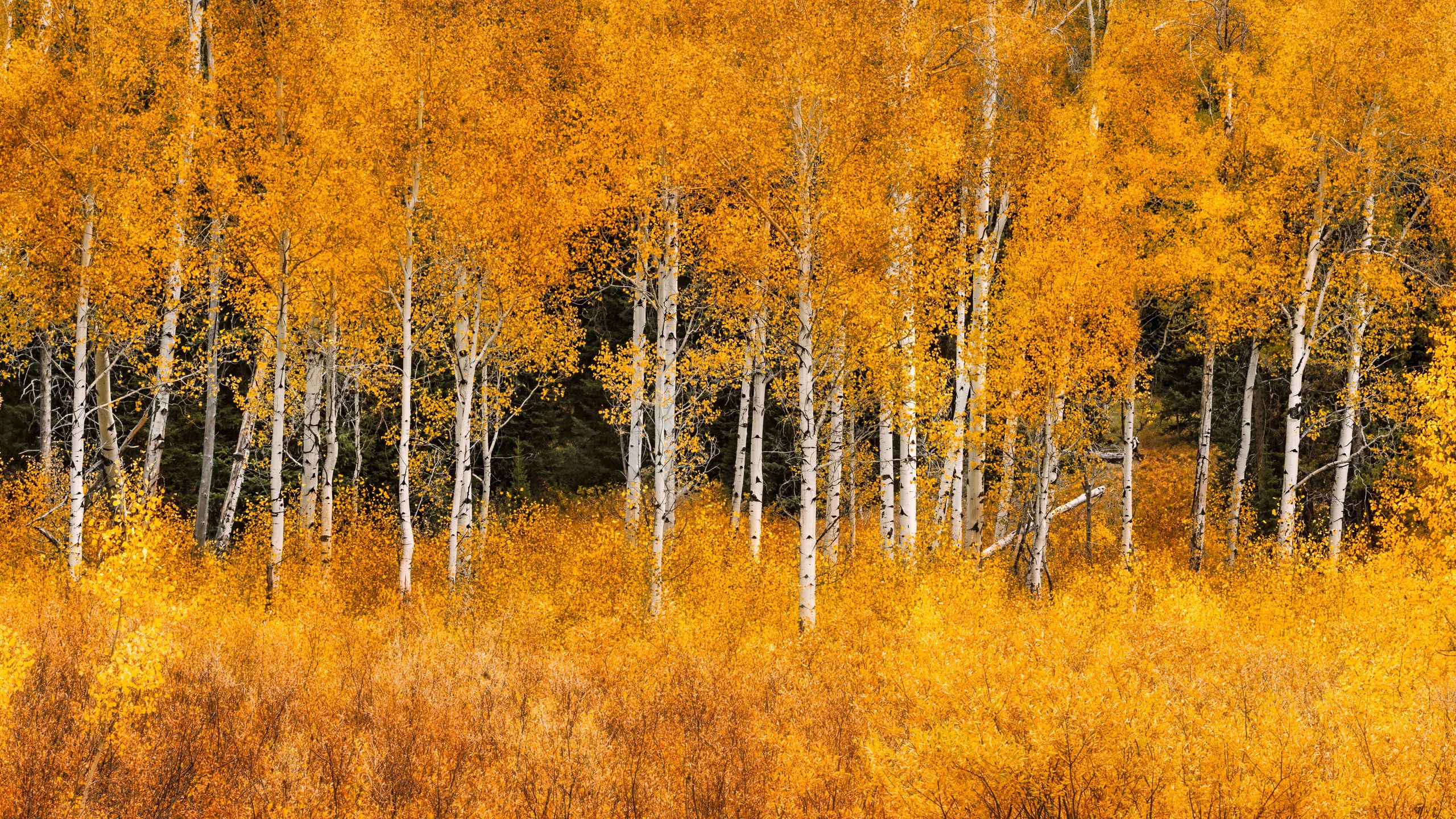
Aspen trees in Vail, Colorado.
(Image credit: Getty Images)
Using Aspen Trees to Reduce Wildfire Risk
The research supports planting and preserving aspen and other deciduous trees around wildfire-prone communities. Creating buffers of less-flammable vegetation is a strategy that forest managers are considering or already implementing in several regions.
However, a narrow line of trees is unlikely to stop a wildfire. The aspen stand must be sufficiently deep to prevent flames from passing over the canopy. Taylor estimated that effective buffers may need to extend roughly 300 to 1,000 feet (100 to 300 meters).
Aspen could also help reduce wildfire risk across larger forested landscapes. Pelletier became interested in the issue after learning that some forestry companies spray glyphosate to remove deciduous trees such as aspen. This allows companies to grow commercially valuable conifer monocultures, but it can leave forests more vulnerable to rapidly spreading fires.
Pelletier hopes the findings will encourage forestry companies and regulators to reconsider that approach.
“There needs to be less of a war on aspen in commercial forests,” she said. In the long term, preserving more aspen could benefit forestry companies by lowering the risk of widespread fire-related losses, even if mixed forests have slightly less short-term commercial value.
Taylor agreed that provinces such as New Brunswick, which have large forestry sectors, should promote more mixed and hardwood forests instead of relying heavily on softwood monocultures.
“That would go a long way to making our landscape more resilient to wildfire,” he said. “And that’s what would have been here anyway, before we started converting the forests to a more industrial forest.”
Pelletier, F., Cardille, J. A., & White, J. C. (2026). Populus tremuloides as a natural fire barrier in Canada’s boreal forest under a changing climate. Forest Ecology and Management, 610, 123671.