


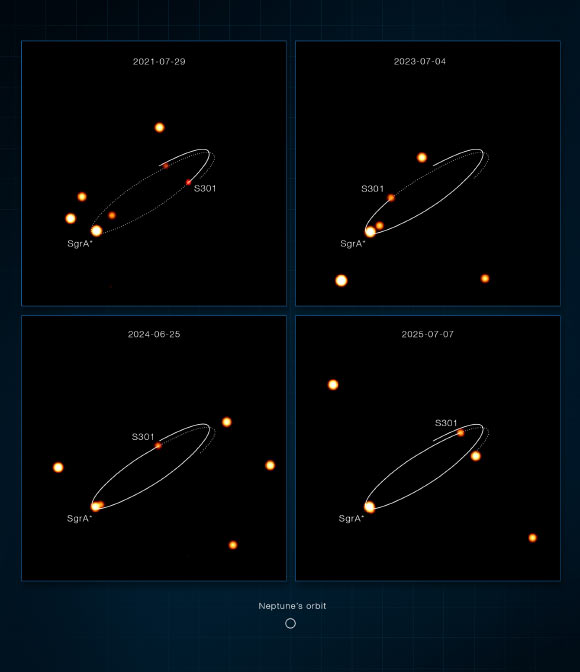
Astronomers have discovered S301, a faint star orbiting the Milky Way’s supermassive black hole, Sagittarius A*, in the closest and most extreme stellar orbit ever observed.
Observations with ESO’s Very Large Telescope Interferometer show the faint star S301 orbiting Sagittarius A*, the supermassive black hole at the center of the Milky Way. S301 follows the tightest known stellar orbit around the black hole. Image credit: ESO / GRAVITY collaboration.
“Sagittarius A* is the supermassive black hole at the center of the Milky Way, located approximately 8,300 parsecs from Earth,” said Dr. Karim Abd El Dayem of the Paris Observatory and colleagues.
“Because individual stars can be tracked in its immediate surroundings, astronomers can use their orbits to study the black hole’s gravitational field.”
“The star acts as a test particle for probing the gravitational potential of a black hole with a mass of approximately 4.3 million Suns.”
The newly identified star, S301, was first detected in spring 2023 with the GRAVITY instrument on the European Southern Observatory’s Very Large Telescope Interferometer.
By following S301’s motion and examining archival observations, the research team confirmed that the star had also been observed as far back as 2017.
S301 completes one orbit around Sagittarius A* in just 8.7 years, giving it the shortest known orbital period of any star around the Galactic Center black hole. Its highly elongated orbit brings it to within approximately 136 to 142 times the black hole’s Schwarzschild radius at its closest approach.
During this close encounter, S301 reaches a speed of approximately 25,000 km/s—more than 8% of the speed of light.
Based on its faintness, astronomers estimate that S301 is a compact, Sun-like main-sequence star with a mass between 1.1 and 1.5 times that of the Sun. Its small size and low brightness distinguish it from the massive giant stars previously observed near Sagittarius A*.
The researchers suggest that S301 may once have belonged to a close binary-star system. If the binary passed too near Sagittarius A*, the black hole’s powerful gravity could have torn it apart through a process known as the Hills mechanism.
Under this scenario, one star would have been ejected from the Galactic Center as a hypervelocity star, while its companion—S301—would have been captured into its current tight and eccentric orbit around Sagittarius A*.
S301’s close orbit could also make it the first star suitable for directly measuring the rotation of the Milky Way’s central black hole.
According to Einstein’s theory of general relativity, a rotating black hole drags and twists the surrounding fabric of space-time. This frame-dragging effect changes the orbits of nearby objects and becomes stronger around rapidly rotating black holes.
“Decades of careful tracking of stars orbiting Sagittarius A*, the central black hole of our Galaxy, have led to this breakthrough discovery of a highly promising star,” said Professor Reinhard Genzel, Nobel laureate and director of the Max Planck Institute for Extraterrestrial Physics.
“S301 orbits very close to Sagittarius A*, opening a new window onto the fundamental nature of space-time in this extreme black hole environment.”
“We hope to use this star to measure black hole rotation within the next 10 years,” said Dr. Felix Mann, a student at the Max Planck Institute for Extraterrestrial Physics.
The discovery of S301 is reported in a paper published in the journal Nature: Discovery of a rotation-sensitive star in Sagittarius A*.
_____
K. Abd El Dayem et al. Discovery of a rotation-sensitive star in Sagittarius A*. Nature, published online August 19, 2026. doi: 10.1038/s41586-026-10894-w
Source: www.sci.news