


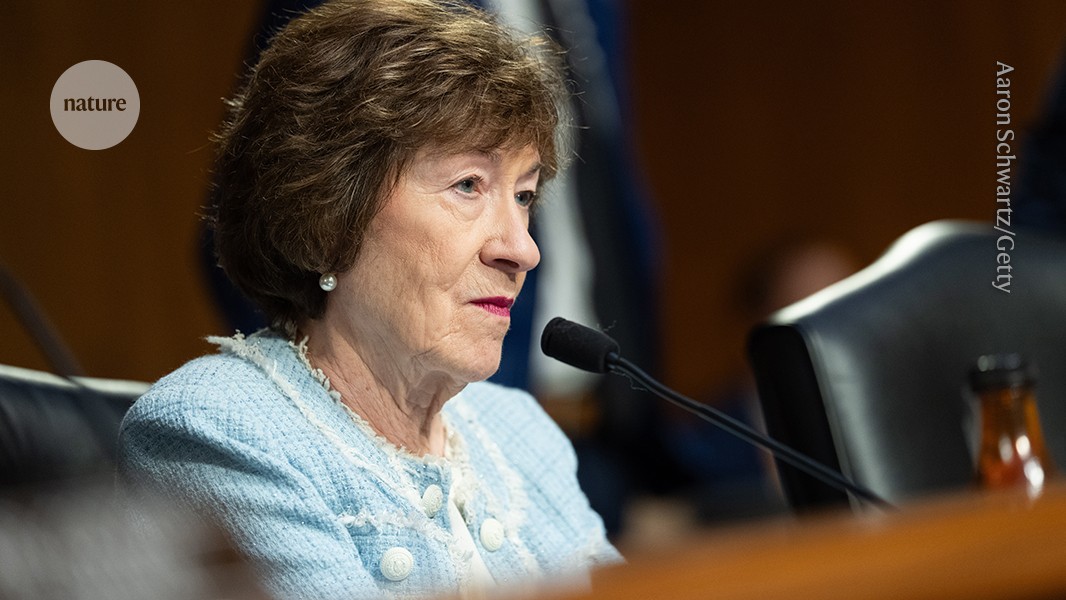
Susan Collins, a Republican senator from Maine, opposes a White House proposal that would give political appointees greater control over federal research grants.
Credit: Aaron Schwartz/Getty
US senators from both political parties released a draft spending bill on 2 August that could temporarily block a controversial White House plan to overhaul federally funded science. The proposal, which says it aims to improve “transparency, accountability, and oversight” of federal funds, includes measures that could significantly change US science policy. These measures include giving political appointees a role in federal grant reviews and limiting research collaboration between US and international scientists. If finalized, the White House rule could take effect on 1 October.
White House proposes sweeping overhaul of US science funding: what researchers need to know
The primary purpose of the latest bill from the US Senate Committee on Appropriations, which oversees federal spending, is to prevent a government shutdown. Federal agencies, including research funders such as the National Science Foundation (NSF), could furlough employees and suspend some operations after 1 October, when the 2026 fiscal year ends, unless Democrats and Republicans in Congress reach an agreement on future spending.
The proposed legislation would extend government funding through 11 December at current levels, giving lawmakers more time to negotiate a long-term spending agreement. As part of the measure to keep the government operating, senators included a provision that would prevent the White House proposal on federal research grants from taking effect before the December extension expires.
Science advocacy groups have welcomed the Senate committee’s bill. “It would not only keep the government open, but it would safeguard scientific progress,” Russ Paulsen, president of Research!America, a non-profit health research advocacy organization based in Arlington, Virginia, said in a statement.
Last year, a dispute between Democrats and Republicans over federal spending resulted in a record 43-day government shutdown. During that period, science agencies, including the National Institutes of Health, suspended activities such as awarding research grants.
Bipartisan support raises hopes for science funding
Many Democratic members of Congress strongly oppose the White House proposal to change the way federally funded science is managed. The plan was issued by the White House Office of Management and Budget (OMB) on 29 May. In June, 125 Democrats in the US House of Representatives sent a letter to OMB director Russell Vought warning that “undoing the peer review process in favor of political grantmaking will delay and disrupt health care research that millions of Americans depend on”.

Inside the political screening process delaying NIH research grants
Several Republicans have also criticized the proposal. The OMB rule would “undermine scientific and biomedical research, and conflict with Congress’ control over the federal funding process”, Susan Collins, a Republican senator from Maine and chair of the appropriations committee, said in a statement last month.
To block the OMB proposal through 11 December, the Senate committee’s bill must first pass the full Senate and then receive approval in the US House of Representatives. Both chambers would have to pass the legislation before it could be signed into law by Republican President Donald Trump.
Although the bill’s passage is not guaranteed, some policy experts are cautiously optimistic. Many members of Congress are facing voters in November’s US midterm elections, creating an incentive to avoid a government shutdown, which is generally unpopular with the public. The OMB rule has also attracted widespread criticism.
The proposal to place political appointees in charge of research and development would be a “disaster for American scientific leadership”, says Asad Ramzanali, director of artificial intelligence and technology policy at Vanderbilt University’s Policy Accelerator in Nashville, Tennessee. The bipartisan nature of the Senate initiative is “promising”, he says. “But nothing is done until a bill passes both chambers and is signed into law.”
Why the White House science funding proposal is unpopular
Source: www.nature.com