Einstein Tile Creates a Photonic Crystal That Twists Light in Unexpected Ways
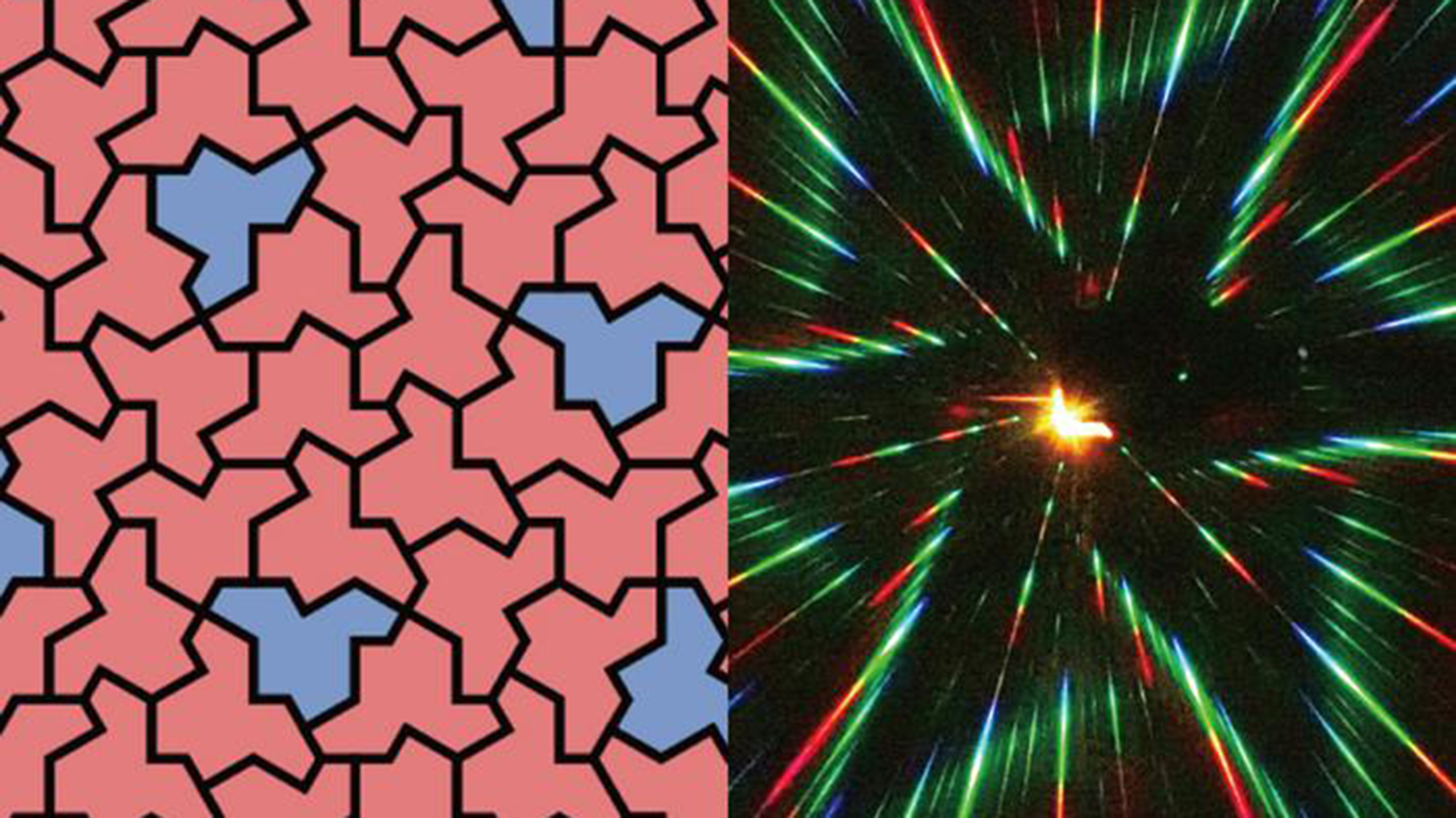
Physicists have transformed an elusive mathematical shape known as an “einstein” tile into a working photonic crystal. The unusual structure bends and scatters light in a way that ordinary crystals cannot, potentially opening new possibilities for optical communications, sensors and photonic computing.
In a study published July 29 in Nature Communications, researchers arranged the non-repeating tile into a pattern of nanoscale holes. The resulting structure, called a photonic quasicrystal, was designed to control how light travels through and interacts with the material.
When the team directed a laser at the crystal, it produced a distinctive swirling, pinwheel-shaped scattering pattern. The pattern changed depending on whether the incoming light was circularly polarized clockwise or counterclockwise.
The discovery is based on a solution to what mathematicians call the “einstein problem.” The decades-old puzzle asks whether a single shape can cover an infinite flat surface without creating a repeating pattern. The term is a pun on “ein stein,” German for “one stone,” and is not a reference to Albert Einstein.
Latest Videos FromLive Science
In the 1970s, mathematician Roger Penrose showed that two different shapes could cover a surface without producing a repeating pattern. In 2023, geometry enthusiast David Smith and his collaborators discovered a single 13-sided shape capable of doing the same. They nicknamed it the “Smith hat,” or simply the “hat tile.”
Yuto Moritake, an experimental physicist at the University of Tokyo, learned about the hat tile in a popular science book in 2024. His research focuses on photonic crystals — materials patterned at the nanoscale to guide, bend and manipulate light for applications including lasers and optical sensors.
Most photonic crystals use regular, repeating grids. Moritake wondered whether replacing that conventional order with the hat tile’s never-repeating geometry would produce new optical effects.
“I decided to include it in our photonic crystal structure,” Moritake told Live Science, describing the hat tile as the starting point for the project.
To create the device, the researchers used electron-beam lithography and etching to produce hundreds of thousands of tiny holes in a thin silicon nitride film. Each hole measured about 100 nanometers in radius — roughly 500 times thinner than a human hair. The holes followed the arrangement of the hat tile across a chip measuring about half a millimeter wide.
When the researchers illuminated the finished chip with a laser, the light diffracted into a pinwheel-shaped pattern. Moritake initially captured the faint, colorful scattering pattern using the long-exposure mode on an iPhone before using specialized cameras for more precise measurements.
The pattern contained sharply defined bright spots called Bragg peaks. These peaks remained in the same positions regardless of where the laser struck the chip, confirming that the structure had long-range order. This is a defining feature of a quasicrystal: its components follow an organized pattern that never exactly repeats.
The hat tile also has no mirror symmetry. In other words, its reflected shape is different from the original, much like a left hand differs from a right hand. This property is known as chirality, and it gave the photonic crystal an unusual optical signature.
That chirality produced the study’s most surprising result. Circularly polarized light can rotate clockwise or counterclockwise as it travels, like a corkscrew. When the team tested the photonic crystal with both forms of circular polarization, each produced a slightly different scattering pattern.
“This structure can have some kind of circular polarization dependence,” Moritake said. He added that the effect was made possible by the hat tile’s asymmetry and was not something he initially expected to observe.
The researchers now want to use the non-repeating geometry to control light traveling inside a photonic chip, rather than simply scattering light from its surface. If successful, the approach could contribute to future technologies in optical communications and optical computing, which use light instead of electricity to transmit and process information.
How much do you know about Albert Einstein? Test your knowledge with our Albert Einstein quiz!