


NASA TEMPO-Lab Helps Educators Teach Teens About Local Air Quality
The NASA Science Activation Program’s Cosmic Storytelling with NASA Data (CosmicDS) project, led by Harvard University in Cambridge, Massachusetts, is helping educators and students explore authentic NASA data. From July 27–29, 2026, the CosmicDS team partnered with the Smithsonian Institution’s BEST AQI (Breathing Easier: Supporting Teen Air Quality Investigations) project to host a Leadership Institute at the Center for Astrophysics | Harvard & Smithsonian (CfA) in Cambridge, Massachusetts.
The three-day institute brought together 13 formal and informal educators who serve as advisors to BEST AQI. The initiative supports teens as they conduct their own air quality investigations and develop evidence-based actions to improve air quality in their communities.
Educators Explore NASA Air Quality Data With TEMPO-Lab
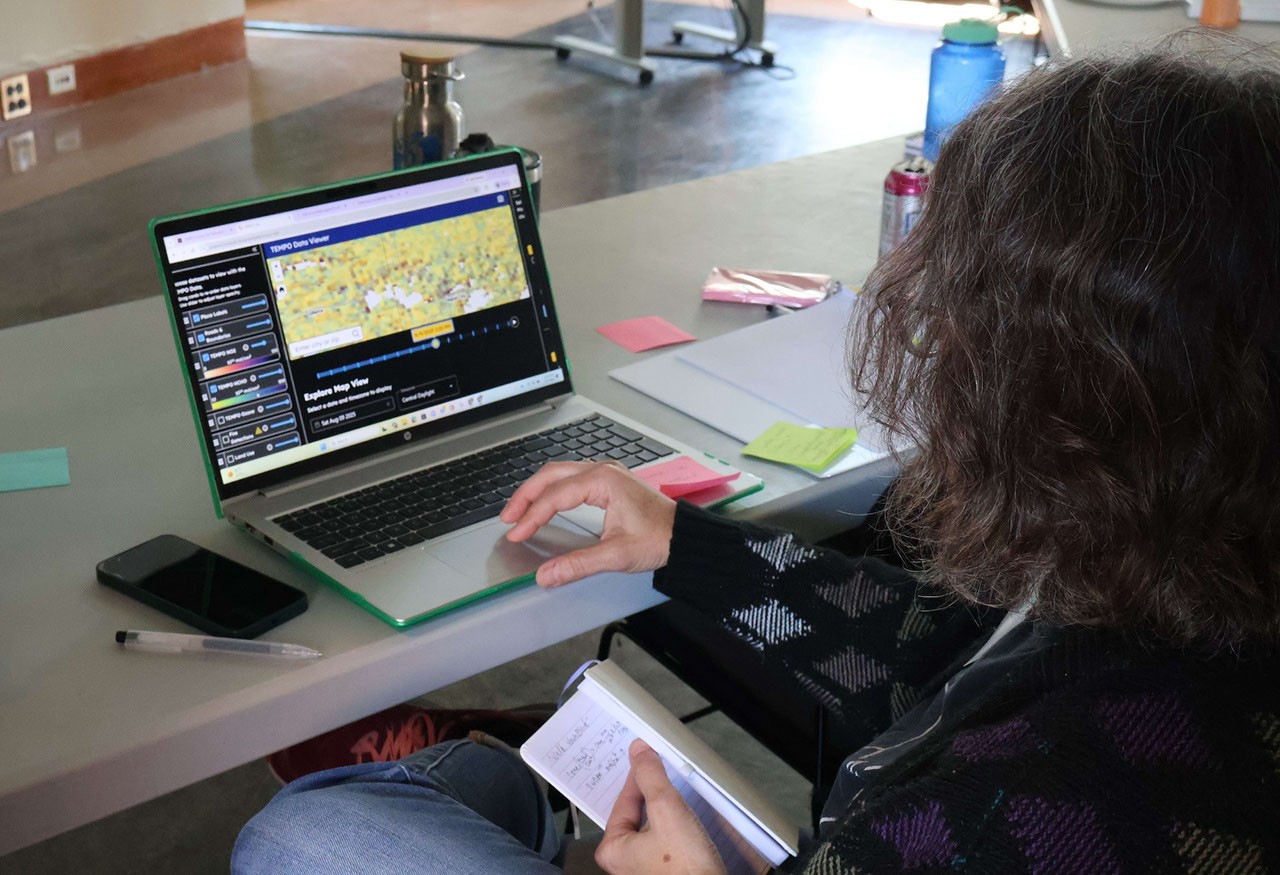
On the first day of the institute, CosmicDS Science Principal Investigator Pat Udomprasert led a hands-on session introducing educators to TEMPO-Lab, a free online tool developed with funding from the NASA Science Activation Program. TEMPO-Lab enables learners to explore and analyze near-real-time air quality data collected by NASA’s TEMPO mission.
NASA’s TEMPO, or Tropospheric Emissions: Monitoring of Pollution, mission measures air pollution across North America every hour during daylight. By using this data, students can investigate pollution patterns and better understand how air quality affects their homes and communities.
During the second and third days of the Leadership Institute, educators worked together to co-develop BEST AQI curriculum materials and classroom resources. They used TEMPO-Lab to create case studies focused on real-world air quality issues, including wildfire smoke, rush-hour traffic, power plant emissions, and agricultural pollution.
These case studies will help teens build the skills they need to investigate air quality in their own communities, interpret NASA data, and identify actions that may contribute to healthier environments.
New NASA Ozone Data Added to TEMPO-Lab Overnight
A special moment during the workshop demonstrated how quickly CosmicDS tools can respond to advances in NASA research. During a science briefing, TEMPO scientist Heesung Chong announced that a new beta version of a ground-level ozone data product had become available.
Because of TEMPO-Lab’s flexible design, CosmicDS software developer John Lewis integrated the new data product into the platform overnight. By the next morning, institute participants were able to explore the latest ozone data for themselves.
The experience showed how NASA education tools can keep pace with active scientific research and give educators and students access to important environmental data soon after it becomes available to scientists.
“The BEST AQI Leadership Institute reinforced the value of TEMPO-Lab as a tool for empowering youth to investigate local air quality issues using authentic NASA data. Educators were excited not only by the scientific capabilities of the platform, but also by its potential to help young people use evidence to make informed decisions and contribute to positive change in their communities.”
— Erika Wright, Education Specialist, Smithsonian Astrophysical Observatory (SAO), and BEST AQI Principal Investigator
Building Air Quality Data Literacy for Students
Providing educators with technical training and ready-to-use curriculum resources is essential for bringing NASA air quality data into classrooms and community programs. These experiences help teens develop valuable data literacy, scientific research, and critical-thinking skills that can support them in any career.
Air quality is also an issue that many young people can see, smell, and feel. BEST AQI helps teens transform those lived experiences into evidence-based understanding and meaningful community action.
Expanding Access to NASA Air Quality Education
The CosmicDS team will continue supporting BEST AQI educators in the year ahead. The 13 educators who participated in the Leadership Institute plan to share the BEST AQI toolkit and TEMPO-Lab with approximately 100 additional educators at partner sites in South Dakota, Maryland, and New York.
Through this growing network, the project could reach thousands of teen air quality researchers and expand opportunities for young people to use authentic NASA data to understand and improve the environments where they live.
Explore TEMPO-Lab to investigate NASA air quality data, and learn more about the CosmicDS project at https://cosmicds.cfa.harvard.edu.
CosmicDS is supported by NASA cooperative agreement award number 80NSSC21M0002 and is part of the NASA Science Activation Program portfolio. The program connects learners with authentic NASA science experiences through partnerships with educators and community organizations.
Source: science.nasa.gov