


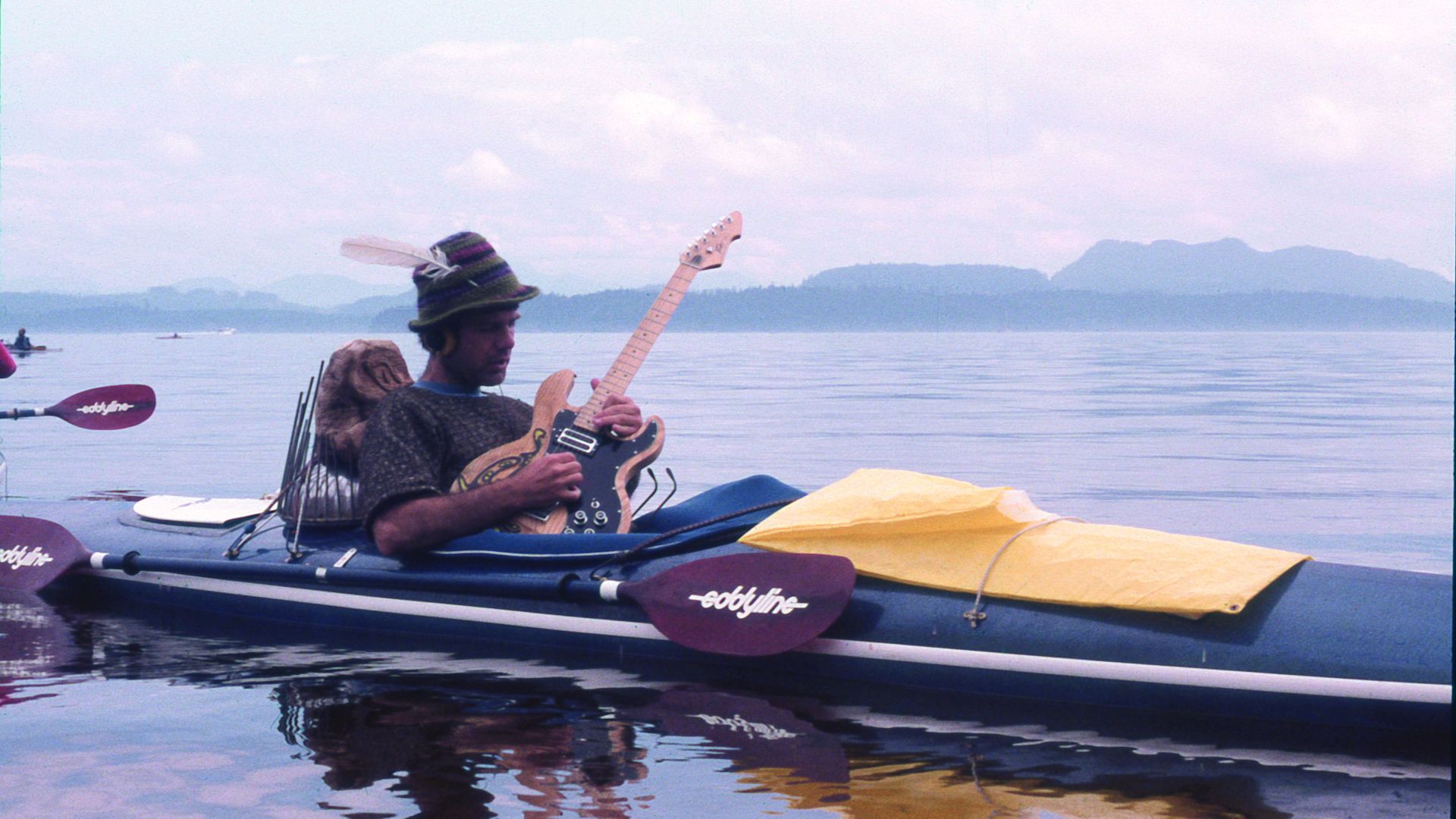
Jim Nollman’s “Orcas’ Greatest Hits” Turns Whale Vocalizations Into Music
For more than 50 years, composer and sound artist Jim Nollman has created music with unconventional collaborators. His musical partners have included turkeys, wolves, dolphins, beluga whales and orcas — animals whose natural vocalizations have become an essential part of his experimental compositions.
Nollman’s latest album, Orcas’ Greatest Hits, will be released Aug. 14 by Smithsonian Folkways Recordings. The album features a selection of recordings built around the underwater vocalizations of orcas, also known as killer whales (Orcinus orca).
Now based in Friday Harbor, Washington, Nollman recorded the orca sounds off the coast of British Columbia between 1985 and 2002. He used underwater microphones called hydrophones to capture the whales’ calls.
These recordings were created through live musical exchanges rather than passive observation. Nollman and other musicians broadcast their music through underwater speakers, prompting the orcas to respond. To limit disturbance, the musicians kept the volume at a safe level and performed after dark, when motorboat noise was less likely to interfere.
Orcas were not Nollman’s first animal collaborators. Soon after graduating from Tufts University in the 1970s, he began experimenting with music and animal communication. His early projects involved turkeys, kangaroo rats, wolves and dolphins. We spoke with Nollman about his career, interspecies music and the unusual experiences that eventually led to his work with the U.S. Navy.
Jim Nollman is a Washington state-based musician, sound artist and author whose work explores interspecies communication. His albums include Playing Music with Animals (1982), What the Dolphin Said (1997) and Music for Swimming and Flying (2021).
How Jim Nollman Began Making Music With Animals
Sascha Pare: How did you first start making music with animals?
Jim Nollman: During my final year at university, I became involved in theater and wrote music for its productions. I was also discovering the work of John Cage and meeting avant-garde musicians in Boston and the San Francisco Bay Area.
I had previously spent time in Mexico playing the flute, where I noticed that the turkeys next door would gobble at a particular pitch and volume. I suggested to an editor at KPFA Radio that I should visit a turkey farm and create a Thanksgiving Day sound piece. The station gave me a sound engineer and a Nagra portable tape recorder.
The farm had about 300 turkeys. I learned that it was the males that gobbled, so the owner placed me with them. When I began singing, the turkeys closest to me responded. Their calls moved through the flock and eventually returned to where I was standing. Then the entire group would fall silent.
I sang dozens of verses of Froggie Went A-Courtin’, an old folk song about animals, and found that I could influence the timing of the flock’s responses.

Jim Nollman’s album Orcas’ Greatest Hits features decades of underwater recordings.
(Image credit: Jim O’Donnell)
At 24, I realized I had found a way into music. I knew I wanted to be a musician, but I was uncomfortable performing in front of large audiences. Working with animals and recording sound in nature allowed me to create music without having to be the center of attention.
After the turkeys, I wondered what other animals might respond to music. I worked with kangaroo rats (Dipodomys deserti), which communicate by thumping inside interconnected burrows. The burrows seemed to have different tones, almost like a network of underground steel drums.
Then I visited a wolf preserve. The wolves had several howl sessions around dawn and again at night. They would not join me if I played outside their key. If I played a flat note, they stopped, as if telling me that I could participate — but only if I got the music right.
That was an important lesson. Making music with animals was not simply a matter of playing sounds and waiting for a reaction. It required listening carefully and responding to the animals.
Orcas, Beluga Whales and Underwater Music
SP: Your new album features orcas. Did you always have a special connection with them?
JN: I recorded orcas for 15 years and accumulated many hours of material. For a long time, I did not know what to do with those recordings. Eventually, I realized that I did not want to become an authority who simply attended whale conferences. My interest was always the direct musical relationship.
Later, I began traveling to the Arctic to work with beluga whales (Delphinapterus leucas). Belugas seemed almost opposite to orcas. Orcas often traveled in close family groups and used relatively simple calls that appeared to carry deep meaning. Their echolocation could be extraordinarily loud, especially when directed toward an underwater speaker. We occasionally had speakers fail because of the intensity.
Beluga whales were much more animated. They seemed to vocalize simultaneously, producing sounds that sometimes resembled laughter. I cannot say exactly how they understood one another, but sound appeared to be central to their social lives.
I traveled from Nome, Alaska, across the Bering Strait and east to the Mackenzie River delta in northern Canada. I also went to Baffin Island in the Canadian High Arctic. In many places, beluga populations were declining, and I eventually stopped the project.
Years later, I visited the Solovetsky Islands in Russia, where large numbers of belugas lived in areas that had been closed to people for decades. That experience was very rewarding.
A Memorable Encounter With a Beluga Whale
SP: What is your favorite memory of working with orcas or beluga whales?
JN: About six or eight years ago, I was invited to Hudson Bay with a group of artists to recreate some of my earlier whale projects. I was serving as a mentor, and we were working with beluga whales.
I decided not to play guitar or mandolin because I had tried those instruments with belugas throughout the Arctic without much success. Instead, I put my head in the water and blew bubbles.
A beluga surfaced and wrapped its mouth around my face. It did the same thing to a woman blowing bubbles from the other side of our kayak. It was one of the most enjoyable experiences I have had with cetaceans.
I have had similarly surprising encounters with other animals. At a game farm in Texas, a giraffe approached and licked my entire face with its enormous tongue. It was a wonderful experience.
How Nollman Selected the Recordings for “Orcas’ Greatest Hits”
SP: The oldest recordings on the album are about 40 years old. What was it like hearing them again?
JN: I had approximately 65 hours of tapes and listened to them over three or four months. About 90% was unusable because it was repetitive. The whales would often return to the same two-note pattern.
I was searching for moments with a groove or an unexplained sense of magic. Some sequences surprised me. One recording featured James Brown guitar riffs played into the water, and I had never heard the whales respond in that way before.
Another recording was made while National Geographic filmed me from a large boat. I played country blues bottleneck guitar, and the whales occasionally entered with a chord change. If I was playing in D, they seemed to respond with a G at exactly the right moment. It happened only a few times, but I found it remarkable.
SP: Did you ever play the recordings back to the orcas?
JN: No. A recording cannot answer the whales. I was trying to create a live, two-way exchange — more like a telephone conversation. Playing a recording back would be like ending an interview and playing an old recording of myself speaking with someone else.
The interaction had to be immediate. Many people wanted to sing or recite poetry to the whales, but the whales did not always respond. Direct communication was essential.

Nollman recorded orca vocalizations off British Columbia between 1985 and 2002.
(Image credit: Jim Nollman)
Do Orcas Recognize Familiar Musicians?
SP: Do you think the orcas responded to you specifically?
JN: Some animals seem to like me, and I definitely established a connection with the orcas. After an eight-year break, I returned to the same whale communities and played music into the water again. They appeared to recognize me immediately.
That was when the country blues recording happened. We were more relaxed with one another, and the exchange felt different. It was also heartbreaking because the whales had lost much of their former habitat as salmon populations declined in the northeastern Pacific Ocean. They were traveling far beyond their usual range.
Jim Nollman’s Work With the U.S. Navy
SP: How did your work with whales lead to a role with the U.S. Navy?
JN: I had been staging underwater concerts during the 1990s. At one festival on Kodiak Island, Alaska, the U.S. Navy was testing ballistic missiles in nearby waters. The activity restricted access to local fishing grounds and damaged the island’s halibut fishery.
A Navy representative with a public-relations background asked to speak before my concert. I agreed, but only if he entered the water and listened to the music himself. The experience affected him, and he later asked whether I had ideas for addressing the Navy’s controversial use of mid-frequency sonar, which had been linked to the deaths of beaked whales.
Two years later, I was invited to a meeting at the Groton submarine base in Connecticut with submarine captains, sonar engineers and whale biologists. I ultimately worked with the Navy for seven years.
My advice was straightforward: if whales were detected nearby, postpone the exercise. It seemed obvious, but the Navy had traditionally viewed whales as collateral damage in its larger mission. I wanted the organization to recognize that military operations and marine conservation could not be treated as separate concerns.
Nollman’s Favorite Track on the New Orca Album
SP: Do you have a favorite song on Orcas’ Greatest Hits?
JN: I like “The Three Jimmies.” I discovered that James Brown’s guitarist was named Jimmy Nolen, which gave the title its idea. I also enjoy the piano part by Jonathan Churcher, who plays a single note every few bars.
The whales’ response is especially striking. At one point, an orca begins echolocating in time with the guitar. Echolocation is how toothed whales perceive their surroundings, so the clicks are part of the animal’s sensory world. That rhythmic response happened only once in 65 hours of recordings, which made it extraordinary.
What Comes Next: “The Cowbird Variations”
SP: What are you working on next?
JN: I am composing new music and hope Orcas’ Greatest Hits performs well enough for Smithsonian Folkways to release the next project, The Cowbird Variations.
The cowbirds would provide the lowest musical part, similar to a bass line in popular music. Other birds and insects, including treehoppers, would complete the composition. The result has a very primitive quality.
I am drawn to cowbirds because they have such a negative reputation. They lay their eggs in other birds’ nests, and their chicks can push the host birds’ eggs or young out of the nest. Yet cowbirds also produce one of the strangest sounds in nature. That contrast is exactly what interests me.
This interview has been condensed and lightly edited for clarity.
Source: www.livescience.com