


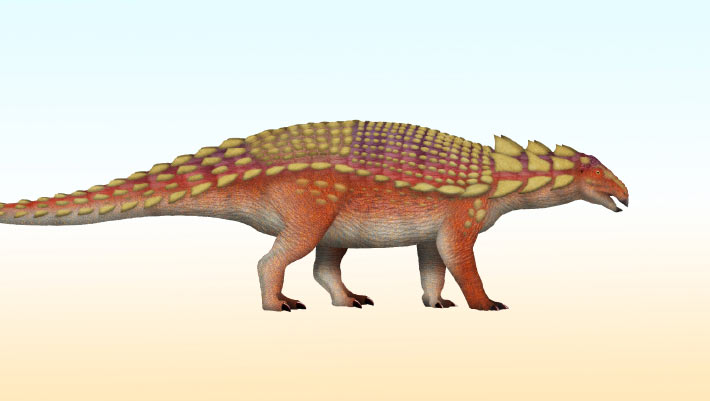
New Nodosaur Dinosaur Nipponopelta ezoensis Identified in Japan
A fossilized skull discovered in Hokkaido, Japan, more than 20 years ago has been identified as belonging to a new genus and species of armored dinosaur.
Nipponopelta ezoensis. Image credit: TotalDino / CC BY 4.0.
Named Nipponopelta ezoensis, the dinosaur lived during the Late Cretaceous Period, approximately 96 to 94 million years ago.
The discovery represents the first officially named nodosaurid dinosaur from Japan and only the second recognized member of the subfamily from Asia. It is also significant because nodosaurids are generally known from body fossils rather than well-preserved skull material.
“Ankylosaurs, traditionally grouped within Ankylosauridae and now often divided into Ankylosauridae and Euankylosauria, are among the most frequently discovered dinosaurs in Cretaceous deposits,” paleontologists from Hokkaido University, led by Susumu Oyabu, and their colleagues explained.
“The two major ankylosaur groups are nodosaurids and ankylosaurids. Nodosaurids are represented by fossils from North America, South America, Asia, Europe and Antarctica, while ankylosaurids are especially well known from North America and Asia.”
Nodosaurids have frequently been discovered in marine or coastal sediments. This pattern suggests that many members of the group were well adapted to coastal plains, estuaries and other environments influenced by the sea.
In Asia, nodosaur fossils are concentrated mainly in Middle Cretaceous deposits from Japan and China. However, their fossil record is considerably less abundant than that of nodosaurids from North America and Europe.
The fossil material assigned to Nipponopelta ezoensis includes parts of the cranium, several skull bones and teeth. The specimens were discovered during the 2000s in Upper Cretaceous rocks of the Hikagenosawa Formation in Yubari City, Hokkaido.
The fossil was initially recognized as belonging to a nodosaurid dinosaur, but its precise taxonomic identity remained unresolved for many years.
Oyabu and colleagues from Japan, Canada and the United States recently reexamined the specimens using modern anatomical and imaging techniques.
Three-dimensional computed tomography, or CT, scans allowed the researchers to digitally reconstruct previously hidden portions of the skull. These included part of the lower jaw, two nearly complete teeth and the dinosaur’s left inner ear.
The scans also revealed a distinctive combination of anatomical features at the back of the skull, helping the team determine that the fossil represented a previously unknown genus and species.
Phylogenetic analysis placed Nipponopelta ezoensis firmly within a group of nodosaurids more closely related to North American and European genera—including Panoplosaurus, Edmontonia and Denversaurus—than to other nodosaurs previously reported from Asia.
To investigate how this unusual distribution evolved, the paleontologists modeled the movements of nodosaurid lineages across the world over millions of years.
“Our biogeographic analysis indicates that the ancestors of Nipponopelta ezoensis and its relatives may have originated across several regions, including Laramidia, Appalachia and Asia,” the researchers said.
The team also reconstructed changes in the preferred habitats of nodosaurids through time. Their results suggest that these dinosaurs generally originated in coastal environments before some lineages expanded into more inland settings.
However, nodosaurids—and Nipponopelta ezoensis in particular—appear to have retained a strong association with marine-influenced habitats.
“Habitat reconstruction indicates that Nipponopelta ezoensis preferred marine-influenced environments and likely inhabited coastal or estuarine areas,” the scientists said.
“This preference for coastal environments may have played an important role in the dispersal of nodosaurids across different regions.”
The discovery of Nipponopelta ezoensis is described in a study published in the journal Cretaceous Research.
_____
Susumu Oyabu et al. A new nodosaurid ankylosaur (Dinosauria: Ornithischia) from the Upper Cretaceous Hikagenosawa Formation of Japan reveals the dispersal history of Asian nodosaurids. Cretaceous Research, published online August 21, 2026. doi: 10.1016/j.cretres.2026.106477
Source: www.sci.news