


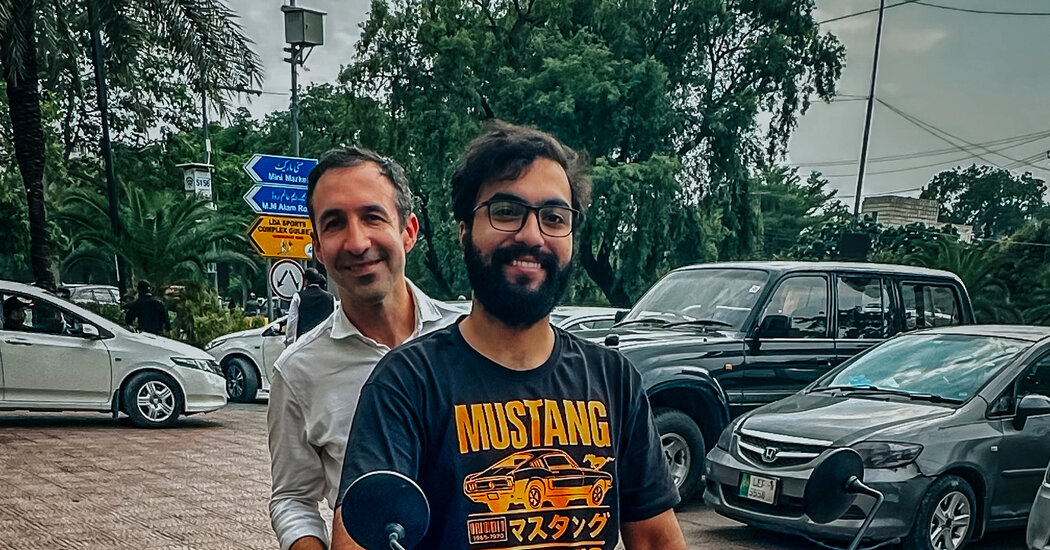
I traveled to Pakistan last month to report on the country’s fast-growing electric motorcycle market. I visited electric motorcycle showrooms, toured an assembly plant and interviewed company founders and prospective buyers. By the end of the trip, I thought I understood nearly everything about Pakistan’s electric vehicle boom.
Except what it actually feels like to ride an electric motorcycle.
That changed during my final days in Lahore — although whether it was a stroke of good fortune or bad luck depends on how you feel about the city’s chaotic roads.
“Do you want to take it out for a drive?” Abdul Rafay, the owner of a new Vlektra electric motorcycle, asked after we finished our interview.
I looked toward a nearby intersection in this city of 14 million people. Motorcycles moved between rickshaws and cars in every direction, and I muttered something about journalists not becoming part of their own stories.
Still, I agreed to take the ride. I borrowed a helmet and climbed onto the back of Rafay’s electric motorcycle — one of hundreds of thousands of new gasoline-free vehicles now operating across Pakistan.
As my article, published today, explains, Pakistan’s electric motorcycle boom reflects broader global changes accelerated by the war in Iran. Higher oil prices have unintentionally sped up the clean energy transition in developing countries, influencing the transportation choices of millions of consumers.
In many countries most vulnerable to rising gasoline prices, two-wheeled vehicles are far more common than cars. As a result, the era of electric motorcycles appears to have arrived in much of the developing world.
‘You got scared, didn’t you?’
Rafay, 24, pulled away from the coffee shop where we had met and entered a roundabout. We were in a relatively affluent part of Lahore, where the roads were smooth and the lane markings were visible. But driving in Pakistan requires a strong appetite for adventure. Traffic can be dense, streets can flood and, often, both happen at the same time.
Rafay also seemed eager to demonstrate the power of his new electric motorcycle. He spotted a small opening and accelerated past a passing rickshaw.
On a long straightaway, he moved around motorcycles and cars before heading toward two orange vehicles traveling just a few feet apart. As Rafay guided us between them, the gap widened just enough for the electric bike to pass safely.
I was recording the ride on my iPhone, and the video shows that the maneuver was carefully executed. But the footage does not capture how certain I felt that one of the orange vehicles would hit my knee.
I had tightened my legs so much that Rafay could feel it.
“You got scared, didn’t you?” he asked, glancing back.
“Yes,” I said, my heart still racing but with a smile on my face.
Who says reporting on climate change has to be depressing?
‘If I can save a few rupees, I’ll do it.’
As for the electric motorcycle, the ride was smooth and the bike had more than enough power.
I am hardly qualified to review motorcycles for Car and Driver. I have not ridden one since 2012, when I had a vacation mishap in Vietnam. And although I live in Italy, the home of the Vespa, I drive a small hatchback equipped with two child car seats.
That was one reason I wanted to speak with Rafay. A motorcycle enthusiast, he said he had loved his previous bike, a Honda CD 70, Pakistan’s most popular gasoline-powered motorcycle. He rode it 40 miles every day between his home and his job as a software engineer — until rising gasoline prices forced him to reconsider the cost.
“If I can save a few rupees,” he said, “I’ll do it.”
After the energy shock linked to the Iran war, Rafay began visiting electric motorcycle and electric scooter dealerships. He sometimes stayed far longer than expected, talking with sales staff as well as other customers who were considering switching from gasoline-powered bikes.
He eventually chose an electric motorcycle that he believed could withstand Pakistan’s demanding road conditions. During my time in Lahore, I saw those conditions firsthand. On some afternoons, monsoon rains overwhelmed the city, leaving low-lying neighborhoods and poorly drained streets covered in water that reached the shins. Daily life continued, as did the flow of motorcycle traffic. But the floods highlighted a major disadvantage shared by both electric and gasoline motorcycles: riders get soaked.
After riding through Lahore with Rafay, I thanked him for handling the electric motorcycle so skillfully and returned his helmet.
Before the next storm arrived, I climbed back into the Toyota I had been using during the week — a vehicle that never made me clench my knees.
Read the full story.
Extreme heat hits Europe as cooler weather may reach the U.S.
Temperatures are expected to climb across large parts of Europe this week, marking the continent’s fifth heat wave since May. Officials warn that the combination of persistent heat and dry conditions could further increase the already serious risk of wildfires.
Forecasters predict temperatures of up to 104 degrees Fahrenheit, or 40 degrees Celsius, first in parts of France, Spain and Italy before the heat spreads into Central Europe. Here’s what to know.
The Eastern United States is typically hot and stormy at this time of year, but forecasters expect temperatures to ease across most of the country beginning Wednesday. Get updates.
Source: www.nytimes.com