


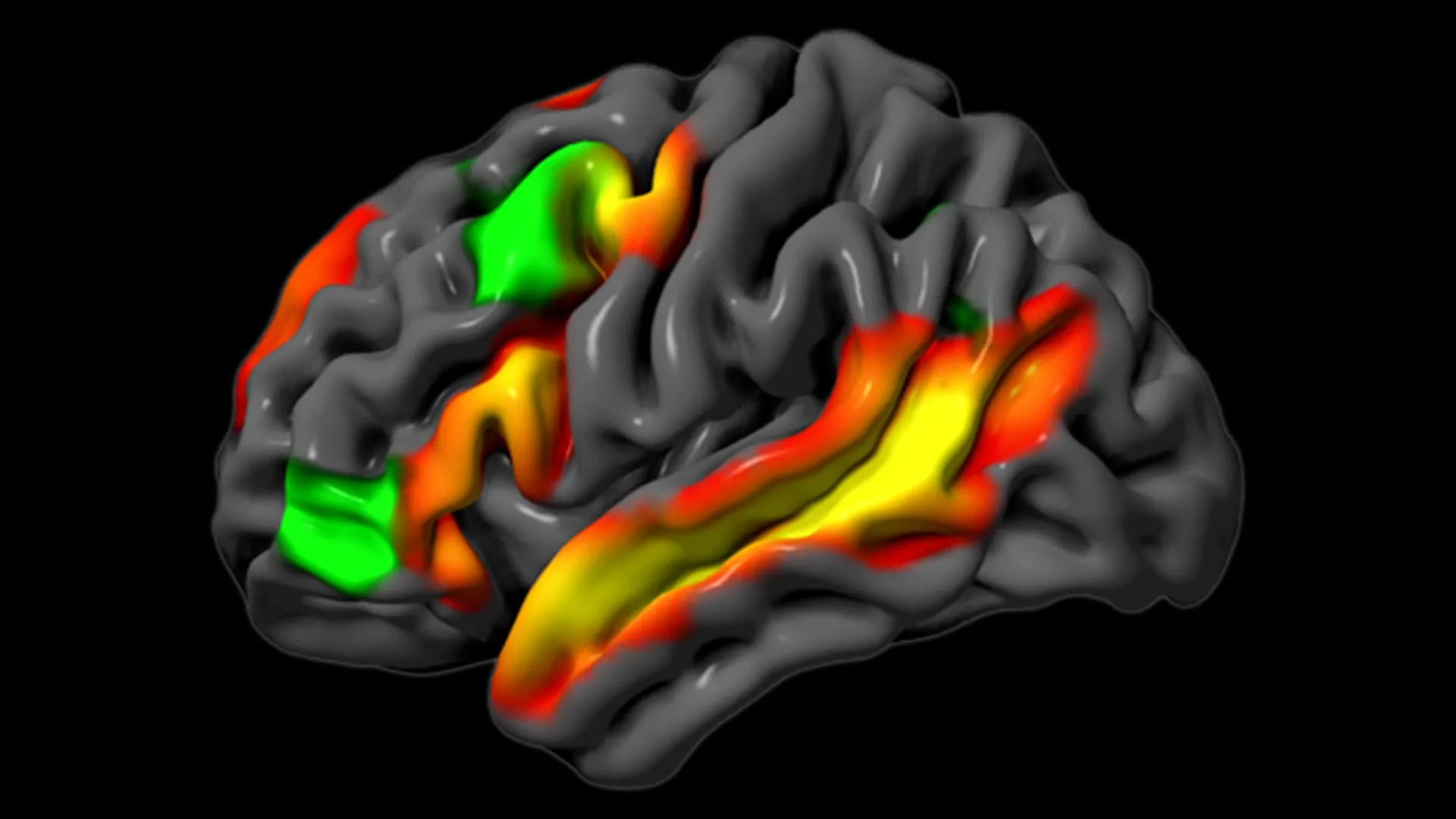
For some people, talking through difficult problems helps organize their thoughts. However, language may not be essential for logical reasoning, according to cognitive neuroscientists at the Massachusetts Institute of Technology’s McGovern Institute for Brain Research.
In a recent study published in PNAS, a team led by Evelina Fedorenko, associate professor of brain and cognitive sciences at MIT, found that people with severe language impairments can still solve problems that require logical reasoning. Brain scans also showed that the regions responsible for language processing were not activated during logical reasoning tasks.
Are language and thought connected?
For thousands of years, philosophers, linguists, and cognitive scientists have debated whether language is essential to human thought. Many researchers have argued that people use language as a tool to structure and process their thinking.
Hope Keene, a postdoctoral researcher and former K. Lisa Yang Center for Integrative Computational Neuroscience (ICoN) graduate research fellow in Fedorenko’s lab, says there are compelling reasons to believe that language and logic may be closely connected.
“Abstract thinking has properties that are very similar to language,” Keene says, pointing to their structural similarities. “Like the small components of a logical proposition, thoughts can be broken into subcomponents and combined hierarchically to create increasingly complex rules, much like language.”
However, Keene and Fedorenko, who is also a researcher at the McGovern Institute, suspected that the brain may separate the communication of an inference from the process of making the inference itself. People rely heavily on language to present problems, discuss possible solutions, and explain how they reached a conclusion. The underlying process of logical reasoning, however, may depend on different brain systems.
“There are aspects of thinking that appear to go beyond the limits of language,” Keene explains. Logical reasoning often requires a level of precision that everyday language cannot provide. Language also unfolds in a linear sequence, one word at a time, while logical thinking sometimes requires people to process information in a nonlinear way.
Testing logical reasoning without language
These questions led Keene to investigate how the brain performs logical reasoning. Studying the issue is challenging because researchers typically use language to explain tasks to human participants and collect their answers.
Fedorenko’s research group addressed this challenge by collaborating with Rosemary Varley, a neuroscientist at University College London who studies acquired language disorders, and her team.
The researchers studied two people whose strokes had damaged regions of the brain involved in language processing. Both participants experienced significant difficulties understanding and producing language.
To test reasoning without relying on language, the researchers created logic games based on numbers and visual patterns. In one task, participants viewed two lists of numbers and had to identify the hidden rule that transformed one list into the other. The rules could involve reversing digits or removing numbers above a specific value. After identifying the rule, participants applied it to new examples.
In another task, participants viewed a collection of geometric patterns and selected the image that correctly completed a visual matrix.
As the puzzles became more difficult, the results indicated that language was not required for this type of reasoning. Participants with severe language impairments performed similarly to participants in the control group. They were also able to communicate the rules they discovered using gestures and drawings.
“This strongly challenges the theory that symbolic rule induction is impossible without language ability,” Keene says.
Brain scans reveal a separation between logic and language
The researchers also examined brain activity in healthy adults as they solved logical problems.
Participants traveled to MIT for a series of MRI scans that measured patterns of brain activity during different tasks. Some tasks involved logic games, while others were designed to identify each participant’s language-processing regions. A separate set of tasks mapped the so-called “multiple-demand networks,” distributed brain systems that support complex problem-solving.
Neurotypical participants completed logic puzzles similar to those given to people with language impairments. They also solved problems involving syllogistic reasoning.
These problems used “if-then” statements, such as: “If the ball is red, then it is large. The ball is red. Is the ball large?”
The researchers varied the difficulty of the puzzles to determine which brain regions became more active as reasoning demands increased. They also compared brain activity when participants had to discover hidden rules with activity recorded when they simply applied rules that had already been provided.
The scans revealed a clear distinction between language processing and logical reasoning. The brain’s language system was not activated during inductive reasoning, which involves identifying hidden rules, or during deductive reasoning, which involves evaluating the validity of logical conclusions.
The findings involving the multiple-demand networks were more unexpected. Researchers had suspected that these networks would play an important role in logical reasoning. The networks were activated during inductive reasoning but did not appear to contribute to deductive reasoning. Keene is continuing to investigate this difference in ongoing research.
For Fedorenko and Keene, the results provide strong evidence that language and logic rely on separate systems in the brain. The findings also build on previous research from Fedorenko’s lab showing that other forms of thought, including object categorization and social reasoning, can occur independently of language.
What the findings mean for aphasia
The study could have important implications for how people understand acquired language disorders, including aphasia.
Professionals who work with people with aphasia have long recognized that losing language ability does not mean losing intelligence. People with aphasia may continue to enjoy chess, complete Sudoku puzzles, and manage their household finances. However, communication difficulties are sometimes mistakenly interpreted as evidence of impaired thinking.
“This study adds to a growing body of research showing that even people with severe aphasia can retain the ability to think abstractly, a defining characteristic of our species,” Fedorenko said. “We must continue educating the public that language impairments associated with conditions such as aphasia and stuttering, as well as limited proficiency among non-native English speakers, do not indicate a person’s intelligence or ability.”
Possible implications for artificial intelligence
The discovery may also offer insights for artificial intelligence research.
Large language models such as ChatGPT and Claude are trained primarily on text and generate text as output. These systems can convincingly simulate certain forms of human reasoning.
Human brains appear to operate differently. In people, language processing and abstract logical reasoning rely on distinct systems. Keene says comparing human reasoning with the way large language models process information could provide valuable ideas for developing future AI systems.
Exactly how the human brain performs inference remains an open area of research. Keene describes the subject as a new frontier in the geography of ideas—one she is eager to continue exploring.
Source: www.sciencedaily.com