


New Freshwater Mosasaur Discovered in France Lived 84 Million Years Ago
Fossils found in southeastern France have revealed a previously unknown mosasaur species that was about 2.5 meters (8 feet) long and likely lived in freshwater lakes rather than the sea.
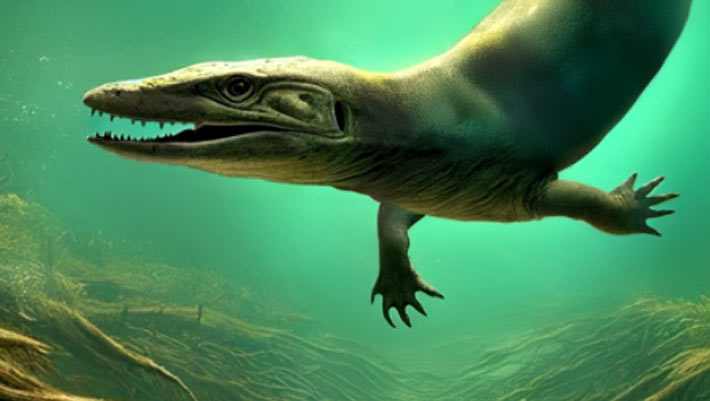
Artist’s impression of Garamaud bausiensis. Image credit: Bardet et al., doi: 10.24072/pcjournal.804.
A new species of freshwater mosasaur
Named Garamaud bausiensis, the newly described species lived in what is now Europe during the Santonian stage of the Late Cretaceous, approximately 84 million years ago.
The animal belonged to Tethysaurinae, an early group of mosasaurs within the superfamily Mosasauroidea.
“Mosasauroidea is a group of extinct aquatic squamates that invaded and diversified into aquatic environments at the beginning of the Cenomanian,” said lead authors Dr. Nathalie Bardet and Dr. Alexandra Houssey of the French National Museum of Natural History and their colleagues.
Mosasaurs spread worldwide from the Santonian to the end of the Maastrichtian before becoming extinct during the mass extinction event at the end of the Cretaceous.
These reptiles had elongated skulls and bodies, as well as long, laterally compressed tails. They ranged from about 1 to 15 meters (3.3 to 50 feet) in length and occupied environments ranging from freshwater and shallow water to the open sea. Their diets included mollusks, arthropods, large fish, and reptiles.
Most mosasaurs had highly specialized aquatic adaptations, including paddle-like limbs and a lost connection between the spinal column and pelvis. As a result, they lacked a true sacrum.
More primitive forms, however, had limbs that appear to have been adapted for terrestrial locomotion and retained a sacrum, indicating a more developed foot and pelvis.
Fossils discovered in Provence
Most mosasaur fossils have been found in marine sediments. However, a small number of species and unidentified mosasaur remains have been discovered in freshwater environments, including shallow estuaries and river deposits.
Freshwater mosasaur fossils are particularly common in Santonian–Campanian continental deposits across Europe. These deposits extend through southern France from Portugal to Hungary and Austria.
The fossilized remains of Garamaud bausiensis were discovered in 1997 in the Bouc-Bel-Air-Susquières area near the city of Bouc-Bel-Air in Provence, southeastern France.
The fossils include parts of the lower jaw, vertebrae, ribs, pelvis, and humerus. They represent at least four individuals, although most of the material appears to belong to a single animal.
“The Bouc-Bel-Air-Susquières area represents a freshwater ecosystem within the continental deposits of the Aix-en-Provence basin, probably a moderately eutrophic, carbonate-producing lake that was periodically affected by flooding and shoaling events,” the paleontologists said.
A rapid flooding episode may explain the preservation of the holotype specimen, although the fossil assemblage also contains broken bones with well-preserved surfaces.
Built for freshwater hunting
Garamaud bausiensis was approximately 2.5 meters (8 feet) long. Unlike more familiar marine mosasaurs, it had limbs that appear to have been adapted for walking on land and a pelvis firmly attached to the spine.
Its long, straight ribs suggest a deep, narrow body that was flattened from side to side. The researchers propose that it may have swum with a meandering motion similar to that of an eel.
CT scans revealed thick, compact bones in the vertebrae, ribs, and humerus. These dense bones would have helped the animal control its buoyancy in the water.
The findings suggest that Garamaud bausiensis could dive to shallow depths and may have been an ambush predator. However, its bone density appears to have been incompatible with a fully land-based lifestyle.
The animal was probably one of the top predators in its ecosystem and may have eaten small fish, reptiles, or amphibians. Its precise diet remains unknown.
What the discovery reveals about mosasaur evolution
“The assignment of this new freshwater mosasaur to Tethysauridae highlights the existence of additional freshwater species in this clade,” the scientists said. “Based on current knowledge, freshwater forms evolved among mosasaurs only within Tethysauridae.”
During the same period, more aquatic mosasaurs with paddle-like limbs and reduced pelvic connections evolved faster-growing bodies and spongy bones. These forms displayed an active, carangiform swimming mode, diversified in open marine environments, and spread around the world.
The discovery of Garamaud bausiensis provides new evidence that mosasaur evolution was more diverse and complex than previously recognized. It also points to broader ecological niche partitioning among post-Turonian mosasaurs.
The study was published on September 28, 2026, in Peer Community Journal.
_____
Bardet, N. et al. 2026. Garamaud bausiensis, a new species of freshwater mosasaurid (Reptilia, Squamata) from the Santonian (Late Cretaceous) of Provence, southeastern France. Peer Community Journal 6: e99. doi: 10.24072/pcjournal.804.
Source: www.sci.news