


CERN Begins Major LHC Upgrade With 40% Stronger Superconducting Magnets
CERN has begun replacing key magnets in the Large Hadron Collider (LHC), launching a major upgrade designed to increase the number of particle collisions. The 27-kilometre collider relies on thousands of magnets—including dipoles, quadrupoles, hexapoles, octopoles and decapoles—to steer and control its particle beams.
What are the LHC’s internal triplet magnets?
Among the LHC’s most important magnets are the internal triplets. These three groups of quadrupole magnets sit on either side of the collider’s four major experiments. Their role is to focus the particle beam as tightly as possible immediately before particles collide inside the detectors.
The more compressed the beam, the more likely particles are to collide. The internal triplets are therefore essential to increasing the LHC’s luminosity—the number of collisions produced in a given period. Higher luminosity gives researchers more data to analyze.
Preparing the Large Hadron Collider for its high-luminosity era
A key part of the future High Luminosity LHC (HiLumi LHC) project is the replacement of the existing internal triplets with a more powerful generation of magnets.
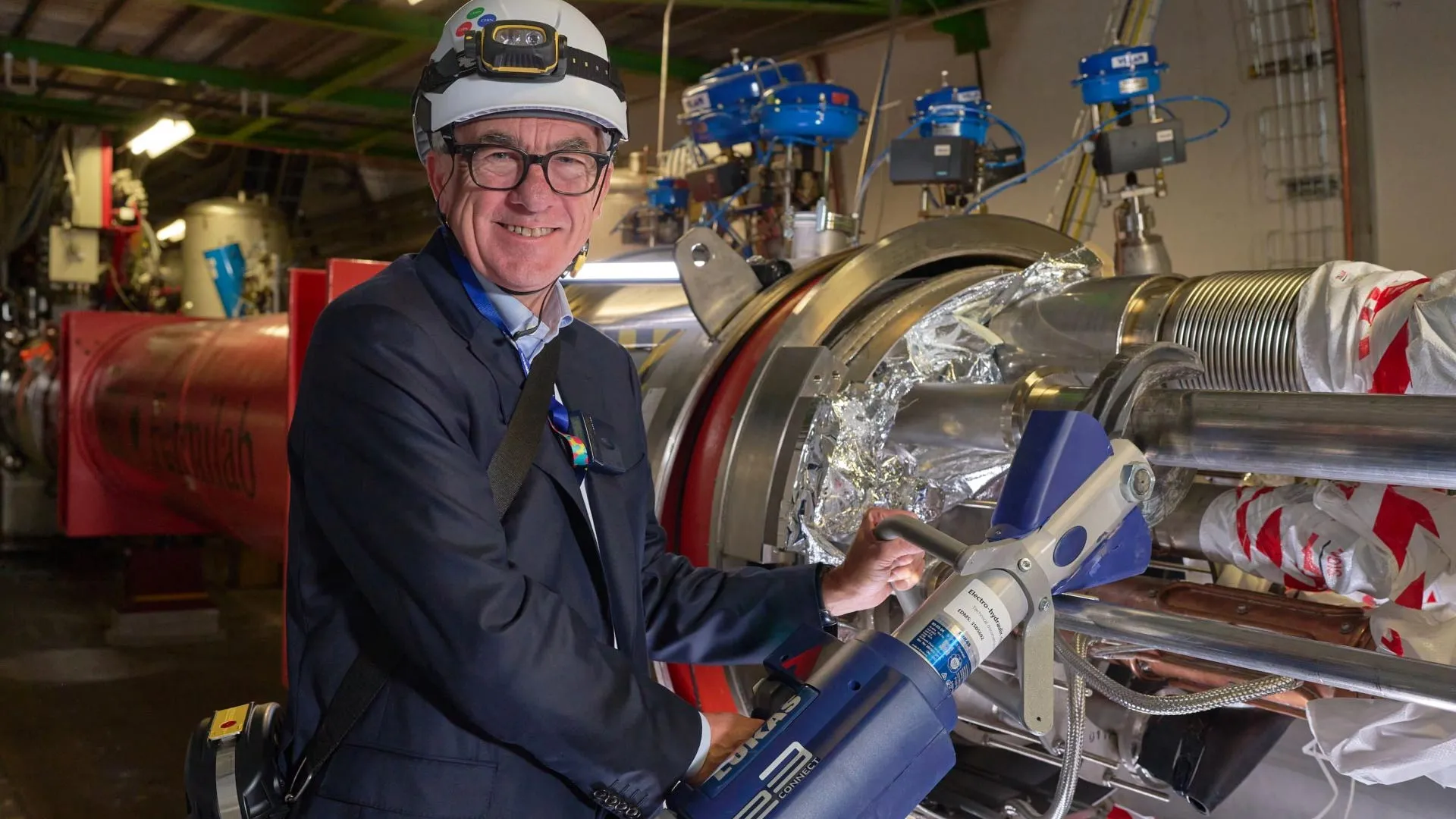
The work will take place during the LHC’s third long shutdown, known as LS3. Crews have now disconnected the first magnet and officially begun the replacement process. CERN Director-General Mark Thomson also visited LHC Point 1, home of the ATLAS experiment, to commemorate the milestone.
“Replacing these magnets with the new HiLumi LHC internal triplet is critical for the upcoming high-luminosity year. The first quadrupole of the new triplet should arrive in the tunnel in early 2029. A total of 16 cryostats and 28 cryoassemblies will be installed—this is a huge undertaking,” explains Jean-Philippe Toc, head of the LS3 coordination team.
New magnets will be about 40% stronger
The new internal triplet is the result of years of research and development, representing a major technological advance over the niobium-titanium magnets currently operating inside the LHC.
The upgraded system will use niobium-tin superconducting coils instead of niobium-titanium. These coils could generate a magnetic field of up to 11.3 tesla—about 40% stronger than the fields produced by the current magnets.
The new equipment will be installed around the ATLAS and CMS experiments, where higher collision rates are particularly important.
ALICE and LHCb operate differently and pursue distinct physics programs, so they do not require the same increase in instantaneous luminosity. Their existing internal triplets can therefore remain in place. However, these magnets will continue to be upgraded so both experiments can benefit from increased overall brightness.
CERN will remove 28 superconducting magnets
Since September 7, CERN teams have been dismantling parts of the collider on both sides of ATLAS and CMS. The goal is to remove the 28 superconducting magnets, including the internal triplet, that will be replaced.
The operation marks the end of an era for hardware that has been part of the LHC since its construction.
“Today’s event is a major milestone for CERN, and in particular for the HiLumi LHC project team. The current internal triplets date back to the construction phase of the LHC and were installed in the machine between 2005 and 2007. After almost 20 years of operation, they will be replaced by a new generation of more powerful magnets. It is truly remarkable to witness such a handover of innovation from one generation to the next,” said Markus Zellerlaus, LHC project leader.
Source: www.sciencedaily.com