


Roman-Era Human Remains in Croatia May Be Linked to the Plague of Cyprian
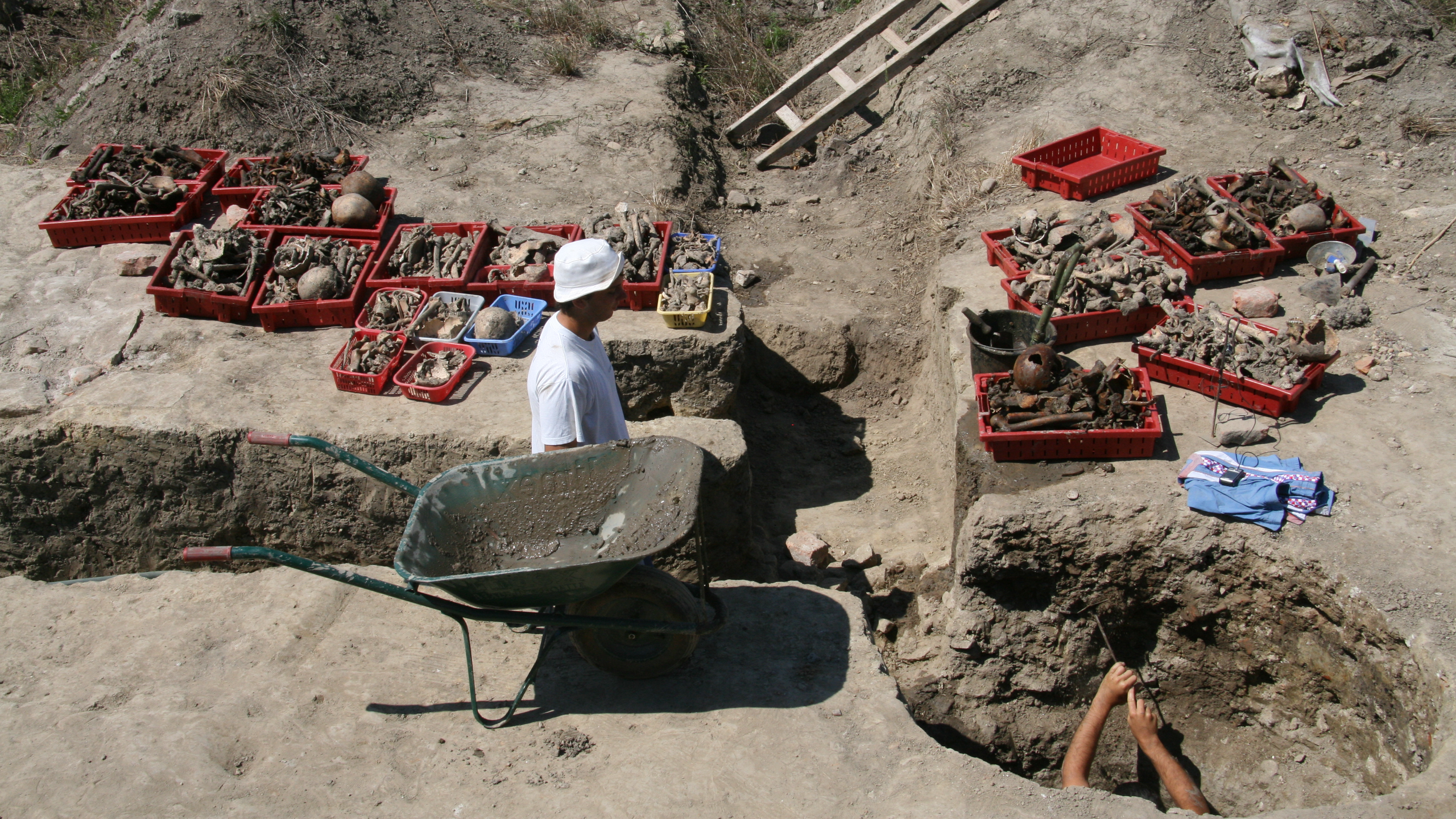
BERLIN — Archaeologists have discovered the remains of at least 43 people in ancient Roman wells near Osijek, Croatia. The mixed group of adults and children may have died during the Plague of Cyprian, a major epidemic that affected the Roman Empire during the mid-third century A.D.
“We have a large number of used Roman wells that were dug in ancient times,” Mario Novak, a bioarchaeologist at the Zagreb Archaeological Institute, told Live Science. “They were essentially used to dispose of bodies during periods of conflict and epidemics.”
Human remains discovered in an ancient Roman well
Novak presented the preliminary findings on Aug. 6 at the 25th European Paleopathological Society Conference in Berlin. The research has not yet been published in a peer-reviewed journal.
From the latest videosLive Science
The burial site was excavated in 2008 near the Roman necropolis of Osijek. The settlement, known in antiquity as Mursa, was located in the Roman province of Pannonia. It was founded during the reign of Emperor Hadrian and became strategically important because Roman soldiers stationed there helped defend the Danube frontier.
Much of ancient Mursa remains buried beneath modern Osijek. The city’s archaeological sites continue to provide evidence of military activity, disease and daily life along the Roman Empire’s northern border.
How the burial differs from Roman battle graves
Novak and his colleagues had previously identified two Roman wells containing the skeletons of young men who suffered severe injuries shortly before death. The injuries suggested that the individuals may have been connected to the Battle of Mursa in A.D. 260.
The newly examined remains appear different. At least 43 people, including men, women and children, were placed in the well. Researchers found no widespread evidence of the major traumatic injuries associated with combat.
“I would say this is a typical cross-section of the civilian population, so it’s not in any way similar to the two mass graves related to combat,” Novak said. “Our working hypothesis is that these people may have been victims of an epidemic.”
Could the remains be linked to the Plague of Cyprian?
Historical records describe a major epidemic known as the Plague of Cyprian, which spread through parts of the Roman Empire during the mid-third century. The outbreak reportedly affected the Roman army along the Danube and may have caused large numbers of deaths across the empire.
The exact cause of the epidemic remains uncertain. Researchers have proposed several possibilities, including hemorrhagic fever and smallpox, but there is currently no definitive diagnosis.
“This provides very interesting data,” Patrick Randolph-Quinney, a biological anthropologist at Sweden’s Uppsala University who was not involved in the research, told Live Science.
“These were not actually mass graves. The bodies were dumped into a series of wells that already existed at the site.”
DNA analysis could reveal the victims’ origins
The skeletons show evidence of common health conditions, including osteoarthritis in the vertebrae and dental cavities. Researchers also identified several possible cases of tuberculosis and scurvy. However, the remains have not yet revealed the cause of death.
“Clearly, more detailed data are needed to better contextualize this finding,” Novak said.
Future DNA analysis may help determine whether the victims were local residents buried quickly during an epidemic or people from other parts of the Roman Empire. Additional testing could also provide clues about their ancestry, health and possible relationship to the Plague of Cyprian.
From Augustus to Nero, find out how much you know about ancient Rome’s famous leaders in this article: Roman emperor quiz!
Source: www.livescience.com