


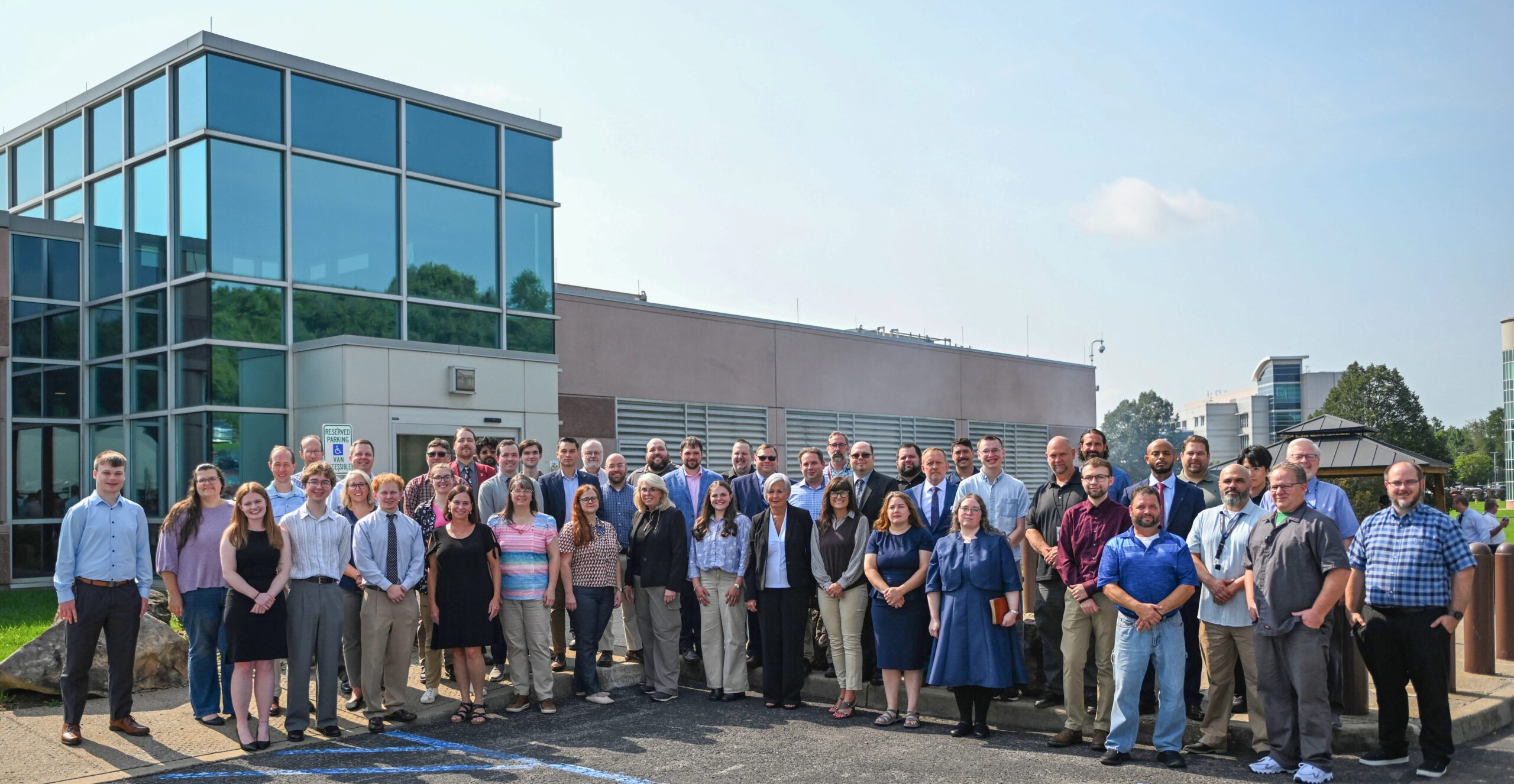
Growing up in Grafton, West Virginia, Fletcher Newell was fascinated by Star Wars, science fiction and space exploration. His interest in NASA grew in 2013, when his fourth-grade class visited a nearby facility he had never heard of: NASA’s Katherine Johnson Independent Verification and Validation Facility, commonly known as NASA IV&V. Thirteen years later, Newell and 48 colleagues were sworn in as NASA employees during a ceremony on Aug. 10.
“I always admired NASA from afar,” said Newell, who began working at NASA IV&V as a systems engineering contractor in early 2025. “To my surprise, NASA was doing impactful work right in my backyard.”
While in high school, Newell developed the programming skills that would shape his career. A self-described computer enthusiast, he taught himself to code after discovering that graphing calculators could be programmed. He began writing basic scripts, then advanced to popular software applications and studied how they were built so he could create his own programs.
As artificial intelligence was beginning to gain wider attention, Newell was already thinking about its potential. “What could be more interesting than what I could teach a computer?” he asked himself. After being accepted into NASA IV&V’s high school internship program as a third-year student in 2019, he combined his programming abilities with his passion for space exploration. Newell created a database of engineering methods and processed hundreds of documents to help colleagues manage technical procedures.
“Working as a high school intern further strengthened my fascination with NASA,” he said.
After graduating in 2020, Newell attended Stanford University in Palo Alto, California, where he majored in computer science. During his college years, artificial intelligence and machine learning continued expanding across industries and becoming increasingly important to the aerospace sector.
Rather than spending his summers interning in nearby Silicon Valley, a global technology hub, Newell returned to West Virginia for three consecutive summers to continue developing his skills at NASA IV&V’s Fairmont facility.
At NASA IV&V, Newell researched artificial intelligence safety as engineers worked to make spacecraft more autonomous and capable of learning. He joined a team evaluating the safety of Terrain Relative Navigation, a vision-based guidance system that enables spacecraft to land on planetary surfaces without GPS.
During his final internship, generative AI was becoming more widely used. Newell worked with a team examining how the technology could be responsibly integrated into NASA’s mission assurance processes.
Newell also researched autonomous spacecraft docking at Stanford University’s Center for AI Safety, contributing to two publications. After earning his undergraduate degree, he remained at Stanford and completed a master’s degree in computer science.
When Newell began searching for a full-time position, NASA IV&V was at the top of his list. When a contractor opportunity became available, he quickly accepted it.
“I enjoyed working at IV&V during high school and college,” he said. “There’s nothing better than pursuing something that suits your interests.”
As a systems engineer, Newell focused on spacecraft mission safety and cybersecurity. He identified and addressed system flaws and vulnerabilities affecting programs including Space Reactor-1 (SR-1) Freedom, Orion, Gateway and the Human Landing System. He also helped guide NASA’s responsible development and deployment of artificial intelligence systems.
Newell’s contributions were quickly recognized. In 2025, less than a year after joining the organization, he was named NASA IV&V Engineer of the Year. According to the award citation, he identified more than 70 issues affecting Gateway and SR-1 Freedom, including problems with clear mission implications. He also earned a reputation for explaining the potential impact of technical issues in a clear and effective way.
“Throughout his internship and now as a full-time engineer, Fletcher has always demonstrated exceptional talent, curiosity and passion for the mission,” said IV&V Director Wes Dedrick. “Once he graduated from Stanford, he could have gone almost anywhere. The fact that he chose to come home to build a career supporting NASA through the IV&V program makes me extremely proud.”
Newell and his colleagues were sworn in during the Aug. 10 ceremony as part of NASA’s effort to fill mission-critical civil service positions. The hiring initiative is bringing technical experts and young professionals into the agency to strengthen its workforce and support future space missions.
“This is an investment in NASA’s future, giving us the opportunity to recruit highly talented individuals into the public service while strengthening our long-term technology capabilities to support our nation’s most challenging missions,” Dedrick said. “At IV&V, initiatives like this allow us to continue to provide the independent expertise and mission assurance our customers rely on.”
Now serving as a civil service computer engineer, Newell is expanding his responsibilities while supporting NASA’s efforts to return humans to the Moon. His work includes identifying safety and security risks associated with the agency’s lunar programs—issues that could threaten crew safety or cause a spacecraft to lose control.
“With IV&V, the team is ensuring all major lunar spacecraft and systems are ready to safely embark on a mission to not only fly around the Moon, but also to put America’s boots on the ground and ultimately establish and work a lunar base,” he said.
More than a decade after his first NASA field trip, Newell is now supporting some of the agency’s highest-priority missions. He admits that he never expected to build his career in West Virginia.
“It was a little strange coming back, but continuing to do a great job at a great organization in a place I already knew,” Newell said. “And that’s really great.”
Source: www.nasa.gov