


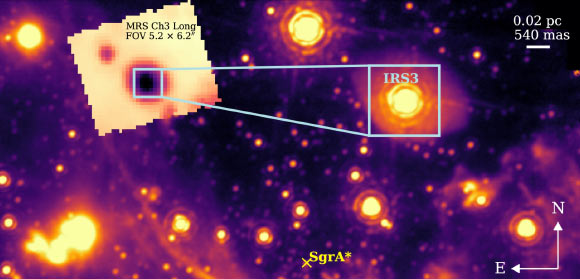
Using NASA, ESA, and CSA James Webb Space Telescope observations, astronomers have discovered that IRS 3—a swollen giant star located just 0.55 light-years from the Milky Way’s central black hole, Sagittarius A*—continues to produce silicate dust and retain water molecules despite the extreme radiation environment at the galactic center.
Mid-infrared images of the IRS 3 environment observed by VLT/NACO and the James Webb Space Telescope MIRI/MRS instruments. Image credit: Peißker et al., doi: 10.1051/0004-6361/202660243.
At the heart of the Milky Way, the supermassive black hole Sagittarius A* dominates an exceptionally violent region filled with intense radiation, powerful stellar winds, and extreme gravitational forces.
Astronomers have long questioned how fragile molecules and dust grains—the raw materials needed to form planets and potentially support life—can survive so close to such a destructive environment.
“The galactic center is one of the most extreme environments, so understanding whether stars can continue to enrich their surroundings is an important question,” said Dr. Florian Peißker, an astronomer at the University of Cologne.
“With Webb, we can directly observe how stars behave under these conditions and see that dust production remains surprisingly resilient.”
IRS 3 is a red giant star approximately 72 million years old and about six times more massive than the Sun.
The star is approaching the final stages of its evolution and is shedding gas and dust in a phase known as the asymptotic giant branch, or AGB.
Dr. Peißker and his colleagues used the James Webb Space Telescope’s MIRI (Mid-Infrared Instrument) to obtain the most complete infrared spectrum yet recorded for IRS 3, helping resolve long-standing questions about the star’s chemistry.
Earlier ground-based observations raised the possibility that IRS 3 could be carbon-rich. However, Webb’s new data reveal two distinct absorption signatures that can only be produced by oxygen-rich, silicate-based dust.
These findings rule out a carbon-dominated composition and firmly identify IRS 3 as an oxygen-rich giant star.
Even more remarkably, the researchers detected clear traces of water molecules in the material surrounding IRS 3.
Water and other complex molecules are highly vulnerable to the ultraviolet and X-ray radiation generated near Sagittarius A*. The detection of intact water so close to the Milky Way’s central black hole suggests that IRS 3’s dense, dusty envelope provides effective protection from the harsh radiation.
ESA astronomer Dr. Macarena García Marín said: “This discovery was made possible thanks to Webb’s sophisticated infrared instruments.”
“This is the first time a continuous mid-infrared spectrum has been collected for this star, allowing us to detect features in the silicate dust and reveal the star’s true chemical identity.”
To interpret the observations, the researchers used a radiation-transport code called Hyperion to create a computer model of the gas and dust shell surrounding IRS 3. They tested approximately 100,000 model variations before identifying the best-fitting solution.
The model indicates that IRS 3 is about 60,000 times more luminous than the Sun. Its surrounding envelope consists of multiple concentric shells, each with different temperatures, densities, and dust compositions. Hot aluminum oxide near the star gradually gives way to cooler silicate grains farther away, with temperatures decreasing by approximately 1,000 K across the structure.
“The detection of water is particularly exciting because it shows that molecular materials can survive in environments dominated by intense radiation,” said Dr. García Marín.
“This shows that even near a supermassive black hole, a star can continue to return material to its surroundings.”
The results appear in the journal Astronomy & Astrophysics.
_____
F. Peißker et al. 2026. Dust generation in harsh environments of Sgr A*: MIRI/JWST observation of O-rich asymptotic giant branch star IRS 3. A&A 712, A79; doi: 10.1051/0004-6361/202660243
Source: www.sci.news