


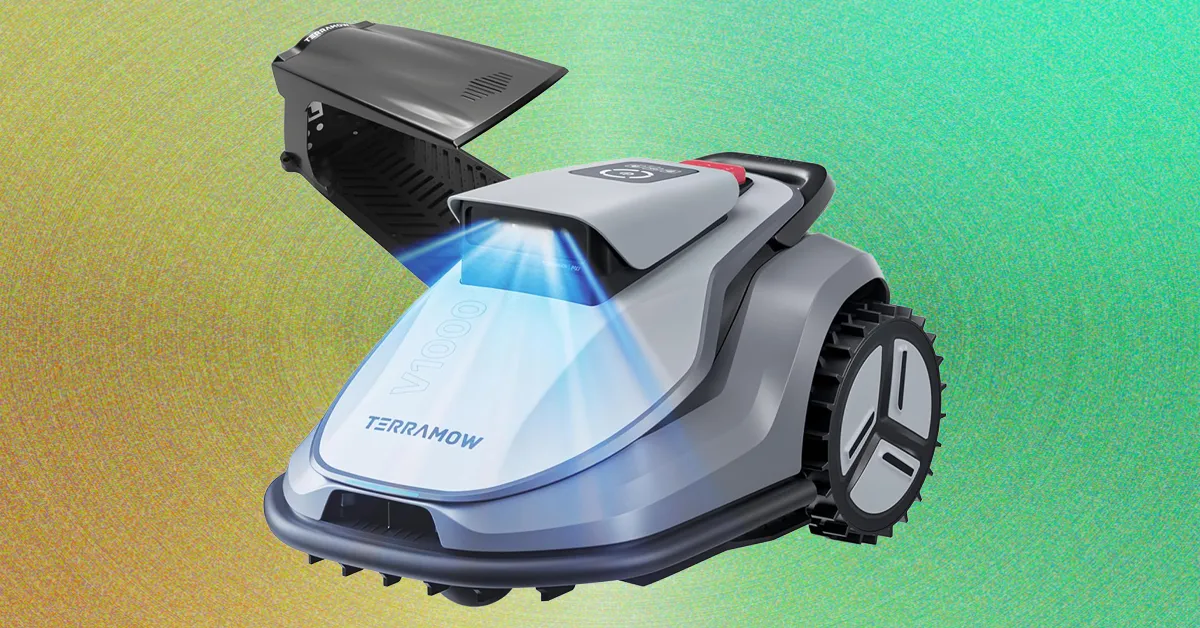
Like many robotic lawn mowers, the TerraMow V1000 has a large power adapter that may not fit directly into some outdoor outlets. Depending on your setup, you may need a weatherproof outdoor electrical box and an extension lead. The mower includes a covered charging station designed to protect it from rain and other outdoor elements, although some competing manufacturers charge several hundred dollars extra for a similar accessory.
The TerraMow V1000 uses a triple-camera system and artificial intelligence to map and navigate your lawn without requiring boundary wires, a guide wire, or an RTK antenna. It connects to your smartphone through Bluetooth and supports Wi-Fi. The mower also includes one year of 4G connectivity, which costs $19 per year afterward. However, 4G is optional if your yard has a reliable Wi-Fi connection. Both 4G and Wi-Fi support firmware updates and remote control when you are away from home. GPS tracking is included, and the mower can send theft alerts for added security.
Setup was one of the easiest experiences I have had with a robotic lawn mower. Since there are no boundary wires or RTK antennas to install, getting started is relatively straightforward. The TerraMow V1000 also offers automatic lawn mapping. With many robotic mowers, creating mowing zones involves manually driving the machine around the perimeter of your lawn. Although I have tested other models with automatic mapping, they often required extensive map editing. The V1000 successfully mapped my relatively simple lawn without any manual input.
The TerraMow V1000 has fairly modest specifications. It can handle slopes of up to 18 degrees, offers cutting heights from 25 to 75 mm, and has an 8-inch (20-cm) cutting width. One useful feature is the ability to assign different mowing settings to individual zones. For example, you can cut one section of grass shorter or adjust how closely the mower trims near an edge. A fully charged battery provides up to 150 minutes of mowing, while a complete recharge takes approximately two hours. As with most robotic lawn mowers, the V1000 can mulch grass clippings and follow a customized mowing schedule through its app.
Impressive Cutting Performance
I did not expect outstanding results from the TerraMow V1000 because it relies entirely on AI-powered vision, a technology that can sometimes be inconsistent. However, the mower exceeded my expectations. It traveled across the lawn in remarkably straight lines and used a subtle fishtail maneuver at the end of each turn. The result was a clean, even cut with narrow, uniform stripes.
When there is enough clearance, the TerraMow V1000 cuts right up to lawn edges, including areas alongside pathways. It leaves a small border near obstacles such as garden sheds and tall plants. Some uncut grass is common with robotic lawn mowers, but the V1000 came closer to providing a complete, consistent cut than any other model I have tested.
Obstacle detection is another strength, especially for households with pets. We have three cats, so reliable obstacle avoidance is essential. I use soccer balls to test robotic lawn mowers and also placed a badminton net with very thin posts across the grass. The TerraMow V1000 detected and avoided both obstacles without making contact.
Overall, the TerraMow V1000’s navigation is impressive. It can create routes between separate grassy areas and reliably return to its charging station. The station does not have to sit directly on the lawn, either. I positioned mine out of sight beside wooden outdoor furniture, across a concrete-paver area, and the mower had no trouble leaving the station or finding its way back.
Source: www.wired.com