



Microsoft Defender ShieldBreak Zero-Day Tracked as CVE-2026-69414
Microsoft has begun developing a security update for a newly disclosed Microsoft Defender zero-day vulnerability known as “ShieldBreak.” The flaw allows local attackers with limited privileges to escalate their access to SYSTEM-level permissions on vulnerable Windows devices.
Security researcher Nightmare Eclipse disclosed the privilege escalation vulnerability after Microsoft released its August 2026 Patch Tuesday security updates.
“Microsoft is aware of the reported vulnerabilities and is actively investigating the validity and potential applicability of these claims,” a Microsoft spokesperson told BleepingComputer when asked about the ShieldBreak zero-day.

“Microsoft is committed to investigating the security issue and updating affected products to protect our customers as quickly as possible.”
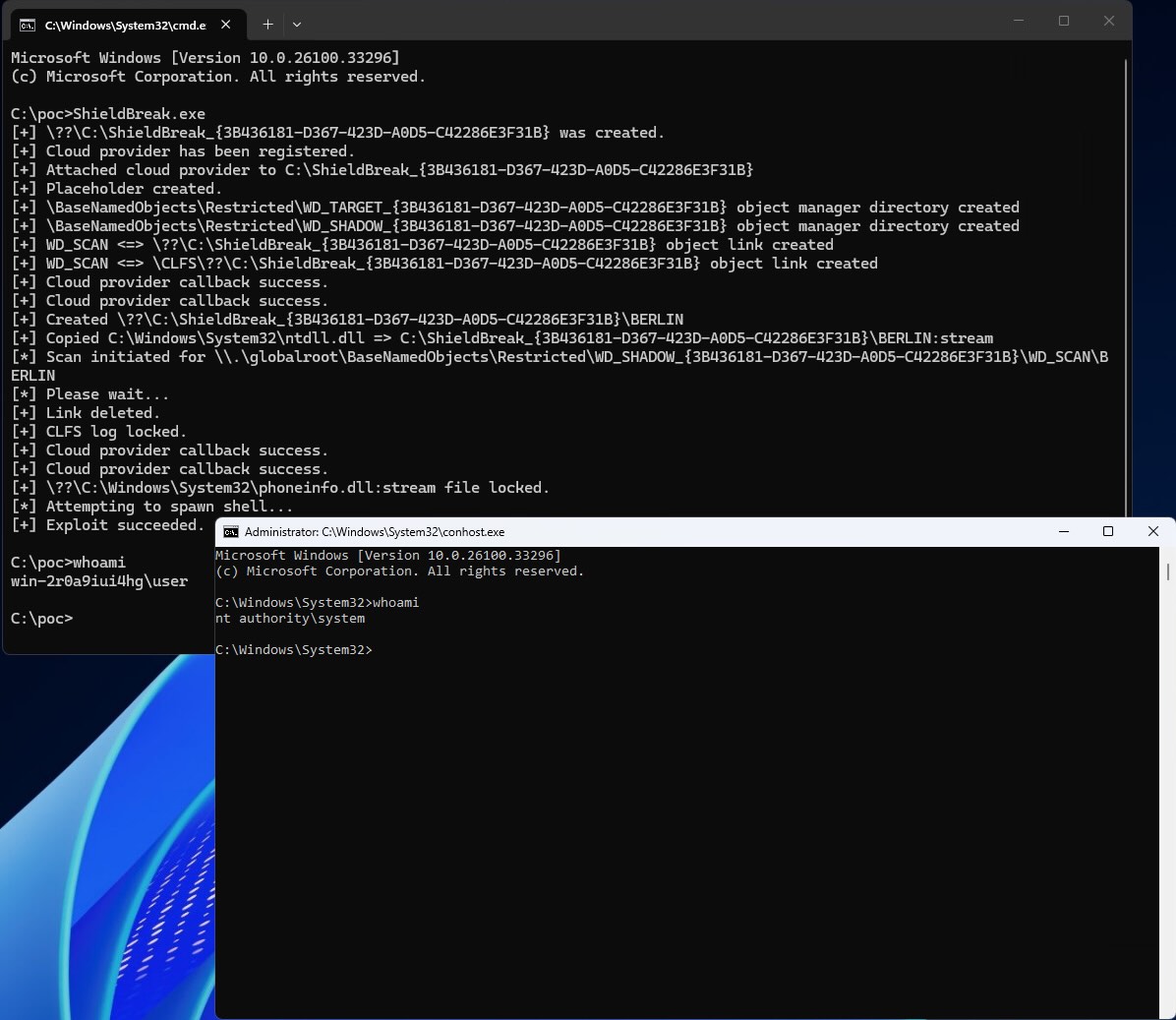
Nightmare Eclipse describes ShieldBreak as a bypass for RoguePlanet, another Microsoft Defender privilege escalation vulnerability disclosed in June. The researcher also published a proof-of-concept (PoC) exploit showing that local attackers can use the flaw to obtain SYSTEM privileges on fully patched Windows 10, Windows 11, and Windows Server systems.
“Microsoft failed to properly patch the RoguePlanet vulnerability CVE-2026-50656. This PoC demonstrates a complete patch bypass,” Nightmare Eclipse said.
“The PoC was tested on the latest versions of Windows 11 25H2, including the Canary channel, and Windows Server 2025. The PoC success rate was also 100%. Please note that Windows 10 and its respective server editions are also vulnerable to ShieldBreak, although they are currently not supported.”
Vulnerability analyst Will Dormann confirmed that the ShieldBreak exploit works, while noting that Microsoft Defender must be enabled for an attacker to successfully escalate privileges.
Microsoft is preparing a patch for CVE-2026-69414
Three days after ShieldBreak was publicly disclosed, Microsoft confirmed that it is tracking the vulnerability as CVE-2026-69414. The company said it is working on a security update but has not confirmed whether the vulnerability was discovered through Nightmare Eclipse’s research.
“Microsoft is aware of an elevation-of-privilege vulnerability in Microsoft Defender’s Microsoft Malware Protection Engine, publicly referred to as ‘ShieldBreak,’” the company said. “We are working to provide a high-quality security update that addresses this vulnerability. We will provide information in this CVE when the update is available.”
Because Microsoft has not yet released a patch, Windows administrators should monitor the company’s security advisories and apply the update as soon as it becomes available. Organizations should also ensure that Microsoft Defender is properly configured and that users do not have unnecessary local administrative privileges.
Nightmare Eclipse published the ShieldBreak exploit without notifying Microsoft as part of an ongoing dispute with the company over vulnerability disclosure and bug bounty practices.
Days after researchers published a proof-of-concept exploit without prior notice, Microsoft responded and warned of potential legal action. Microsoft accused individuals involved in uncoordinated disclosures of engaging in “malicious activities that cause real harm” to customers, prompting criticism from members of the security research community.
Since April, Nightmare Eclipse has published multiple zero-day exploits targeting Microsoft Defender, BitLocker, and other Windows components. The vulnerabilities have been referred to as LegacyHive, RoguePlanet, BlueHammer, RedSun, YellowKey, GreenPlasma, and MiniPlasma, and are documented through the UnDefend project.
Microsoft addressed the YellowKey, GreenPlasma, and MiniPlasma vulnerabilities in the June 2026 Patch Tuesday updates, along with RoguePlanet. However, other flaws disclosed by Nightmare Eclipse remain unpatched zero-days awaiting official security updates.

The overall prevention score can hide what happens after initial access. If an attacker uses valid credentials, your defenses can drop sharply.
Blue Report 2026 measures defense techniques by technology across 338 million simulations run in customer production environments.
Source: www.bleepingcomputer.com