


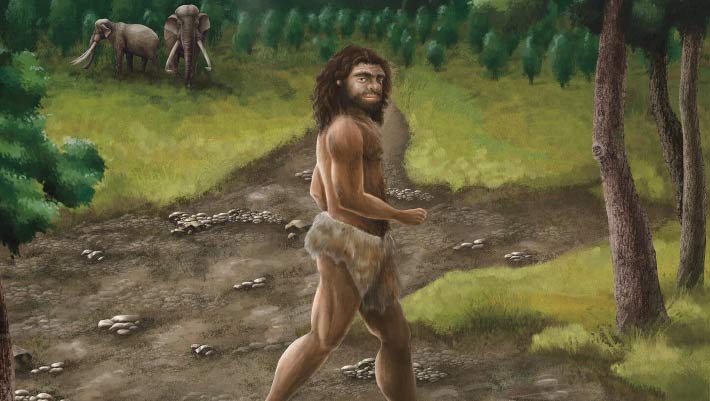
Two fossil bones recovered from the Penghu Strait suggest that Denisovans in prehistoric Taiwan were exceptionally large. The extinct human relatives, whose lineage diverged from Neanderthals roughly 550,000 years ago, were widely distributed across East Asia before disappearing from the fossil record about 45,000 years ago.
Artist’s concept of Penghu Denisovans walking under the bright sun during the Pleistocene in Taiwan. Image credit: Cheng-Han Sun.
Denisovans are an extinct human group and the sister lineage of Neanderthals. Their identity was first established through ancient genetic evidence, and researchers have since identified Denisovan remains in Siberia, Tibet, northern China, and Taiwan.
“The Denisovan clade is a sister group to Neanderthals proposed from ancient genomic evidence,” said Yosuke Kaifu, a researcher at the University of Tokyo and the National Museum of Nature and Science in Tokyo, and his colleagues.
“Well-preserved skulls, mandibles, teeth, phalanges, and other fossil fragments from Denisova Cave in southern Siberia, Xiahe in Tibet, Harbin in northeastern China, and Penghu in Taiwan have been biomolecularly identified as belonging to this group.”
Previous studies indicate that Denisovans had several distinctive physical traits, including large brains, robust lower jaws, large teeth, three-rooted lower second molars, reduced or absent third molars, and phalanges that differed from those of Neanderthals.
However, the overall Denisovan body structure—including height, body proportions, skeletal strength, and postcranial anatomy—has remained largely unknown because so few bones from the body have been discovered.
In the new study, the researchers examined two Denisovan bones recovered from the Penghu Strait, a submerged continental shelf in the Taiwan Strait. The specimens, known as Penghu No. 2 and Penghu No. 3, are a femur and a tibia.
The team analyzed ancient proteins preserved in the fossils and identified collagen variations consistent with Denisovan ancestry. Dating of associated fossils from the same region suggests that the bones are approximately 45,000 to 43,000 years old, placing them near the end of the Denisovan presence in East Asia.
The most striking feature of the specimens was their extraordinary size.
Based on the femur’s measurements, researchers estimated that its owner stood about 180 centimeters (5 feet 11 inches) tall and weighed approximately 83 kilograms (183 pounds). The individual represented by the tibia may have reached around 190 centimeters (6 feet 3 inches) in height and weighed about 91 kilograms (200 pounds).
These estimates place the Penghu Denisovans among the largest known human individuals from the Pleistocene. Their size was comparable to that of some of the largest archaic humans and early modern humans known from Africa and Europe.
The findings challenge a long-standing prediction in physical anthropology known as Bergmann’s law. This principle generally suggests that populations living farther from the equator tend to have larger bodies, while populations living in warmer, tropical regions—such as Taiwan, located at approximately 23 degrees north latitude—tend to be smaller.
The researchers suggest that the Denisovans’ large body size may have been linked to their diet and hunting behavior.
“Recent evidence shows that Denisovans on the Tibetan Plateau exploited a wide range of animals, including caprines, megaherbivores, and carnivores. Isotopic evidence also indicates that the Penghu No. 3 individual relied heavily on meat,” the researchers wrote.
“One possibility is that the Denisovans’ large bodies supported a hunting strategy that targeted different animals and used tools distinct from those of local Homo sapiens populations.”
Penghu No. 2 also displayed an unexpected feature on the back of the femur: a prominent bony ridge known as a pilaster. This feature is commonly associated with modern humans and may reflect the mechanical demands of a highly mobile or nomadic lifestyle.
The femoral feature could represent behavioral convergence between Denisovans and early modern humans. Alternatively, it may reflect interbreeding between the two groups, a possibility supported by genetic evidence showing that Denisovans contributed DNA to some modern human populations in Asia.
“Although the genetic basis of the femoral pilaster remains unclear, and the hypothesis will ultimately need to be tested with genomic data from Denisovan fossils, the feature is consistent with evidence of Denisovan introgression into modern humans in South Asia,” the researchers wrote.
The discovery provides rare anatomical evidence of Denisovan body size and suggests that at least some Denisovans living in prehistoric Taiwan were exceptionally tall and heavily built.
The team’s paper was posted to the preprint server bioRxiv on August 8, 2026.
_____
Yosuke Kaifu et al. 2026. Foot bones of Taiwanese Denisovans reveal their large body size. bioRxiv. doi: 10.64898/2026.08.07.743438
Source: www.sci.news