


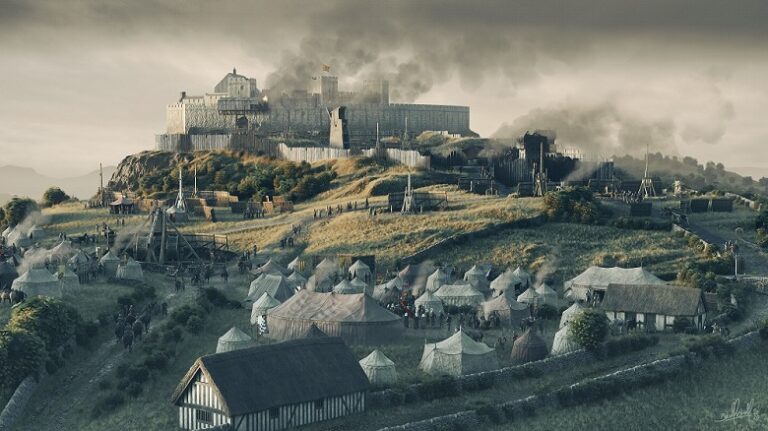
During medieval sieges, trebuchets were powerful weapons that could turn a single stone into a deadly projectile. At Stirling Castle in Scotland, archaeologists have identified what may be the only known historical victim of a trebuchet attack: a man whose upper body was crushed by a stone traveling at an estimated 300 kilometers per hour.
The man’s skeleton was discovered beneath the castle chapel alongside the remains of several other people who appear to have died violent deaths. Known as Skeleton 150—and referred to as “Trebuchet Man” in research notes—he stood out because much of his upper body had been shattered. Paleopathologist Joe Buckberry of the University of Bradford presented the findings at the 25th European Congress of the Society of Paleopathology. The research suggests Skeleton 150 is the only confirmed trebuchet victim identified to date.
Shattered Skeleton Reveals Medieval Siege Death
Skeleton 150 suffered catastrophic injuries. His skull was fractured in 61 places, while approximately 60 sharp bone fragments were found scattered across his ribs. His right shoulder was broken, and his right leg was shattered from the knee upward.
Backberry and her colleagues reconstructed the circumstances of his death using forensic analysis, microscopy, X-rays, and micro-CT scans. Together, the evidence points to a sudden, high-energy impact from a heavy object traveling at extreme speed. The injury pattern indicates that the man’s right shoulder and the back of his head absorbed the initial force. The impact may then have driven his body into the ground, fracturing his ribs and pinning him beneath the projectile.
The fractures occurred while the bones were still fresh, confirming that the damage happened at or near the time of death—not after the body had decomposed. The injuries also rule out several other possible causes associated with medieval warfare. Skeleton 150 was unlikely to have been trampled by a horse or crushed beneath a cart. A fall from the castle walls would probably not have generated enough force to cause such extensive damage, and the angle of impact would not match the pattern found on his bones.
Source: arstechnica.com