


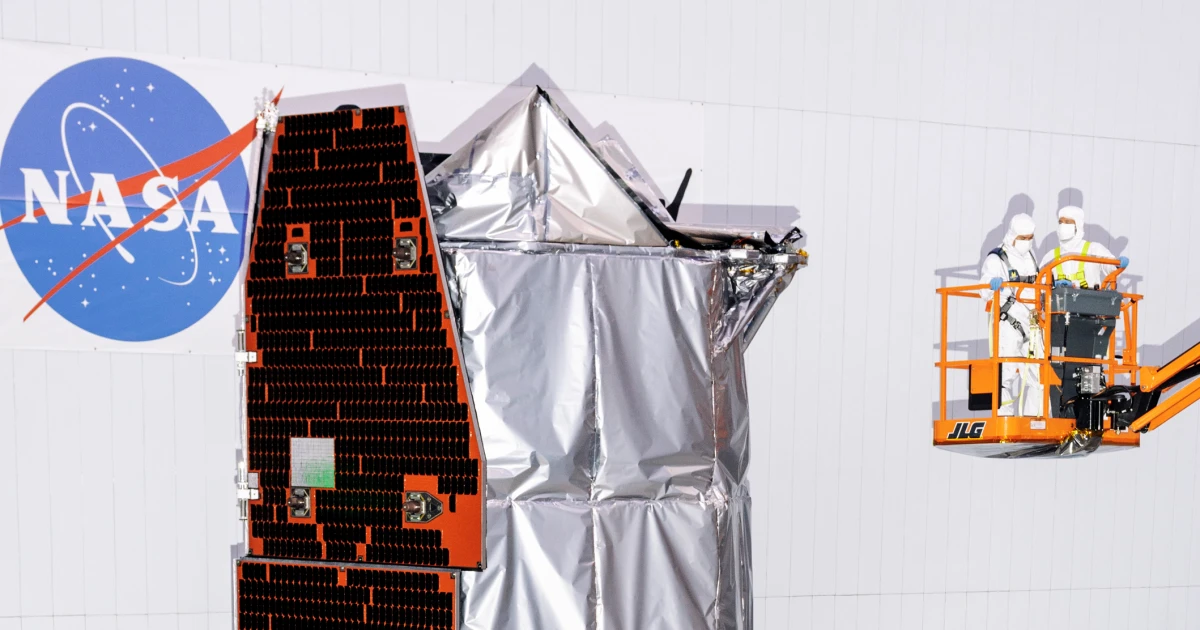
In contrast to many of NASA’s flagship missions, the Roman Telescope has been delivered on budget and ahead of schedule. “It wasn’t an easy task,” Benford remarks.
“Launching this observatory into space has been a significant focus of my career. Over the years, it felt like an ongoing struggle to bring it to fruition,” he explained.
This ambitious project has faced major disruptions, including the COVID-19 pandemic and two of the longest government shutdowns in U.S. history—both last year and this year. NASA initially aimed to launch the Roman Telescope by May 2027 at the latest.
The observatory will be launched aboard a SpaceX Falcon Heavy rocket, embarking on a journey that will take over three months to its destination in space. Once it reaches its location, mission controllers will conduct thorough tests on the observatory’s equipment before commencing scientific observations.
Jason Andrew, NBC News
Benford mentioned that if everything proceeds as planned, the telescope could release its first stunning images by the end of this year.
“It might be around Christmas; I hope it turns out to be a wonderful present,” he added.
Currently, NASA has no other major space telescope initiatives on the table. The agency is proposing the Habitable World Observatory mission to search for signs of life on exoplanets, but should it move forward, it won’t launch until the 2040s.
Thus, the launch of the Roman Telescope holds special significance for Goddard employees, some of whom also contributed to the Hubble and Webb telescopes.
“Being excited doesn’t seem sufficient. I’ve devoted half of my career to this,” said mission systems engineer Mark Melton, who anticipates shedding tears when the telescope is finally deployed.
“It was once just a concept on paper; now it’s becoming a reality,” he reflected.
Source: www.nbcnews.com