


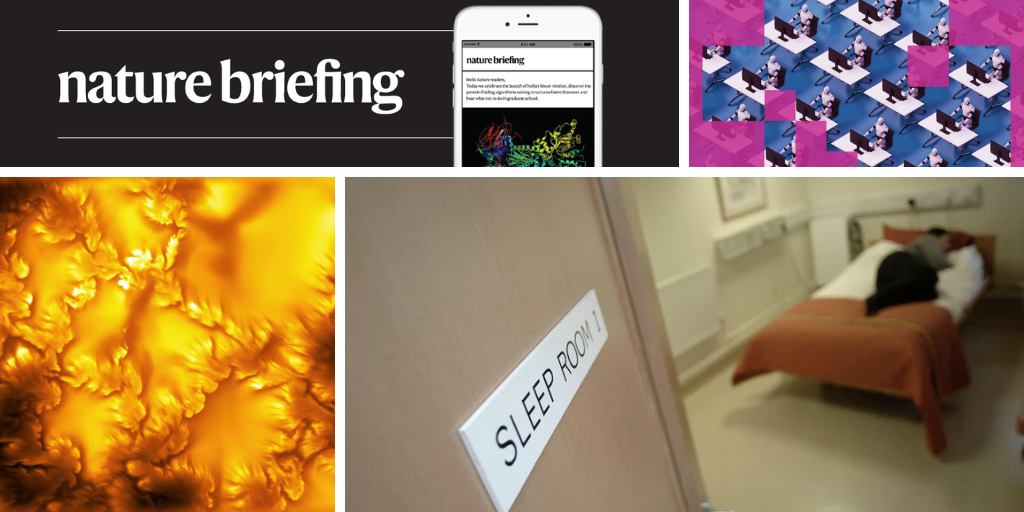
Hello Nature readers. Would you like to receive this science briefing free in your inbox every day? Sign up here.
Doctors test narcolepsy treatments by measuring whether medicines help people fall asleep and remain asleep throughout the night.
Credit: Lucia Graphus/Alamy
The U.S. Food and Drug Administration has approved the first medicine designed to treat type 1 narcolepsy, a neurological sleep disorder. Ovepolextone, sold under the brand name Orzeyful, targets the underlying cause of narcolepsy by activating receptors that respond to the peptide orexin. This helps the brain regulate several bodily systems, including the sleep–wake cycle. The medicine belongs to a growing class of treatments called orexin agonists. Researchers hope these drugs could transform neurological care in much the same way that GLP-1 receptor agonists, such as Ozempic and Wegovy, have changed treatment for diabetes and obesity. GLP-1 medicines are now also being studied for a broad range of other health conditions.
Nature | 6 min read
Postdoctoral researchers protested in Argentina last week after budget cuts and administrative delays left hundreds of scientists uncertain about their careers. Nearly 400 people have been affected by delays linked to spending reductions under the government of President Javier Milei. CONICET, Argentina’s main scientific institution, says it might not know until August next year which applicants will enter its permanent research-career programme. In the meantime, many postdoctoral researchers whose fellowships expire could be left without pay. The country’s science and technology budget is expected to fall to approximately 0.14% of gross domestic product, its lowest level in decades.
Artificial-intelligence systems still struggle to conduct fully independent scientific research, according to researchers testing their ability to design and complete unrestricted studies. Computer scientist Sayash Kapur, co-author of AI Snake Oil, and his colleagues asked an AI tool to reproduce research based on questions from two published papers. The system was then asked to compile its findings for review by the original authors. Although the AI completed some tasks, including running an experiment without becoming stuck, human reviewers found that it pursued an unproductive line of inquiry, failed to follow instructions completely and produced a weak research paper.
Nature | 7 min read
Reference: arXiv preprint (not peer reviewed)
This week’s image: the Sun’s highest-resolution surface view

The most detailed image yet of the Sun’s photosphere could help scientists investigate why stars rapidly lose magnetic flux and why the solar corona is so hot. Captured at a wavelength of 416 nanometres by the Daniel K. Inouye Solar Telescope, the image shows feather-like structures associated with the Kelvin–Helmholtz instability. This phenomenon occurs when parallel streams of fluid move at different speeds. The boundary between them becomes unstable, producing wave-like vortices that can grow and eventually break apart, much like strong winds create waves on lakes and oceans. “The interface becomes unstable, creating wave-like vortices that can grow until they eventually break apart,” said astronomer and study co-author Friedrich Weger. (Reuters | 7 min read)
Reference: Nature paper (NSF/NSO/AURA/MPS)
Featured science stories and analysis
In Earth and Life, palaeontologist Andrew Knoll explores how physical, chemical and biological processes combined over billions of years to make Earth habitable. By tracing the planet’s major biogeochemical cycles, Knoll examines how life-supporting elements such as atmospheric oxygen emerged and changed, how organisms began to reshape Earth and how the geological past can inform our understanding of modern climate change. “Good historians recognize that they are storytellers,” geobiologist Diane Newman writes in a review of the book. “Knoll is one of them.”
Nature | 7 min read
“Fifteen years ago, space travel experiences would have been of little consideration in this part of the Karoo,” writes science communicator Anton Binnemann about the remote region of South Africa. The arrival of the MeerKAT and Square Kilometre Array telescopes has changed the area’s tourism and employment prospects. The Carnarvon Astro Guide now connects major astronomical observatories with local communities, creating opportunities for science communication and sustainable tourism. Large-scale astronomy projects are connecting observatories and local people. “Astronomical infrastructure provides a scientific home, local guides provide an interpretive interface, and the night sky becomes a shared space where science, place, culture and livelihood intersect,” Binnemann writes.
Nature Astronomy | 15 min read
In the 1980s, neurologist Francisco Lopera led pioneering research in Colombia by tracing the family histories of people who carried mutations linked to early-onset dementia. A small number of families also appeared to carry rare protective gene variants that delayed the onset of symptoms by decades. However, a high-profile research programme based on those findings may contain serious flaws. A Science investigation has raised questions about studies of protective Alzheimer’s genes. The research group involved has defended its work, but critics warn that the controversy could undermine confidence in the wider field. “This whole little cottage industry has grown on an incredibly shaky foundation,” says neurologist Michael Glacius.
On Friday, Leaf Penguinson was exploring the atmospheric forests of La Gomera, one of Spain’s Canary Islands. Can you find the penguin? When you are ready, see the answer here.
I also hid in the woods for a while, but I am delighted to be back in your inbox. If we missed an important story or you have feedback about this newsletter, contact us at [email protected].
Thank you for reading,
Flora Graham, Nature Briefing Editor-in-Chief
Contributed by Jacob Smith
• Nature Briefing: Careers — practical insights, expert advice and award-winning journalism to help you make the most of your working life.
• Nature Briefing: Microbiology — the world’s most abundant life forms, microorganisms, and their importance for health, the environment and food systems.
• Nature Briefing: The Anthropocene — essential coverage of climate change, biodiversity, sustainability and geoengineering.
• Nature Briefing: AI and Robotics — the latest developments in artificial intelligence and robotics, written by humans, of course.
• Nature Briefing: Cancer — a weekly newsletter created for cancer researchers and healthcare professionals.
• Nature Briefing: Translational Research — news and analysis covering biotechnology, drug discovery and pharmaceutical innovation.
Source: www.nature.com