


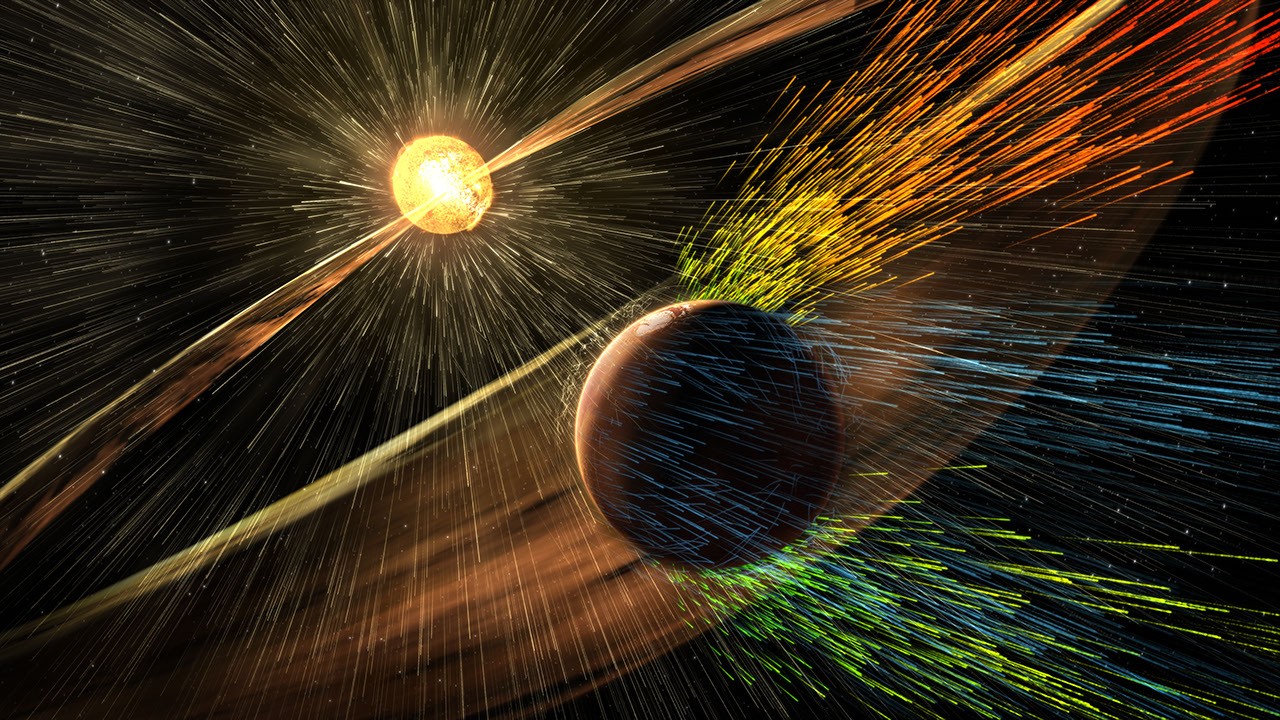
NASA’s MAVEN (Mars Atmosphere and Volatile Evolution) mission has unveiled a crucial insight into Martian auroras, revealing that they form similarly to Earth’s auroras.
These groundbreaking results were published on Thursday in Nature Communications. Researchers found that the same mechanisms responsible for circulating and releasing charged particles into Earth’s atmosphere also operate on Mars, albeit on a much smaller scale due to the differences in their magnetic fields.
The MAVEN spacecraft, which had been orbiting Mars, lost communication with Earth on December 6, 2025. NASA officially declared the mission terminated after determining that the spacecraft was unrecoverable. However, the invaluable data collected from this mission continues to inform NASA’s science initiatives and future Mars explorations.
As the Sun’s magnetic field approaches Earth’s magnetosphere—a protective magnetic bubble surrounding our planet—it can reconnect, injecting energy and mass throughout this bubble. This process generates electrical currents that propel charged particles into the atmosphere, producing the stunning aurora borealis. Known as the Dungey cycle, this mechanism controls plasma circulation in Earth’s magnetosphere and ionosphere.
The recent study indicates that a miniature version of the Dungey cycle occurs within Mars’ strong crustal magnetic field, offering scientists a unique perspective on Martian auroras.
Lead author Xiaosui Xu, a research physicist at the Space Science Institute at the University of California, Berkeley, stated, “We knew magnetic reconnection was happening on Mars, but we didn’t anticipate it would resemble the Dungey cycle.”
Unlike Earth, Mars lacks a global magnetic field. Instead, it contains numerous localized magnetospheres formed by its highly magnetized crust. These areas originated about 4 billion years ago when lava cooled in the presence of Mars’ ancient global magnetic field but have since been diminished by solar winds that strip away the atmosphere, as discussed in NASA’s studies.
The MAVEN mission observed highly localized auroras over these crustal regions, akin to the auroras seen in Earth’s polar zones. However, a comprehensive understanding of how these auroras form has only developed recently. The study incorporated several instruments aboard MAVEN to analyze Dungey-like behavior effectively. A magnetometer and a solar wind electron spectrometer measured the magnetic configuration and derived the associated currents, while a STATIC (superthermal and thermionic composition) instrument was utilized to measure plasma flow in the ionosphere.
“We truly maximized STATIC’s capabilities to obtain the necessary data,” Xu remarked. “This discovery was the final piece in deciphering local auroras.”
The realization that Dungey-like cycles can operate in Mars’ crustal magnetic fields provides crucial answers regarding how electrons gain energy to create auroras. It also indicates that Dungey-like processes can occur on varying scales, enhancing our understanding of similar occurrences across the solar system.
MAVEN principal investigator Shannon Currie, a research fellow at the Atmospheric and Space Physics Laboratory at the University of Colorado Boulder, noted, “This remarkable finding alters our perspective on Mars’ auroras and is a vital step toward comprehending the divergent evolution of Mars and Earth, despite their shared fundamental physics.” Currie expressed pride in the team’s work and enthusiasm for further discoveries about the Red Planet and its evolutionary path.
Gaining deeper insights into this process will empower scientists to better understand how the solar environment interacts with Mars, a critical factor for future robotic and human missions.
“I recall discussing the dynamics of Earth’s magnetic field in relation to Mars during my graduate studies,” Xu reflected. “It’s astonishing to be part of a team that unearthed the answer to that question.”
The MAVEN mission is integral to NASA’s Mars Exploration Program, with its principal investigator based at the University of Colorado Boulder’s Atmospheric and Space Physics Laboratory, which manages the mission’s science activities, public relations, and communications. NASA’s Goddard Space Flight Center in Greenbelt, Maryland, oversees the MAVEN mission, while Lockheed Martin Space constructs the spacecraft and manages mission operations. NASA’s Jet Propulsion Laboratory in Southern California offers navigation and deep space network support.
Discover more about NASA’s MAVEN mission below.
https://science.nasa.gov/mission/maven/
Karen Fox / Alana Johnson
Headquarters, Washington
240-285-5155 / 202-672-4780
[email protected] / [email protected]
Ronnie Shechtman
NASA’s Goddard Space Flight Center, Greenbelt, Maryland
[email protected]
Source: science.nasa.gov