


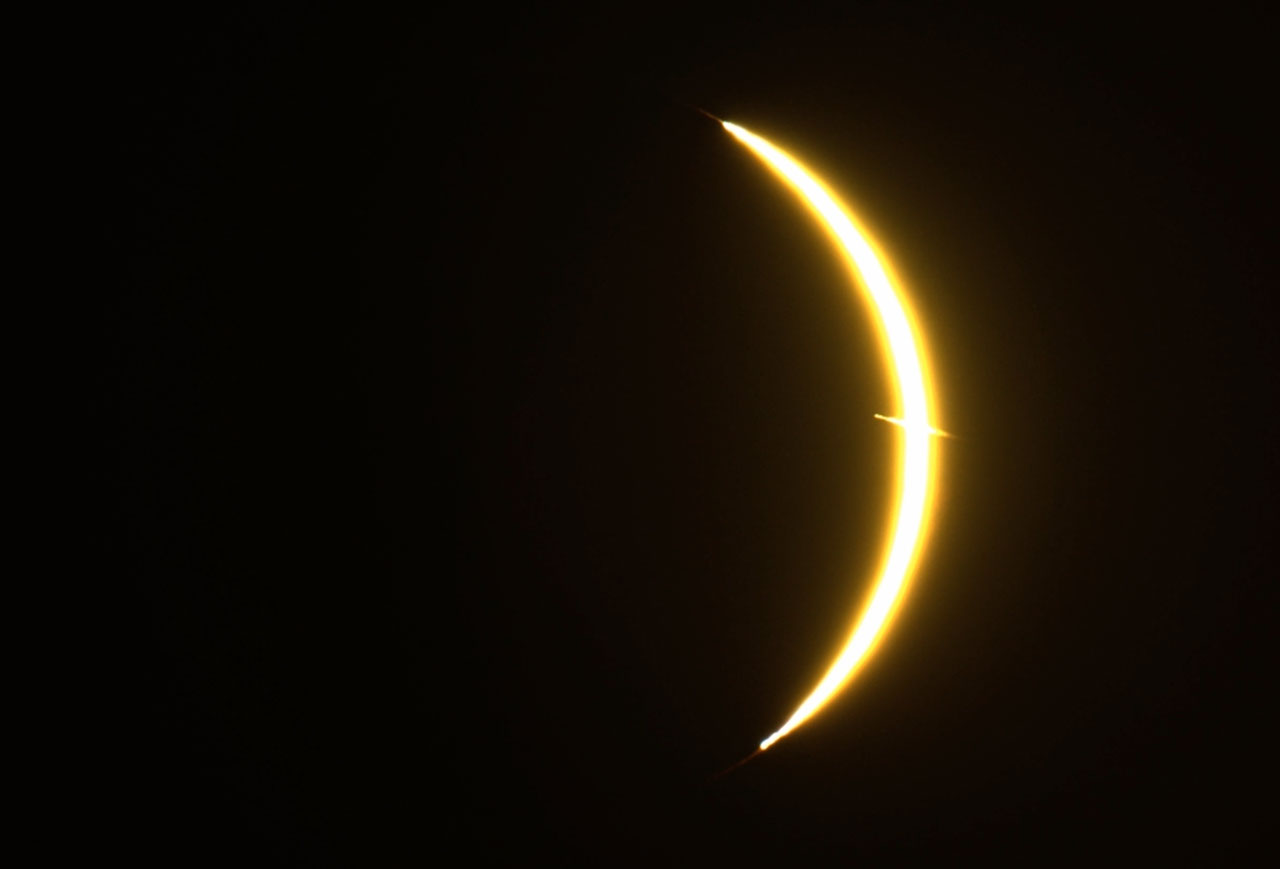
Explanation: What disappeared while crossing the partially eclipsed Sun? Let’s examine the evidence. This 24-frames-per-second video was recorded on August 12, 2026, at 20:28 local time in Spain (40° 34′ 30.3″ N, 1° 12′ 28.8″ W), during the peak of the Perseid meteor shower. Could the object be a meteorite?
Meteor showers appear to originate from a region of the sky known as the radiant point. For the Perseids, this point is located in the constellation Perseus, because Earth is moving through debris left behind by a comet. However, the object’s apparent path and small angular size make it unlikely to be a meteor. It appears smaller than the Sun and Moon, which each span roughly 0.5 degrees in the sky.
What about its brightness? Meteors can be visible even without direct sunlight, but this object does not appear to travel like a typical meteor or fireball. Could sunlight be reflecting off another object instead?
After comparing the location, time, and position in the sky with available flight data, the mystery is solved: the object crossing the partially eclipsed Sun was most likely a contrail.
Tomorrow’s photos: Another mystery.
Source: science.nasa.gov