


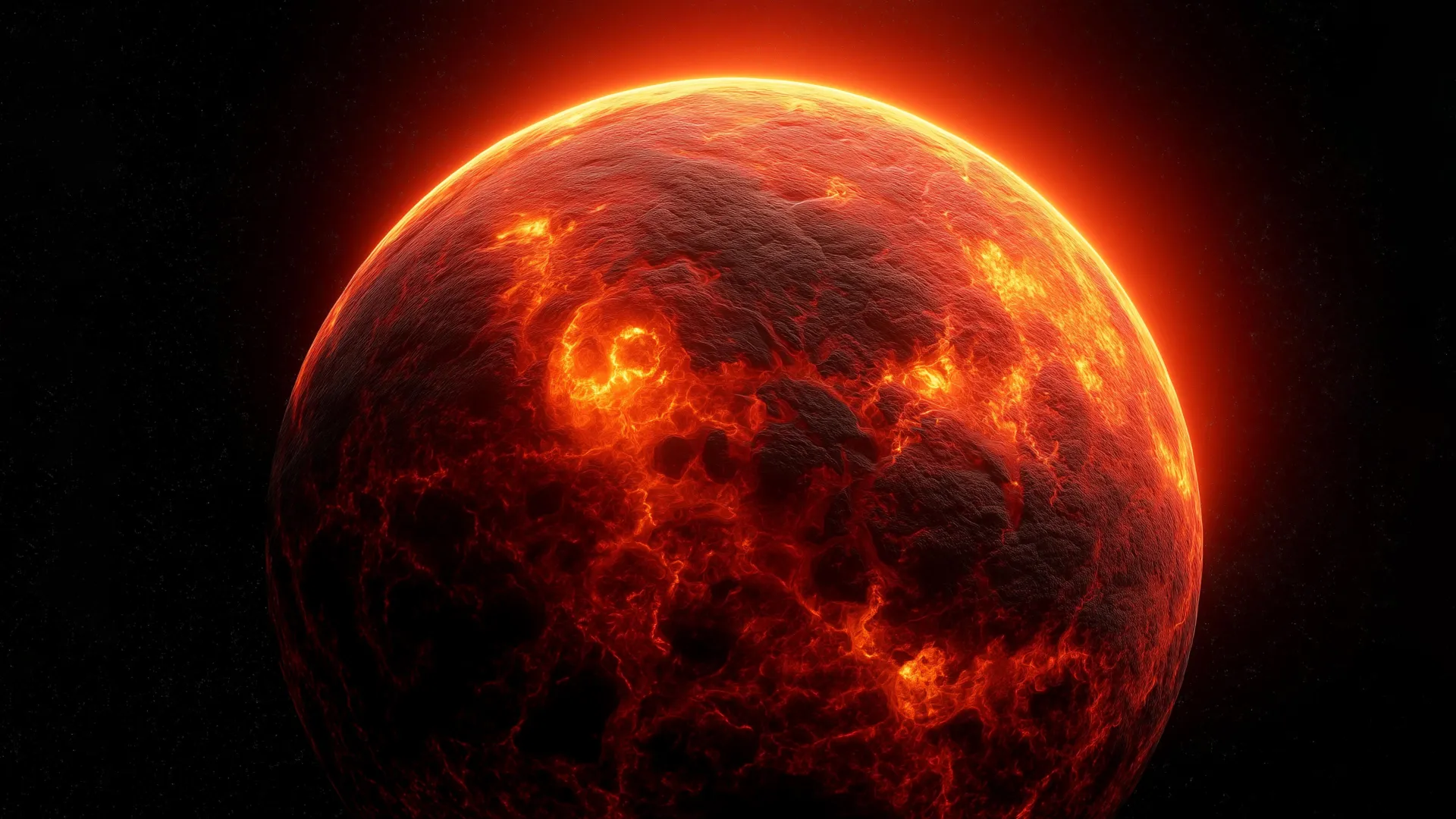
Imagine the year 2158. You’re pursuing a PhD in planetary volcanology at Utopia Planitia University on Mars, surviving on freeze-dried ramen while searching for the best exoplanets for volcanic research. After studying Jupiter’s volcanic moon Io, your focus shifts to rocky worlds beyond our solar system, where intense volcanic activity is driven not by gravitational forces but by the searing heat of nearby stars. Ideally, these exoplanets should be within 50 light-years to optimize faster-than-light (FTL) research missions on budget.
While this scenario may sound futuristic, astronomers are already investigating promising candidates today.
Utilizing NASA’s James Webb Space Telescope (JWST), researchers explored the super-Earth 55 Cancri e (55 Cnc e), a remarkably rocky planet located approximately 41 light-years from Earth. Measuring about 1.88 times the radius and 8 times the mass of Earth, this planet orbits its sun-like star in a mere 0.7 days, in stark contrast to Mercury, which takes 88 days to complete its orbit.
Due to its close proximity to its star, scientists suspect that 55 Cancri e has a surface hot enough to remain molten. These groundbreaking findings are currently being prepared for publication. Research in natural astronomy could provide invaluable insights into the formation and evolution of lava exoplanets.
James Webb Unveils Hydrogen-Rich Atmosphere
The research team utilized JWST to monitor five eclipses of 55 Cancri e, comparing their observations with longstanding models of rocky exoplanet evolution, which typically predict atmospheres rich in carbon monoxide (CO) and carbon dioxide (CO2).
Contrary to those expectations, new observations have revealed an atmosphere abundant in carbon monoxide, with relatively minor amounts of carbon dioxide and surprisingly high levels of hydrogen.
Additionally, the team noted variations among the five eclipse observations, suggesting volcanic outgassing or cloud formation from material ejected from the planet’s interior may be responsible for these fluctuations. They hypothesize these clouds could temporarily cool the planet’s surface before dissipating due to ongoing outgassing.
The study states, “The secondary atmosphere of a rocky planet is determined by its interior composition and resulting outgassing, linking atmospheric composition directly to the interior’s redox state. The preference for hydrogen-rich models and their steep inversions imply an interior with relatively low oxygen fugacity, consistent with outgassing from a reduced magma ocean.”
Understanding Planetary Chemistry
A planet’s redox state refers to the chemical balance of oxygen and hydrogen/iron within its core. For 55 Cancri e, the results indicate a strong hydrogen preference, elucidating the planet’s hydrogen-rich atmosphere.
Observing these atmospheres provides a crucial window into the internal chemistry of distant worlds, revealing what lies beneath their surfaces.
Rising Interest in Lava Exoplanets
First identified in 2004, 55 Cancri e has sparked a surge of interest in lava exoplanets, especially as more of these extreme worlds are discovered.
Other notable lava exoplanets include K2-141 b, L 98-59 d, TOI-561 b, HD 63433 d, and CoRoT-7 b, with orbital periods of approximately 6.7 hours, 7.5 days, 10.5 hours, 4.2 days, and 20.4 hours, respectively.
Similar to 55 Cancri, these planets are tidally locked to their hosts and experience extreme temperatures. On 55 Cancri e, molten rock is believed to be concentrated on the sunlit side, while others like L 98-59 d may host global magma oceans similar to Jupiter’s moon Io.
Comparison: Io vs. Lava Exoplanet
Both Io and lava exoplanets exhibit large-scale volcanic activity, but the mechanisms triggering this activity differ significantly.
Io’s volcanoes are fueled by tidal heating, where Jupiter’s massive gravity causes its moons to continuously expand and contract, generating enough internal heat for violent volcanic eruptions.
In contrast, lava exoplanets such as 55 Cancri e are primarily heated by their close proximity to their host star, which melts surface rock. Due to their tidal locking, these molten regions may remain permanently on the sunlit side.
As astronomers continue their research with state-of-the-art observatories like JWST, 55 Cancri e and similar lava worlds are poised to unlock further secrets regarding the formation, evolution, and hidden interiors of the most extreme rocky planets discovered to date.
Source: www.sciencedaily.com