


S301: A Newly Discovered Star Orbiting the Supermassive Black Hole at the Center of the Milky Way
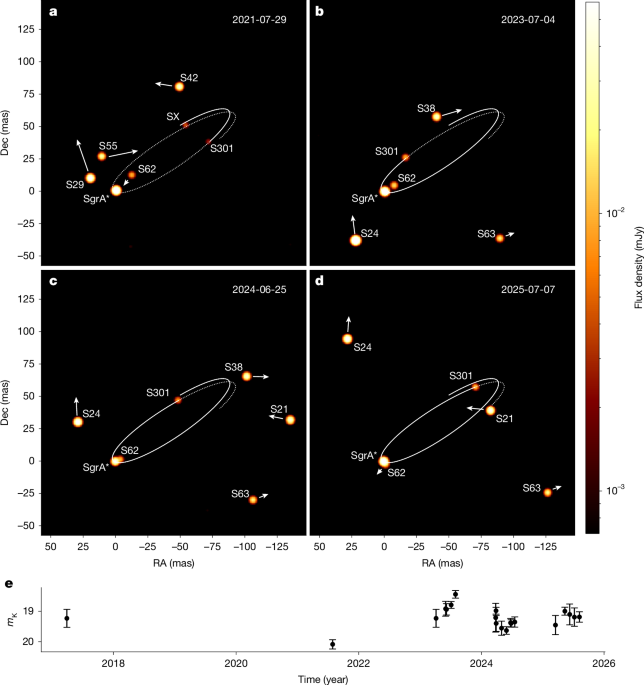
S301 is a faint, fast-moving star orbiting Sgr A*, the supermassive black hole at the center of our Galaxy. Using high-resolution observations from the GRAVITY instrument, astronomers reconstructed S301’s orbit and found that it travels on an exceptionally compact and highly eccentric path.
The star’s orbit makes S301 a promising target for testing general relativity, measuring the spin of Sgr A*, studying stellar dynamics in the Galactic Center, and investigating the possible origin of low-mass S-stars.
Observations of S301 Over More Than Eight Years
<p>The analysis of S301 is based on 19 datasets collected over more than eight years. The star was first identified in 2023 during observations pointed directly toward Sgr A*. Its proximity to the black hole and substantial proper motion suggested that S301 could be moving along a compact orbit.</p>

<p>Following its initial discovery, dedicated observing campaigns were conducted between 2023 and 2025. These observations provided sufficient orbital coverage to trace S301’s motion backward in time and identify two earlier datasets, obtained in 2017 and 2021, in which the star was expected to be visible. The observations used in the analysis are summarized in Extended Data Table 1.</p>

<h3>Recovering S301 in the 2021 Data</h3>

<p>Researchers first fitted a preliminary orbit to the 2023–2025 measurements. Samples from a Markov chain were then used to predict the position of S301 in 2021.</p>

<p>The 2021 observations were part of a Galactic Center mosaic covering approximately 200 × 200 mas. Because this pointing was affected by poor seeing, the data were processed using stricter quality criteria. Only individual detector integrations with fringe-tracking ratios of at least 90% were retained, removing measurements with insufficient coherent flux.</p>

<p>After this quality cut, S301 was identified near the position predicted by the preliminary orbit, as shown in Extended Data Fig. 3, left. The 2021 detection provided an important additional measurement for refining the star’s orbital solution.</p>

<h3>Recovering S301 in the 2017 Data</h3>

<p>Using the improved orbit fit, the team predicted S301’s position in 2017. These observations were originally collected to monitor S2, a star approximately five magnitudes brighter than S301.</p>

<p>The 2017 dataset contains individual exposures recorded over five consecutive nights in March. Some observations used split-polarization mode. For image reconstruction, both polarization channels were treated as independent measurements and combined with the unpolarized data.</p>

<p>S301 was again detected close to its predicted position, as shown in Extended Data Fig. 3, right. The successful recovery of the star in observations from 2017 and 2021 significantly strengthens the identification and confirms its rapid motion around Sgr A*.</p>
High-Resolution Images of the Central 800 Astronomical Units
<p>The highest-resolution and deepest images of the Galactic Center were reconstructed from GRAVITY observations. An example is presented in Extended Data Fig. 1 using the <strong>GRAVITY-RESOLVE</strong> image reconstruction tool, also referred to as GR.</p>

<p>GR is designed to identify stars that appear as unresolved point sources to the GRAVITY interferometer, including faint stars that have not previously been detected. The software uses a hierarchical forward model that accounts for the GRAVITY instrument response, optical aberrations, spectral transmission through the beam combiner, and a statistical model of the Galactic Center.</p>

<p>Because an image contains a very large number of possible degrees of freedom, GR uses Bayesian inference to constrain the reconstruction. Prior information about the known stellar population helps distinguish real stars from noise and imaging artifacts.</p>

<p>The method takes advantage of GRAVITY’s angular resolution of approximately 1.7 mas and its phase-referencing capability. These features enable high-contrast imaging and the creation of detailed mosaics of the central region, techniques originally developed and widely used in radio interferometry.</p>

<h3>Identifying S301 in Image Reconstructions</h3>

<p>The positions of S301 shown in Fig. 2 were initially measured through image reconstruction. The GR model was initialized with all known bright sources in the field of view, including Sgr A*. Prior distributions for the positions and fluxes of the stars reflected the current knowledge of the Galactic Center.</p>

<p>Each dataset was reconstructed 10 times using different random seeds. A faint candidate source was accepted only if it appeared in at least five of the 10 independent reconstructions. The positions of accepted sources were referenced to Sgr A* and averaged to obtain the final astrometric measurements.</p>
Astrometric Uncertainties and the GRAVITY Pixel Grid
<p>The uncertainties of newly identified sources were calculated from the scatter between independent image-reconstruction runs. The finite resolution of the image pixel grid was also included.</p>

<p>This approach improves on earlier analyses in which astrometric errors were approximated solely by the image-pixel size. If a faint source appears in the same pixel in all 10 reconstructions, the measured standard deviation is zero. Such a result is physically unrealistic because the true position is not known with infinite precision within that pixel.</p>

<p>To account for this limitation, the analysis includes a discretization uncertainty. The root-mean-square position error for a single pixel was calculated independently in right ascension and declination. With a pixel size of 0.8 mas, the resulting uncertainty is approximately 207 μas.</p>

<p>This value functions as an effective astrometric noise floor for the GR image reconstructions and prevents the positional uncertainties from being underestimated.</p>
Independent Fits to GRAVITY Data Confirm S301
<p>In addition to GR image reconstruction, two independent analysis tools were used to fit the GRAVITY data. These methods model individual stars as parameterized point sources and provide independent estimates of their positions and brightness.</p>

<p>The fitting methods offer an important cross-check. They test whether S301 is recovered at the same location and with comparable photometry as in the image-reconstruction analysis.</p>

<p>Each GRAVITY exposure was first fitted separately to measure the variable flux of Sgr A*, effectively producing a light curve. The measured fluxes and positions of Sgr A* and other bright, known sources were then used as starting values for a combined fit. For S301, the image-reconstruction results supplied the initial position and flux.</p>

<p>Both fitting methods recovered S301 at the same position as GR, within the statistical uncertainties.</p>

<p>However, a fitting-only approach would not be sufficient to discover a star as faint as S301. Point-source fitting generally converges to a local minimum in parameter space, whereas image reconstruction explores the full parameter space more efficiently and is therefore better suited to finding previously unknown sources.</p>
Additional Detection Using CLEAN Imaging
<p>S301 was also independently recovered with the classical interferometric imaging method <strong>CLEAN</strong>, as shown in Extended Data Fig. 2.</p>

<p>The individual exposures were first CLEANed on Sgr A* to account for its variable emission. The corresponding coherent flux from Sgr A* was then subtracted from the data. The cleaned observations were combined and processed again with a deeper CLEAN reconstruction, enabling the detection of fainter sources such as S301 and S62.</p>
Best-Fit Orbit of S301 Around Sgr A*
<p>The astrometric positions of S301 were fitted using the same general approach applied to the S2 star. The orbital model includes the Rømer delay and the first post-Newtonian correction caused by the Schwarzschild gravitational potential of Sgr A*.</p>

<p>Relativistic Doppler shifts and gravitational redshift were not included because these effects influence radial-velocity measurements, which are not currently available for S301. The lack of radial-velocity data also creates an ambiguity in the three-dimensional orientation of the orbit.</p>

<p>Two viable orbital solutions are presented in Extended Data Table 2. Both solutions have consistent semi-major axes, eccentricities, and pericentre times within the uncertainties. The main difference is the orientation of the orbital plane.</p>

<p>In principle, the Rømer delay could resolve this orientation ambiguity. However, the current orbital phase coverage of S301 is not yet sufficient to distinguish conclusively between the two possibilities.</p>

<p>S301’s orbit is unusual compared with the orbits of other known S-stars. Its combination of very high eccentricity and small semi-major axis produces an exceptionally small pericentre distance:</p>

<p>$$r_{\rm p}=a(1-e)$$</p>

<p>As a result, S301 is an outlier among the known S-stars and approaches Sgr A* more closely than comparable objects. One of the two possible orbital solutions is also aligned within approximately 3° of the inner clockwise disk of young, massive stars reported in previous studies.</p>
Using S301 to Measure the Spin of Sgr A*
<p>The close orbit of S301 could eventually allow astronomers to measure the spin of Sgr A* through the <strong>Lense–Thirring effect</strong>. This relativistic frame-dragging effect causes the orbit of a star to precess as it moves through the curved spacetime around a rotating black hole.</p>

<p>The orbit-averaged Lense–Thirring precession of the in-plane major axis and the orbital plane is given by:</p>

<p>$$\begin{array}{c}
\Delta {\varpi }_{\mathrm{LT}}=-8{\rm{\pi }}\chi \cos \xi
{\left(\frac{G{M}_{\mathrm{MBH}}}{a(1-{e}^{2}){c}^{2}}\right)}^{3/2},\\
\Delta {\Theta }_{\mathrm{LT}}=-4{\rm{\pi }}\chi \sin \xi \sin \lambda
{\left(\frac{G{M}_{\mathrm{MBH}}}{a(1-{e}^{2}){c}^{2}}\right)}^{3/2},
\end{array}$$</p>

<p>Here, <em>ξ</em> is the angle between the black-hole spin axis and the orbital angular momentum, while <em>λ</em> describes the position angle of the projected spin axis in the orbital plane. The dimensionless spin parameter of Sgr A* is denoted by <em>χ</em>.</p>

<p>For S301, the in-plane contribution per revolution is approximately:</p>

<p><strong>0.11° χ cos ξ</strong></p>

<h3>Simulated Future Measurements</h3>

<p>To determine how effectively S301 could probe the spin of Sgr A*, researchers performed mock-data analyses combining existing measurements with simulated observations from 2026 to 2035.</p>

<p>The synthetic datasets used the orbital parameters listed in Extended Data Table 2, together with the mass and distance of Sgr A* adopted from previous measurements. The simulations assumed an optimistic spin magnitude of χ = 1 and an orientation approximately aligned with the orbital angular momentum of S301.</p>

<p>Under these conditions, frame dragging produces primarily in-plane orbital precession, with relatively little change in the orbital plane. The simulated observations were fitted to determine whether the black-hole spin could be recovered.</p>

<p>The assumed future measurement precision was:</p>

<ul>
  <li>Astrometric precision of approximately 100 μas, consistent with the expected final performance of GRAVITY+.</li>
  <li>Radial-velocity precision of approximately 1 km s<sup>−1</sup>, potentially achievable with future ELT/MICADO observations.</li>
  <li>Approximately 10 observations per year through 2035.</li>
  <li>Ten additional measurements concentrated around the pericentre passage.</li>
</ul>

<p>With this observing strategy, the spin parameter could be constrained to an uncertainty of less than 0.2. This would correspond to a greater-than-5σ distinction between a maximally spinning black hole with χ = 1 and a non-spinning black hole with χ = 0.</p>

<p>The significance of the measurement depends strongly on the orientation of the spin axis. The strongest detections occur when the spin is aligned or anti-aligned with the orbital angular momentum. The weakest detections occur when the spin axis lies close to the orbit’s semi-major axis.</p>

<p>Future precision measurements will also require orbital modelling through second post-Newtonian order, or 2PN, to prevent systematic biases, particularly when the true black-hole spin is low.</p>
S301’s Spectral Type, Mass and Age
<p>S301 has an observed K-band magnitude of <strong>m<sub>K</sub> = 19.3 ± 0.3</strong>. Assuming an extinction of 2.42 and a Galactic Center distance of <strong>R<sub>0</sub> = 8.3 kpc</strong>, the star has an absolute K-band magnitude of approximately 2.28.</p>

<p>This brightness is inconsistent with a giant star but is compatible with a main-sequence star. Its estimated spectral type is late A or early F. Using a colour index of <em>V − K = 0.6</em>, the absolute V-band magnitude is approximately 2.88.</p>

<p>The resulting luminosity is approximately <strong>5.5 solar luminosities</strong>, consistent with a spectral type near F1.5 and a mass slightly below 1.5 solar masses. Depending on its age, the mass of S301 is estimated to lie between approximately <strong>1.1 and 1.5 solar masses</strong>, with younger ages corresponding to higher masses.</p>

<h3>Stellar Evolution Models</h3>

<p>The possible age and mass of S301 were estimated using MIST isochrones. The analysis used MIST version 1.2 tracks with a rotation rate of Ω/Ω<sub>crit</sub> = 0.4 and solar metallicity.</p>

<p>Evolutionary points were identified where the model track crossed the inferred absolute magnitude of the star. The corresponding ages and masses are shown as a solid blue line in Extended Data Fig. 8. Because the MIST tracks do not include a K-band magnitude, the JWST F210M magnitude was used as a proxy.</p>

<p>For comparison, the analysis was repeated using K-band magnitudes from PARSEC version 1.2S isochrones. Although PARSEC does not include stellar rotation, its results agree closely with the MIST estimates. Both models indicate a likely mass range of approximately 1.1–1.5 solar masses.</p>
Tidal Effects on S301 Are Negligible
<p>Previous work has suggested that tidal interactions could prevent the measurement of relativistic Kerr effects around Sgr A*. Those studies primarily considered stars with masses of 10 solar masses or more. Because S301 is substantially less massive, tidal effects are expected to be negligible.</p>

<p>The energy deposited into the star during each orbit can be estimated using the leading-order quadrupole term:</p>

<p>$$\begin{array}{c}
\Delta E\approx {T}_{2}(\eta )
{\left(\frac{{M}_{\mathrm{MBH}}}{{m}_{\star }}\right)}^{2}
\frac{G{m}_{\star }^{2}}{{R}_{\star }}
{\left(\frac{{r}_{{\rm p}}}{{R}_{\star }}\right)}^{-6},\\
\eta ={\left(\frac{{m}_{\star }}{{M}_{\mathrm{MBH}}}\right)}^{1/2}
{\left(\frac{{r}_{{\rm p}}}{{R}_{\star }}\right)}^{3/2}.
\end{array}$$</p>

<p>Here, <em>r<sub>p</sub></em> is the pericentre distance, <em>R<sub>⋆</sub></em> is the stellar radius, <em>m<sub>⋆</sub></em> is the stellar mass, and <em>T<sub>2</sub></em> is the tidal coupling constant.</p>

<p>Assuming an <em>n = 3</em> polytropic stellar model, the tidal coupling constant is approximated for η ≥ 10 by:</p>

<p>$$T(\eta )\approx 3.8\times 10^{-5}
{\left(\frac{\eta }{10}\right)}^{-6.5}.$$</p>

<p>The estimated energy input per orbit is approximately:</p>

<p>$$\delta E\approx 10^{-16}\frac{Gm_{\star }^{2}}{R_{\star }}.$$</p>

<p>At this rate, it would take roughly 10<sup>17</sup> years for tides to inject an order-unity fraction of the star’s total energy. Tidal heating can therefore be safely neglected for S301’s present orbit.</p>
S301 Is Distinct from Previously Claimed Short-Period Stars
<p>Several short-period stars with orbital periods as short as four years were reported during the past five years using adaptive-optics imaging. Those observations had approximately 15 times lower angular resolution than GRAVITY.</p>

<p>The analysis rules out the possibility that the objects identified as S4711 and S62 in one previous study are actually S301:</p>

<ul>
  <li><strong>S4711:</strong> Its reported eccentricity of <em>e = 0.768</em> is considerably lower than S301’s eccentricity. Its projected orbit also differs, extending toward the east.</li>
  <li><strong>S62:</strong> Although its reported eccentricity of <em>e = 0.976</em> is comparable to that of S301, its orbit is described as anticlockwise, unlike S301’s motion.</li>
</ul>

<p>None of the other previously claimed objects has orbital elements consistent with S301. The evidence therefore indicates that S301 is a newly discovered star.</p>

<p>The GRAVITY observations reached a limiting magnitude of approximately <strong>m<sub>K</sub> ≈ 20</strong>. This sensitivity should have allowed the team to detect any of the previously claimed stars if they had been present within the observed fields. However, none of the reconstructed images showed a statistically significant flux contribution beyond the background that could be attributed to those objects.</p>
Newtonian Perturbations and Their Impact on Measuring Black-Hole Spin
<p>Initial simulations of the S301 spin measurement assumed that the star orbits an isolated Kerr black hole without external perturbations. In reality, a population of stellar-mass black holes is expected to form a dense stellar cusp around Sgr A*. Gravitational interactions with this population can produce orbital precession comparable to the Lense–Thirring effect.</p>

<p>Recent observations constrain the extended mass within the central 10 mpc to less than approximately 1,200 solar masses. To investigate the impact of realistic perturbers, N-body simulations were performed with a cluster of 60 stellar-mass black holes, each with a mass of 20 solar masses, distributed within 10 mpc according to:</p>

<p><strong>ρ(r) ∝ r<sup>−2</sup></strong></p>

<p>Across 100 independent initial-condition realizations, the cluster produced an average orbital-plane precession of approximately:</p>

<p><strong>0.65<sub>−0.56</sub><sup>+0.36</sup> arcmin per orbital period</strong></p>

<p>This perturbation is generally smaller than the Lense–Thirring signal for moderate-to-high black-hole spins and favourable spin orientations.</p>

<p>The two effects also have different observational signatures. Frame dragging is concentrated near pericentre, whereas perturbations from a granular stellar background tend to produce their strongest deviations near apocentre. This difference in orbital phase, together with the distinct time dependence of the signals, could allow future observations to separate relativistic frame dragging from Newtonian perturbations.</p>

<p>In an extreme scenario where all of the extended mass permitted by S2 observations is concentrated inside S301’s orbit in a disk nearly aligned with the star’s orbital plane, Newtonian nodal precession could be up to an order of magnitude larger than the Lense–Thirring effect. For most orientations and less concentrated mass distributions, however, the Newtonian contribution is expected to be one or two orders of magnitude smaller than the relativistic spin signal.</p>
A Possible Hills-Mechanism Origin for S301
<p>The <strong>Hills mechanism</strong> describes the disruption of a binary system by a supermassive black hole. One member of the binary can be captured into a tight orbit around the black hole, while the other is ejected as a hypervelocity star.</p>

<p>The captured star’s semi-major axis is approximately:</p>

<p>$$a_{\rm cap}=f_{1}
\left(\frac{M_{\rm MBH}}{m_{\rm bin}}\right)^{2/3}
a_{\rm bin},$$</p>

<p>where <em>f<sub>1</sub> ≈ 0.5</em> for circular, equal-mass binaries.</p>

<p>The captured star inherits approximately the binary’s pericentre distance around the black hole. The binary separation must therefore remain within a few times its characteristic tidal-disruption radius. The eccentricity of the captured star is then:</p>

<p>$$e_{\rm cap}=1-f_{2}
\left(\frac{m_{\rm bin}}{M_{\rm MBH}}\right)^{1/3},$$</p>

<p>where <em>f<sub>2</sub></em> is a factor of order unity. The resulting eccentricity distribution depends on binary mass ratio, inclination, internal eccentricity, and the pericentre distribution of disrupted binaries.</p>

<p>Simulations using an observationally motivated binary population predict eccentricities between approximately 0.97 and 0.996 for captured stars with semi-major axes of 2 × 10<sup>−3</sup> to 4 × 10<sup>−3</sup> pc and masses of 1.3–1.7 solar masses. The median predicted eccentricity is approximately 0.985, making binary disruption a natural explanation for S301’s extreme eccentricity.</p>

<h3>The Progenitor Binary</h3>

<p>For nearly equal-mass binaries, the Hills mapping is approximately:</p>

<p>$$a_{\rm cap}\approx \frac{1}{2}
\left(\frac{M_{\rm MBH}}{2m_{\ast}}\right)^{2/3}
a_{\rm bin}.$$</p>

<p>Using S301’s measured semi-major axis and an estimated stellar mass of 1.3–1.7 solar masses gives a pre-disruption binary separation of approximately 0.05–0.2 au. The corresponding binary orbital period would have been roughly 5–20 days.</p>

<p>Compact binaries with these properties are common among F-type stars and are expected to be tidally circularized and nearly synchronized. If S301 was synchronized before being captured, its spin period at the time of capture would have been comparable to the original binary period.</p>

<p>For a stellar radius of approximately 1.3–1.7 solar radii, this predicts an equatorial rotation speed of approximately:</p>

<p><strong>v<sub>rot</sub> ≈ 20–70 km s<sup>−1</sup></strong></p>

<p>High-resolution spectroscopy with ELT/MICADO could test this prediction by measuring S301’s projected rotational velocity, <em>v sin i</em>. Such a measurement would provide a direct test of the proposed Hills-binary origin.</p>

<h3>How Many S301-Like Stars Should Exist?</h3>

<p>Hills disruptions can simultaneously produce tightly bound S-stars near the Galactic Center and hypervelocity stars throughout the Milky Way. For an estimated Hills disruption rate of approximately:</p>

<p><strong>10<sup>−5</sup>–10<sup>−4</sup> yr<sup>−1</sup></strong></p>

<p>steady-state arguments suggest that several S301-like stars could exist on similarly relativistic orbits at any given time.</p>

<p>If approximately 10% of disrupted binaries have the separation required to create S301-like orbits, the estimated formation rate is:</p>

<p><strong>Ṅ<sub>S301</sub> ≈ 10<sup>−6</sup> yr<sup>−1</sup></strong></p>

<p>Given a collisional lifetime exceeding 10<sup>8</sup> years, the steady-state population could contain roughly 100 stars on similar orbits. Most would probably be close to solar mass and therefore too faint for current observations.</p>

<p>Further analysis of GRAVITY+ coverage and sensitivity is needed to determine whether this estimate is consistent with the detection of only one S301-like object so far. Continued GRAVITY+ monitoring and future ELT observations could reveal a larger population of faint, low-mass S-stars deep within the gravitational potential of Sgr A*.</p>

<p>Such a population would enable ensemble measurements of the spin of Sgr A* and improve constraints on the distribution of stellar-mass black holes and other compact perturbers within the central approximately 10<sup>−2</sup> pc.</p>
Dynamical Timescales for S301
<p>The orbital evolution of S301 is governed by several competing timescales, including orbital motion, relativistic precession, relaxation, stellar collisions, and gravitational-wave effects.</p>

<h3>Two-Body Relaxation</h3>

<p>Relaxation describes the long-term dynamical evolution of an object caused by gravitational interactions with its environment. In the Galactic Center, relaxation can be divided into resonant and non-resonant components.</p>

<p>Resonant relaxation results from coherent torques generated by surrounding stars and can rapidly change angular momentum. Non-resonant, or two-body, relaxation is caused by uncorrelated encounters and primarily changes orbital energy over longer timescales.</p>

<p>The approximate two-body relaxation time is:</p>

<p>$$t_{\rm rx}=0.34
\frac{\sigma^{3}}
{G^{2}n\langle m^{2}\rangle \ln\Lambda},$$</p>

<p>where the one-dimensional velocity dispersion is approximately:</p>

<p>$$\sigma\approx \sqrt{\frac{GM}{(1+\gamma)r}}.$$</p>

<p>Here, <em>n</em> is the number density, γ is the density-profile index, ⟨m<sup>2</sup>⟩ is the second moment of the mass distribution, and ln Λ is the Coulomb logarithm. Because the relaxation rate depends on the square of the perturber mass, stellar-mass black holes can dominate the relaxation process.</p>

<p>The Galactic Center environment was modelled using two populations: 10-solar-mass black holes and 1-solar-mass stars. The stellar component was initialized with a Nuker density profile:</p>

<p>$$\rho(r)=\rho_{\rm o}
\left(\frac{r}{r_{\rm o}}\right)^{-\gamma}
\left[1+\left(\frac{r}{r_{\rm o}}\right)^{\alpha}\right]^{(\gamma-\beta)/\alpha},$$</p>

<p>with γ = 1.5, α = 2, and β = 5. The total initial masses were 2.5 × 10<sup>7</sup> solar masses in stars and 2.5 × 10<sup>5</sup> solar masses in black holes.</p>

<p>The central black hole was modelled with an initial mass of 4.15 × 10<sup>6</sup> solar masses, growing to 4.27 × 10<sup>6</sup> solar masses through the consumption of stars and black holes. After allowing the model to relax for 10 Gyr, the enclosed mass within 0.01 pc was approximately 1,200 solar masses, consistent with current observational limits.</p>

<p>The final density profiles between approximately 10<sup>−4</sup> pc and 0.01 pc are described by:</p>

<p>$$\begin{array}{c}
\rho_{\rm bh}=4.95\times10^{8}
\left(\frac{r}{0.0033\,{\rm pc}}\right)^{-1.75}
M_{\odot}\,{\rm pc}^{-3},\\
\rho_{\ast}=3.46\times10^{8}
\left(\frac{r}{0.0033\,{\rm pc}}\right)^{-1.4}
M_{\odot}\,{\rm pc}^{-3}.
\end{array}$$</p>

<p>At S301’s semi-major axis of approximately 3.3 × 10<sup>−3</sup> pc, the estimated two-body relaxation timescale is approximately <strong>9 × 10<sup>8</sup> years</strong>.</p>

<h3>Angular-Momentum Relaxation</h3>

<p>Angular-momentum relaxation, including resonant relaxation, was calculated using diffusion coefficients derived for the adopted density profiles. The corresponding timescales are:</p>

<p>$$\begin{array}{c}
t_{{\rm rx},j({\rm NRR})}=\frac{j^{2}}{D_{jj,{\rm NRR}}},\\
t_{{\rm rx},j({\rm RR})}=
\frac{j^{2}}{D_{jj,{\rm NRR}}+D_{jj,{\rm RR}}},
\end{array}$$</p>

<p>where <em>j</em> is the angular momentum normalized to the circular angular momentum at the same orbital energy. The upper expression gives the non-resonant relaxation timescale, while the lower expression includes resonant relaxation.</p>

<p>For S301, both timescales are approximately <strong>3 × 10<sup>7</sup> years</strong>. This indicates that resonant relaxation is not important for this star. The result is expected because S301 experiences rapid Schwarzschild precession, which suppresses the coherent torques required for resonant relaxation. In this regime, the star lies within the so-called Schwarzschild barrier.</p>

<p>An alternative approximation, <em>t<sub>rx,j</sub>(NRR) ≈ j<sup>2</sup>t<sub>rx</sub></em>, gives results consistent with the full calculation.</p>
Collision Timescales in the Galactic Center
<p>The average time between collisions for a target star is:</p>

<p>$$t_{\rm coll}=\frac{1}{n\Sigma v_{\rm rel}},$$</p>

<p>where <em>n</em> is the local number density of potential impactors, <em>v<sub>rel</sub></em> is their relative velocity, and Σ is the collision cross-section.</p>

<p>Including gravitational focusing, the cross-section is:</p>

<p>$$\Sigma=\pi(R_{\star}+R_{\rm imp})^{2}
\left(1+\frac{v_{\rm esc}^{2}}{v_{\rm rel}^{2}}\right),$$</p>

<p>with:</p>

<p>$$v_{\rm esc}^{2}=
\frac{2G(m_{\star}+m_{\rm imp})}
{R_{\star}+R_{\rm imp}}.$$</p>

<p>For S301, the estimated stellar properties are approximately <em>m<sub>⋆</sub> = 1.5M<sub>⊙</sub></em> and <em>R<sub>⋆</sub> = 1.4R<sub>⊙</sub></em>. The resulting local collision timescales are approximately:</p>

<ul>
  <li><strong>2.0 × 10<sup>9</sup> years</strong> for collisions with stellar-mass black holes.</li>
  <li><strong>2.1 × 10<sup>8</sup> years</strong> for collisions with ordinary stars.</li>
</ul>

<h3>Uncertainties and Environmental Effects</h3>

<p>The estimated relaxation and collision timescales are local values. Interactions near pericentre could, in principle, shorten both timescales significantly. A simple orbit-averaged calculation using the background density profile suggests a reduction by approximately an order of magnitude.</p>

<p>However, the expected number of scatterers near S301’s pericentre is less than one for the adopted density models. The local estimates are therefore likely to provide a more realistic description of the star’s environment.</p>

<p>These calculations also assume that S301 evolves through localized diffusion. In practice, interactions with a small number of massive perturbers may produce a heavy-tailed distribution of orbital changes. Large, non-local perturbations could therefore accelerate the star’s orbital evolution.</p>
Summary of S301’s Dynamical Timescales
<p>The timescale hierarchy around S301 is:</p>

<p><strong>T<sub>orb</sub> ≪ T<sub>SP</sub> ≪ T<sub>LT</sub> ≪ T<sub>Vec-RLX</sub> ≪ T<sub>coll</sub>, T<sub>Sca-RLX</sub> ≪ T<sub>GW</sub></strong></p>

<p>This hierarchy identifies the physical processes most relevant to S301’s orbital evolution. The star completes its orbit rapidly, undergoes relativistic Schwarzschild precession, and may eventually reveal the Lense–Thirring signature of the spin of Sgr A*. Stellar collisions and relaxation occur over much longer periods, while gravitational-wave effects are negligible on currently relevant timescales.</p>

<p>With continued high-resolution monitoring from GRAVITY+, radial-velocity measurements from future extremely large telescopes, and improved modelling of relativistic and Newtonian perturbations, S301 could become one of the most powerful probes of the environment surrounding the Milky Way’s central black hole.</p>
Key Findings About S301
<ul>
  <li>S301 was identified in GRAVITY observations of the Galactic Center and traced across datasets from 2017 to 2025.</li>
  <li>The star follows a compact, highly eccentric orbit around Sgr A*.</li>
  <li>Independent GRAVITY fitting methods and CLEAN imaging confirm its position and brightness.</li>
  <li>S301 is likely a late A-type or early F-type main-sequence star with a mass of approximately 1.1–1.5 solar masses.</li>
  <li>Tidal heating is negligible over the star’s current orbit.</li>
  <li>The star is distinct from previously claimed short-period Galactic Center stars.</li>
  <li>Its orbit may be suitable for measuring the spin of Sgr A* through frame dragging.</li>
  <li>S301’s extreme orbit may have formed through the Hills mechanism, following the disruption of a compact binary.</li>
  <li>Future GRAVITY+ and ELT observations could reveal additional faint stars on similarly relativistic orbits.</li>
</ul>
Source: www.nature.com