


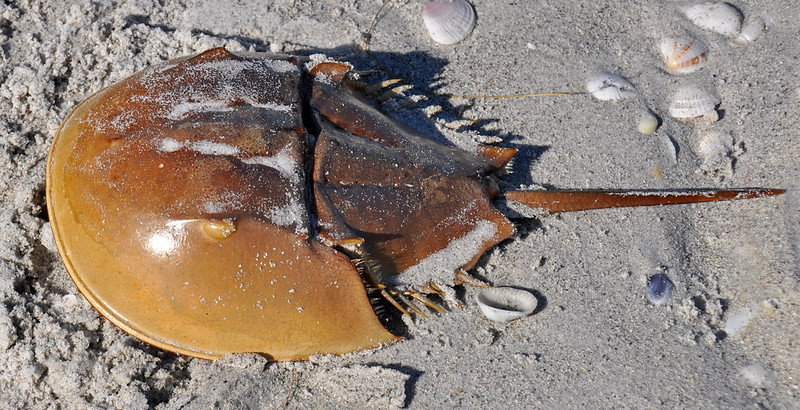
Horseshoe crabs are ancient marine arthropods more closely related to spiders and scorpions than to true crabs. They first appeared more than 450 million years ago and are often called “living fossils” because their overall body plan has changed relatively little over time. However, the fossil record of horseshoe crabs is limited, particularly when it comes to reproductive anatomy. This raises an important question: are horseshoe crabs truly living fossils?
Modern horseshoe crabs reproduce through external fertilization. During spawning, females release hundreds of eggs into saltwater while males release sperm over them. Scientists have long assumed that horseshoe crabs have always reproduced this way. That conclusion, however, has largely been based on a lack of evidence to the contrary. Before this discovery, paleontologists had found only three horseshoe crab fossils from the past 252 million years with preserved reproductive systems.
Previous researchers viewed the long-term persistence of external fertilization as evidence of evolutionary stability in horseshoe crabs. A new fossil species discovered by James Ramsdell and his colleagues in Michigan’s approximately 450-million-year-old Big Hill Formation challenges the idea that these animals have remained unchanged throughout their evolutionary history.
To analyze the fossil, scientists used two types of microscopy. Polarized-light microscopy helped reveal fossil structures that may have been compressed or fused into the surrounding rock. Fluorescence microscopy provided additional evidence of preserved soft tissues. Certain tissues, including ovarian tissue and fossilized eggs, emit light under fluorescence, allowing researchers to distinguish biological material from bubbles, cracks, and mineral deposits.
The analysis revealed several surprising features of this ancient horseshoe crab. Its exoskeleton was more shovel-shaped than the rounded, elongated shells of modern horseshoe crabs. The fossil was also approximately 11 times smaller than a modern adult horseshoe crab, showing that early adult horseshoe crabs differed considerably in both size and body shape.
The fossil also preserved a complex network of ovaries containing unfertilized eggs. This ovarian system formed a band of interconnected tubes along the inner surface of the shell and held both unfertilized and developing eggs. Each fossil egg measured approximately 0.1 to 0.15 millimeters in diameter—about the width of a human hair. Their similar size indicates that the eggs likely developed at the same time through a process known as synchronous development.
Because the fossil’s oviduct contained a developing egg, researchers determined that the animal was an adult. This finding suggests that early adult horseshoe crabs were much smaller and differently shaped than their modern relatives. Despite these physical differences, the fossil’s reproductive anatomy closely resembles that of living horseshoe crabs because both possess similar ovarian systems and eggs. As in previous studies, researchers found no evidence of internal fertilization.
The researchers concluded that ancient horseshoe crabs also reproduced through external fertilization. The fossil is more than 215 million years older than previously known horseshoe crab fossils preserving evidence of this reproductive strategy. This discovery suggests that external fertilization may have persisted in horseshoe crabs for nearly 500 million years.
However, the findings show that the evolutionary history of horseshoe crabs is more complex than the term “living fossil” suggests. Although their reproductive system may have remained nearly unchanged for hundreds of millions of years, their exoskeletons evolved in size and shape. The discovery demonstrates that different parts of the horseshoe crab body evolved at different rates. In other words, horseshoe crabs are not completely unchanged: their bodies evolved, while their reproductive strategy endured.
Post views: 29
Source: sciworthy.com