


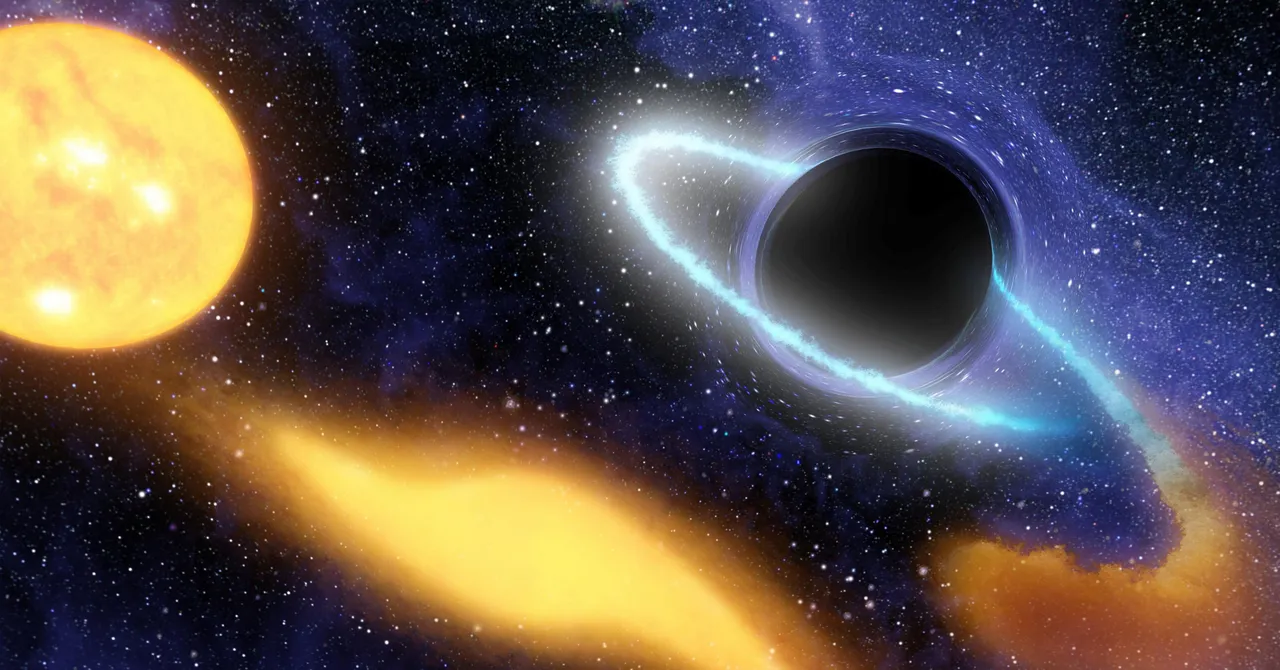
team of Astronomers has discovered the fastest-known star in the Milky Way—and its extraordinary speed may reveal a dramatic past. Named S301, the star orbits Sagittarius A*, the supermassive black hole at the center of our galaxy. Sagittarius A* has a mass roughly 4 million times greater than the Sun.
S301 reaches a maximum speed of approximately 25,000 kilometers per second (km/s) and completes one orbit around Sagittarius A* every 8.7 years. By comparison, the Sun travels around the center of the Milky Way at about 230 km/s. At its peak velocity, S301 moves at around 8% of the speed of light—more than 100 times faster than the Sun’s orbital speed.
S301’s remarkable speed is caused by its extremely close approach to the black hole. According to the European Southern Observatory (ESO), the distance between S301 and Sagittarius A* at their closest point is comparable to the distance between Saturn and the Sun.
As S301 approaches Sagittarius A*, the black hole’s immense gravitational pull accelerates the star. However, S301 does not plunge directly into the black hole. Instead, it follows a highly elongated orbit that carries it around Sagittarius A*.
This elongated orbit explains why S301’s speed changes so dramatically. Like planets and comets in our solar system, the star moves fastest when it is closest to the object it orbits and slows as it travels farther away. Halley’s Comet follows a similar pattern around the Sun.
S301 currently holds the record for the highest known orbital velocity of any star in the Milky Way and is also the closest known star to Sagittarius A*. Researchers believe it likely formed elsewhere and may have lost a companion during its journey toward the galactic center.
“S301’s orbital properties, together with the fact that stars cannot form so close to massive black holes, indicate that the star was likely once part of a binary system. Sagittarius A*’s tidal forces may have torn the pair apart, capturing S301 while ejecting its companion at tremendous speed—possibly fast enough to escape the galaxy entirely.” Learn more from the ESO.
Astronomers expect that continued observations of S301 may help them determine Sagittarius A*’s rotation within the next decade. A black hole’s mass and spin are two of its most important astrophysical properties. Although scientists have found evidence that Sagittarius A* is rotating, its exact spin rate and direction remain unknown.
Source: www.wired.com