


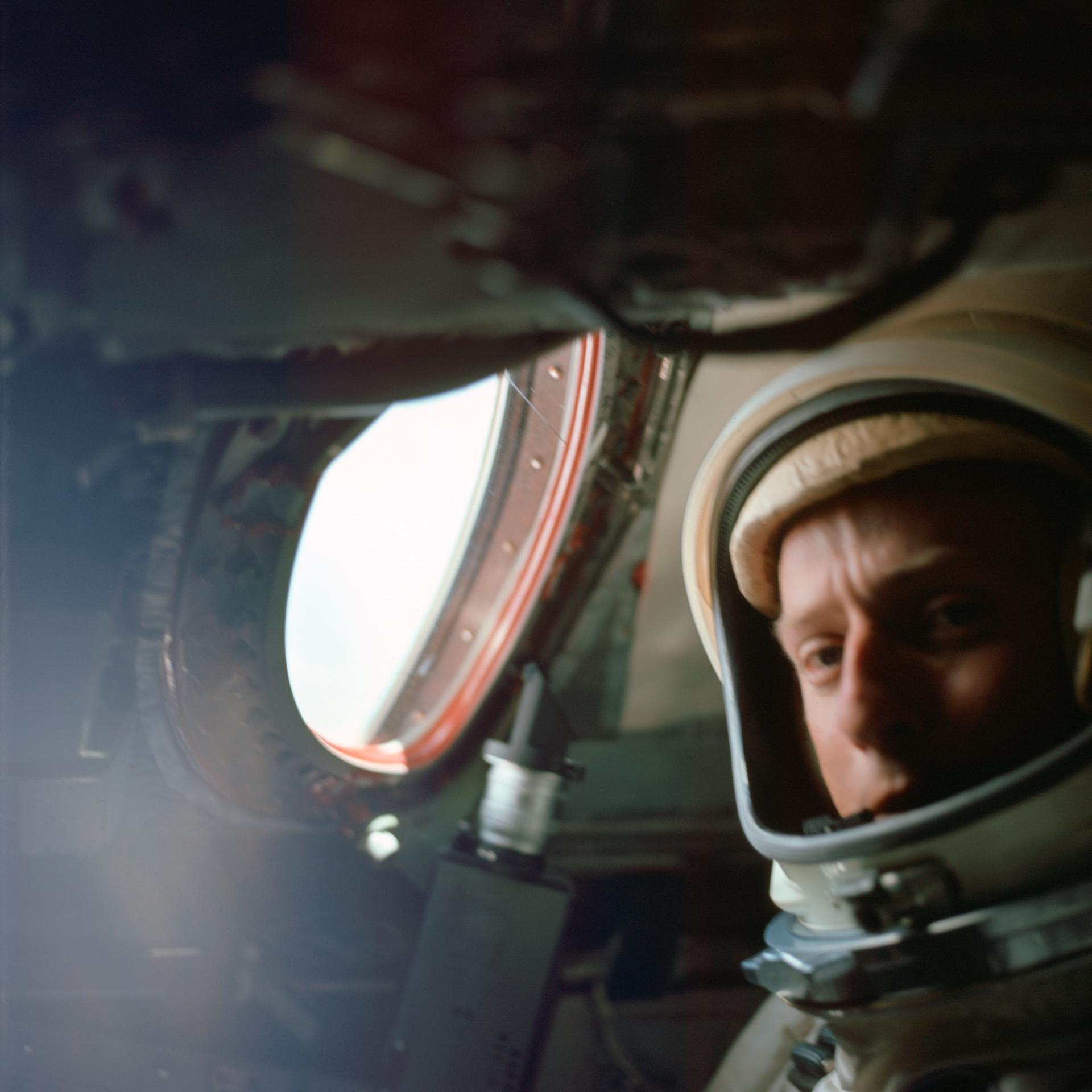
How clearly can astronauts see Earth from orbit? NASA astronaut L. Gordon Cooper Jr. explored that question during the Mercury Atlas 9 mission in May 1963. While orbiting approximately 160 miles (257 kilometers) above Earth, Cooper used a 70 mm camera to capture 29 color photographs of the planet’s surface.
Cooper described the view from the window of the Faith 7 spacecraft as spectacular. He reported seeing vehicles traveling along dirt roads, trains producing visible smoke, and the rooftops of houses. His observations sparked public and scientific debate: Could astronauts really identify objects on Earth from space?
Some vision experts argued that even astronauts with 20/20 eyesight would have difficulty seeing objects less than approximately 150 feet wide from orbital altitude. Cooper reportedly had exceptional 20/12 vision, yet critics still questioned his claim that he could see a white car raising a cloud of dust near the U.S.-Mexico border. Other Mercury astronauts also reported seeing roads, ships, and other features on Earth in surprising detail.
The astronauts’ reports prompted some mental health experts to question whether the effects of spaceflight could be influencing their perceptions. An article in Air Force and Space Digest quoted psychiatrists who speculated that weightlessness might cause hallucinations. At the same time, vision researchers began investigating what the human eye could actually see from space.
NASA and its partners developed two visual-acuity experiments and conducted them during the crewed Gemini V and Gemini VII missions. In the first experiment, astronauts looked through an optical device similar to binoculars. They viewed squares positioned at different locations and displayed at various contrast levels, then identified the direction of each rectangle.
The second experiment involved two large ground-based vision charts made from white rectangles. Manufactured by the Dow Chemical Corporation, the rectangles ranged from approximately 150 to 600 feet in length. Researchers placed one set on dark, plowed soil near Laredo, Texas, and another near Carnarvon, Australia. Astronauts aboard Gemini V and Gemini VII attempted to determine the rectangles’ orientation from orbit. This visual-acuity test became known as the “Eye-Q” chart.
Cloud cover, sunlight scattering through the Gemini spacecraft windows, and the astronauts’ orbital position made the experiment challenging. Even so, astronauts on both missions were able to see portions of the Laredo test site during several orbital passes.
The Laredo Eye-Q results, combined with binocular-style vision tests conducted before, during, and after the missions, confirmed that astronauts could identify certain Earth features from orbit. The experiments showed that astronauts were able to see roads and ships in the water, while also indicating that their visual acuity did not decline during the two-week spaceflight.1
Determining what astronauts could see from orbit was about more than verifying their observations. Understanding the limits of human vision in space—and analyzing photographs taken during NASA’s early crewed missions—had important consequences for Earth science. Geologists, geographers, oceanographers, and other researchers recognized the value of observing Earth from above.
Interest in the photographs and firsthand observations of Mercury and Gemini astronauts encouraged NASA and its partners to develop new Earth-observation technologies. NASA, the U.S. Geological Survey, the Office of Naval Research, and the U.S. Department of Agriculture identified applications for satellite imagery, including tracking crops, mapping geological features, monitoring natural disasters, and studying ocean processes.
The promise of these real-world applications helped inspire the creation of the Earth Resources Technology Satellite (ERTS), later renamed Landsat 1. Launched by NASA in 1972, Landsat 1 used a camera and multispectral scanner to collect data for monitoring oceans, farmland, natural disaster areas, and other features across the planet.
More than 60 years after America’s first crewed spaceflights, NASA continues to observe Earth from orbit, aircraft, and ground-based systems. The pioneering observations of Mercury and Gemini astronauts helped demonstrate the scientific value of viewing Earth from space and contributed to the development of modern satellite remote sensing.
Note
[1] In the years that followed, scientists documented that approximately 70% of astronauts experience spaceflight-associated neuro-ocular syndrome (SANS) during long-duration missions.
Source: www.nasa.gov