


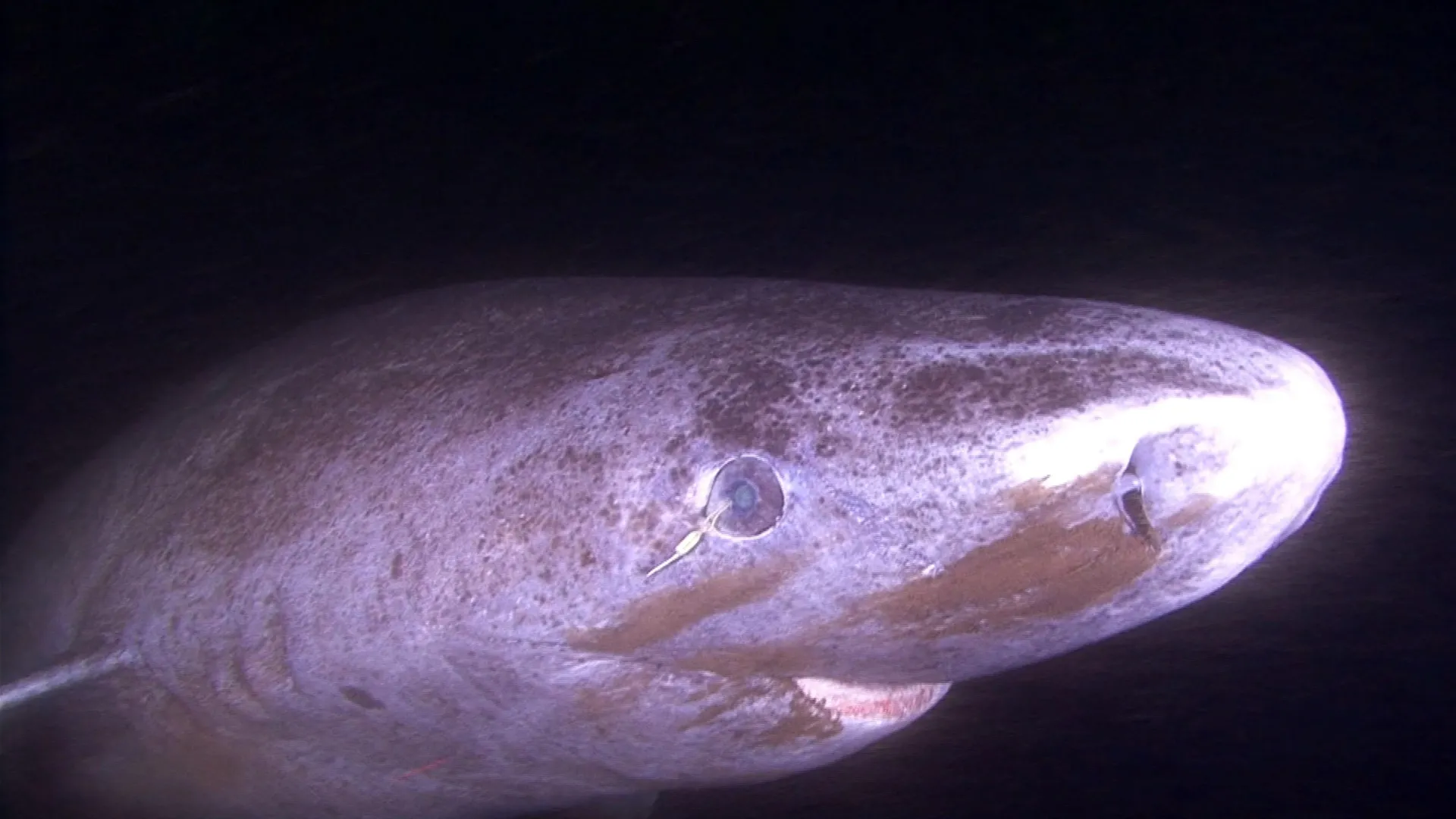
Dorota Skowronska-Krawczyk watches a Greenland shark glide slowly through the dark waters of the Arctic on her computer screen.
“You can see its eyes moving,” says Skowronska-Krawczyk, an associate professor of physiology and biophysics at the University of California, Irvine, as she points to the video. “It’s interesting that sharks follow light.”
Greenland sharks are the longest-living vertebrates known to science, with some individuals estimated to live for up to 400 years. They have thick gray bodies, small heads, and short, rounded snouts. Their cloudy eyes can appear almost lifeless, and parasites are frequently found attached directly to their eyeballs.
Because of these parasites and the extremely dark, murky environment where Greenland sharks live, scientists have long suspected that the species may be functionally blind.
However, new research led by Skowronska-Krawczyk suggests that Greenland shark vision may be far more capable than previously believed.
Greenland shark eyes defy expectations
The study, co-authored by Walter Salzburger and Lily G. Fogg of the University of Basel in Switzerland, examines the evolution of Greenland shark vision. The findings challenge long-standing assumptions about the species’ eyesight while offering new insights into aging, retinal health, and extreme longevity.
Published in Nature Communications, the research suggests that Greenland sharks may preserve their vision for centuries through powerful DNA repair mechanisms and other protective adaptations. Their visual systems also appear specially suited to the extremely low levels of blue light found in their Arctic habitat.
Skowronska-Krawczyk studies the molecular processes behind age-related eye diseases to better understand how aging affects vision. Her interest in Greenland sharks began after she read a 2016 research paper by John Freng Steffensen, published in Science.
“One conclusion I drew from the paper was that many Greenland sharks have parasites in their eyes that can impair their vision,” she says. “Evolutionarily speaking, animals do not retain organs they no longer need. After watching many videos, we realized that these sharks were moving their eyes toward light.”
This observation prompted Skowronska-Krawczyk and her colleagues to investigate the sharks’ visual systems in greater detail.
Studying the eyes of centuries-old sharks
The Greenland sharks examined in the study were captured using scientific longlines between 2020 and 2024 near the University of Copenhagen’s Arctic research station on Disko Island, Greenland.
Steffensen, a professor of marine biology at the University of Copenhagen, collaborated with Peter G. Bushnell of Indiana University South Bend and Richard W. Brill of the Virginia Institute of Marine Science. The researchers dissected the sharks’ eyes and preserved the tissue in a fixative for further analysis.
Emily Tom, PhD, a University of California, Irvine student and physician-scientist in training in Skowronska-Krawczyk’s laboratory, remembers when one of the preserved eyes arrived.
“When I opened the package, there was a giant, 200-year-old eyeball sitting on dry ice, just staring at me,” the 28-year-old researcher says with a laugh. “We were used to working with mouse eyeballs the size of papaya seeds, so we had to figure out how to work with baseball-sized eyeballs. Fortunately, Dorota is very hands-on in both her teaching style and her laboratory work, which you don’t often find in professors.”
Tom carefully dissected the eye tissue.
“The lab smelled like a fish market,” she says.
Handling the tissue required precision. If the samples became too warm and reached room temperature, they could begin to deteriorate.
No signs of retinal cell death
Tom conducted histological and vision-specific analyses of the ocular tissue. The researchers found no evidence of widespread cell death in the retina.
They also discovered that rhodopsin, a protein essential for vision in low-light conditions, remained active in the sharks’ retinas. The protein is tuned to blue light, potentially allowing Greenland sharks to see the faint illumination that reaches the deeper waters of the Arctic Ocean.
“Not many people study sharks, especially shark vision,” Tom says. “We can learn a great deal about vision and longevity from long-lived species such as Greenland sharks. Funding this type of research is extremely important.”
The results suggest that the Greenland shark’s exceptional lifespan is not necessarily accompanied by the severe retinal deterioration scientists might expect in an animal that can live for centuries.
What Greenland sharks can teach us about aging
For Skowronska-Krawczyk, the study raises the possibility that understanding how Greenland shark eyes remain healthy for centuries could eventually help researchers develop new ways to prevent age-related vision loss.
The findings may also inform research into eye diseases such as macular degeneration and glaucoma. More broadly, they raise important questions about how vision evolves, how tissues maintain their function over exceptionally long lifespans, and whether some of these protective mechanisms could one day be applied to human health.
Skowronska-Krawczyk says uncertainty surrounding federal research funding has created concerns about continued support for this work, but she remains confident that researchers “will prevail.”
“What I love about my job is that we are producing results for the first time in the world. We are on the front lines, discovering new mechanisms, rules, and biological processes,” Skowronska-Krawczyk says as she looks at a frozen shark on the screen. “Being able to share that excitement with my students is the best part of this job.”
Source: www.sciencedaily.com