


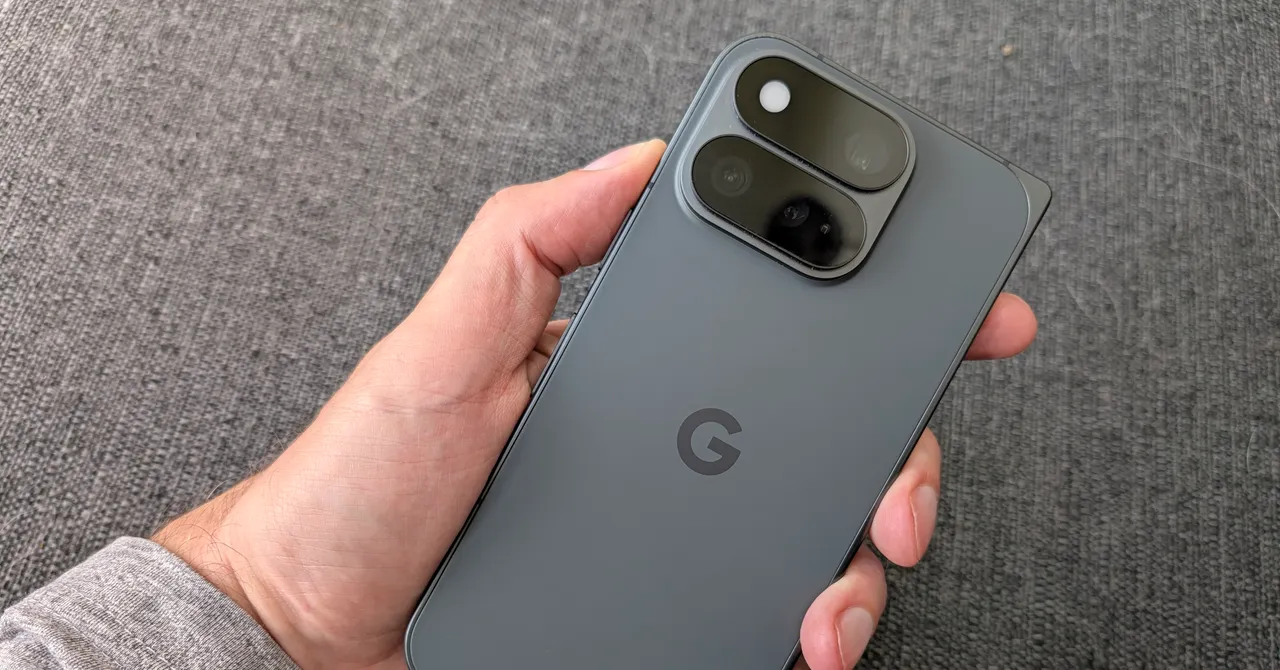
Unfortunately, the Google Pixel 11 Pro Fold is available in only two colors. The Obsidian model, which I reviewed, looks more like a dark matte gray than true black. The Olive Green version features a more reflective, gold-toned frame.
I’m not a fan of Google’s asymmetrical design. When the Pixel 11 Pro Fold is closed, curved cutouts are visible in the corners. When the phone is unfolded, its two halves also have slightly different thicknesses. Like every foldable phone, the Pixel 11 Pro Fold has a visible crease down the center of the inner display. However, Google’s crease is among the most noticeable. Some users may not mind it, but detail-oriented buyers are likely to notice it immediately.
The fingerprint sensor built into the power button is another minor annoyance. You have to lift the phone and touch the sensor to unlock it, rather than simply pressing an in-display fingerprint reader. The Pixel 11 Pro Fold also supports facial recognition, and it works well in adequate lighting. However, face unlock does not work in a dark room, which remains frustrating.
The Pixel 11 Pro Fold features two bright, sharp OLED displays: an 8-inch inner screen and a 6.5-inch cover display. Both reach a peak brightness of up to 3,600 nits, making them easy to see in direct sunlight. They also support variable refresh rates of up to 120Hz, delivering smooth scrolling and animations. The displays look excellent overall, with the crease being my only significant complaint.
Pro Pretender
I’m not convinced the Pixel 11 Pro Fold fully earns the “Pro” name. Google’s new HiLight feature uses colored LEDs in the camera module’s flash to display different colors for incoming callers or create a rainbow animation while you chat with Gemini. It’s visually appealing, even if the feature feels somewhat underdeveloped. HiLight can be useful when you place your phone face down while working or relaxing, but it remains a minor addition rather than a true Pro-level feature.
Like the rest of the Pixel 11 lineup, the Pixel 11 Pro Fold is powered by Google’s Tensor G6 processor. The foldable phone comes with 16 GB of RAM and offers 256 GB, 512 GB, or 1 TB of storage. After upgrading from the Pixel 10 Pro XL, my experience was mostly smooth. However, the phone froze several times while using Gmail in split-screen mode or after launching the app on the outer display and expanding it onto the inner screen.
The Pixel 11 Pro Fold also shares several similarities with the standard Pixel 11 because it lacks the high-end camera system found on its Pro sibling. Foldable phones often struggle to match traditional flagship smartphones in camera specifications because of their thinner, more complex designs. They must also accommodate two front-facing cameras—one for the cover display and another for the unfolded inner screen.
Photo: Simon Hill
Source: www.wired.com