


More than a billion years of Earth’s geological history are missing from some rock formations. New research led by a University of Wollongong (UOW) PhD candidate suggests that the gap, known as the Great Unconformity, may have formed as mantle convection slowly lifted and lowered entire continents, exposing ancient rocks to erosion before later sediments buried the surfaces.
Earth’s mysterious lost billion years
Layers of sedimentary rock normally accumulate over time, creating a geological timeline in which younger rocks lie above older ones. By studying these layers, scientists can reconstruct ancient environments and trace how Earth changed over billions of years.
In many locations, however, sedimentary rocks from the Cambrian period, about 540 million years ago, lie directly on much older crystalline rocks such as granite. Some of those underlying rocks are more than a billion years old. The missing layers between them form a major break in Earth’s geological record called the Great Unconformity.
One of the clearest examples is in the Grand Canyon in the United States, an area that was once part of the ancient continental landmass of Laurentia, now North America. Similar gaps have been identified in Europe, Australia, Africa and Asia.
The amount of missing time varies by location. In some places, about 200 million years of geological history are absent; in others, more than a billion years is missing.
How forces deep inside Earth erased the rock record
Research led by Santosh Dhungana, a PhD candidate at UOW, offers a new explanation for this long-standing geological mystery. Published in Nature, the study used computer simulations to examine how Earth’s mantle moved over hundreds of millions of years.
Dhungana worked with his supervisor and co-author, Associate Professor Nicholas Flament. The researchers noted that scientists have proposed several explanations for the Great Unconformity, but few have been rigorously tested against the long-term behavior of Earth’s interior.
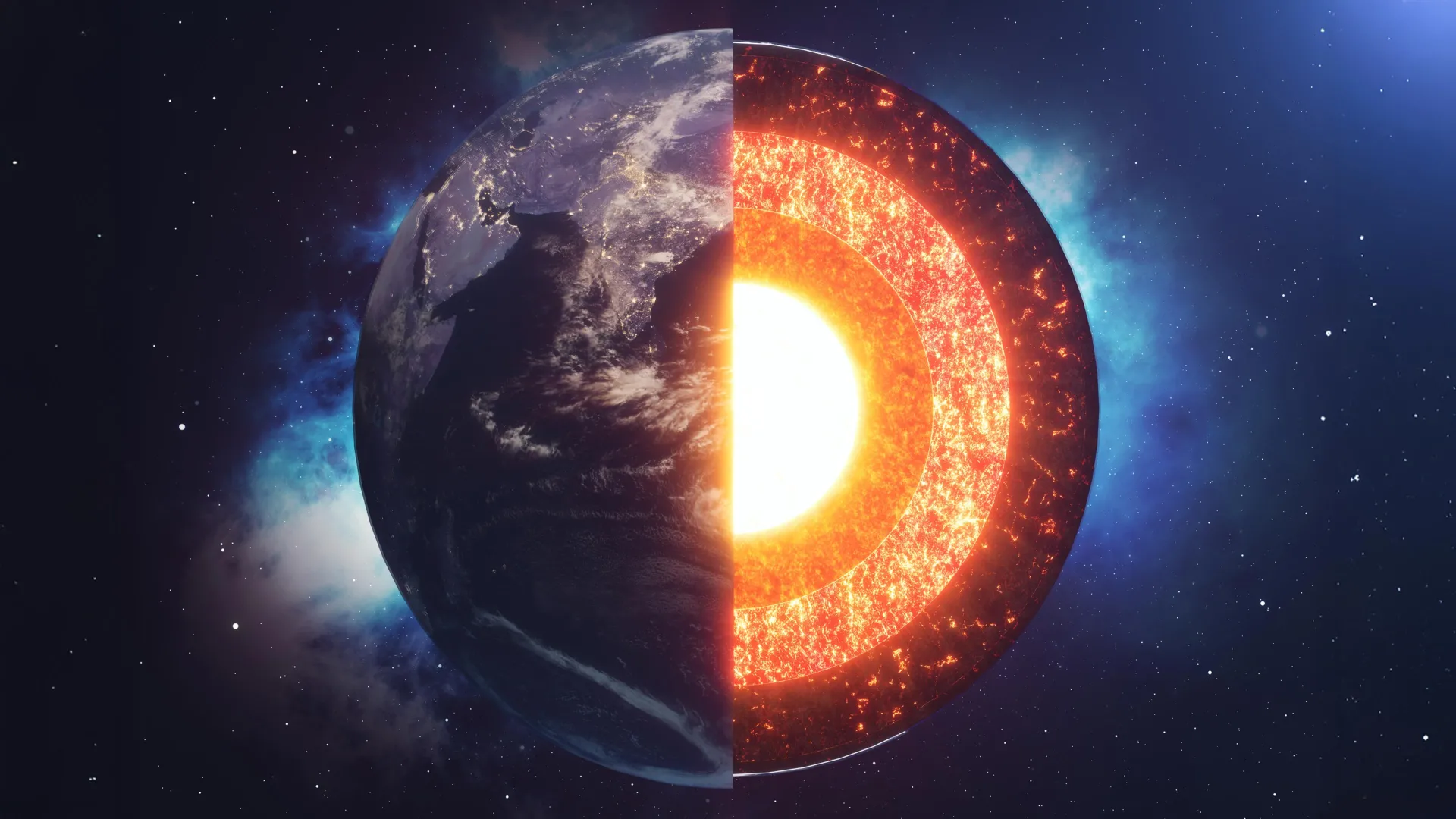
The mantle is a vast layer of hot, mostly solid rock beneath Earth’s crust. Although it appears rigid on human timescales, it can deform and flow extremely slowly over geological time. Heat-driven circulation in the mantle, known as mantle convection, can cause large areas of the surface to rise or sink.
When a continent rises, wind, water and other natural processes can erode its surface. If the land later sinks, the ocean can spread across it, allowing new sediment to accumulate over the eroded rock. This sequence can remove older layers while preserving the boundary between ancient rock and newer deposits.
“Imagine a book with a huge section cut out in the middle,” Dhungana said. “A large discrepancy is a gap in Earth’s story where the story jumps from an early chapter to a much later part of the story. Our study suggests that these pages were not lost by chance.”
Continents rose and sank over hundreds of millions of years
The simulations showed similar patterns across three major ancient continental regions: Laurentia, Baltica, which includes northern Europe, and northern China.
According to the models, mantle convection uplifted the ancient cores of these continents during the Neoproterozoic era, which lasted from about 1 billion years ago to 540 million years ago. This period preceded the Cambrian period and its rapid expansion of animal diversity, commonly known as the Cambrian Explosion.
As the continents remained elevated, prolonged erosion may have stripped away extensive layers of older rock, removing hundreds of millions of years of geological history.
The researchers found that the uplift was followed by widespread subsidence during the Phanerozoic era, covering approximately the past 540 million years. As the continental regions gradually sank, advancing oceans covered the eroded surfaces. New sediments then accumulated on top of the exposed older rocks, preserving the boundary between the two rock types.
Over immense spans of time, repeated uplift, erosion, subsidence and deposition may have produced the large unconformities visible in rock formations today.
A possible common cause for a widespread geological gap
A key finding was the close match between the simulations and the geographic distribution of the Great Unconformity. The model predicted long-term uplift followed by subsidence in North America, northern Europe and northern China—regions where these geological gaps are particularly well documented and preserved.
This agreement supports the idea that processes deep within the mantle played a major role in removing large portions of the geological record. It also suggests that common forces may explain the pattern across multiple regions, rather than each location requiring a separate cause.
“Sometimes what’s missing can tell us more about Earth’s story than what we can see. A single long period of uplift followed by long periods of subsidence would have been an ideal way to remove rocks and preserve worn surfaces,” Flament said.
The research links geological evidence at Earth’s surface with slow processes deep below it. It does not prove that mantle convection was the sole cause of the Great Unconformity, but it provides a testable explanation for why so much ancient history disappeared and how the remaining geological evidence survived.
“Many explanations have been proposed for the Great Unconformity, but few have been tested for how the Earth actually behaves over time. We are excited to propose a solution to this geological puzzle,” the researchers said.
Source: www.sciencedaily.com