


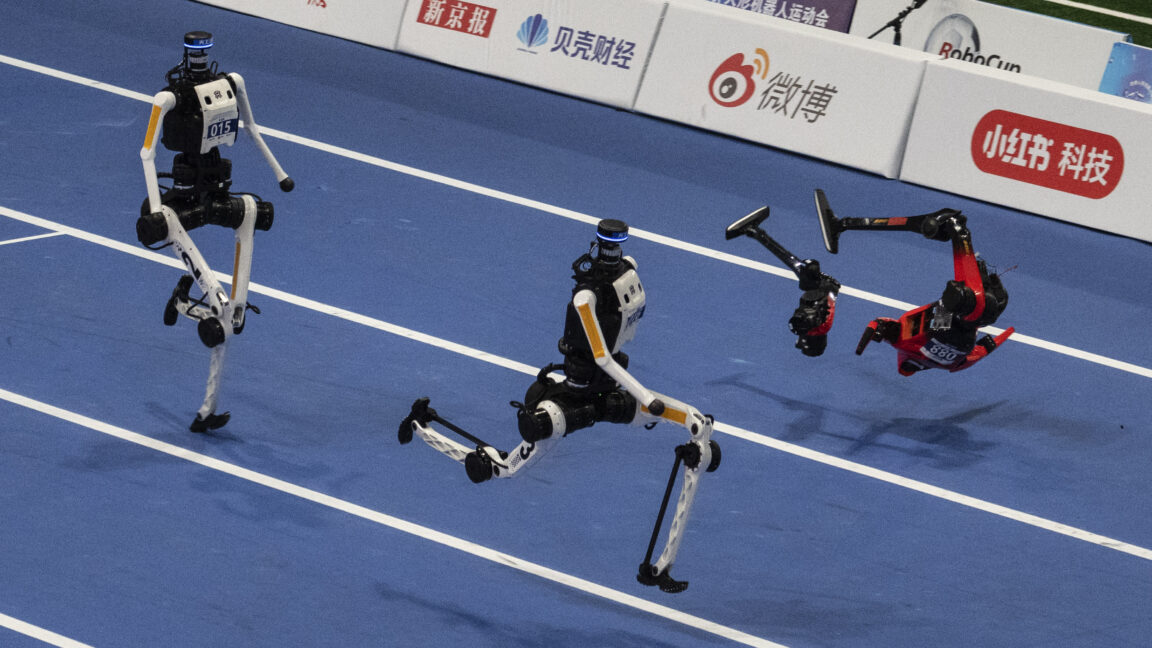
The limits of humanoid robot autonomy
Patel said the continued use of direct human control during many events highlights how far autonomous robots still have to go. Humans can often learn new tasks quickly and adapt on the fly, while robots typically need extensive training through trial and error in simulated or real-world environments.
“For a robot to learn from an interaction, you have to account for every possible edge case, and in reality, that is not practical,” Patel told Ars. “You can simulate 100,000 nail-driving scenarios, but that represents only one task among millions of real-world activities.”
The artificial intelligence models powering modern robots can learn from enormous collections of visual data and human demonstrations. However, gathering high-quality training data remains time-consuming and expensive. Even efforts by companies to pay people to wear head-mounted cameras have not produced enough demonstrations of the many tasks humanoid robots may eventually need to perform.
“We need to make significant advances in algorithms before robots can generalize well enough to work eight-hour shifts in unpredictable environments,” Patel explained.
Even the most autonomous humanoid robots competing in the Global Humanoid Robot Competition still depend heavily on cloud computing to run demanding AI models. Instead of processing every task on onboard hardware, some robots use high-speed wireless connections to communicate with remote systems. The South China Morning Post reported that one robot uses a 5G module to send data to an “embodied intelligence system” and receive instructions about what to do next.
Real-world testing will ultimately provide a more meaningful measure of humanoid robot capabilities than demonstrations at the World Humanoid Robot Games. Investors spent more than $6 billion on humanoid robotics companies in 2025 alone, while Chinese robotics firms have been especially active in testing and deploying humanoid machines.
US companies, including Boston Dynamics and Agility Robotics, are also accelerating commercialization efforts and preparing to deploy humanoid robots in factories, warehouses, and other industrial settings. At the same time, the US government has restricted imports of some foreign robots, including several popular Chinese humanoid models.
Still, not every robotics researcher believes humanoid robots are the best solution for every job. Many of the robots already performing useful work come in specialized shapes and sizes designed for specific environments. Patel’s own research focuses on software algorithms that enable different types of robots to switch more smoothly between tasks.
Source: arstechnica.com