


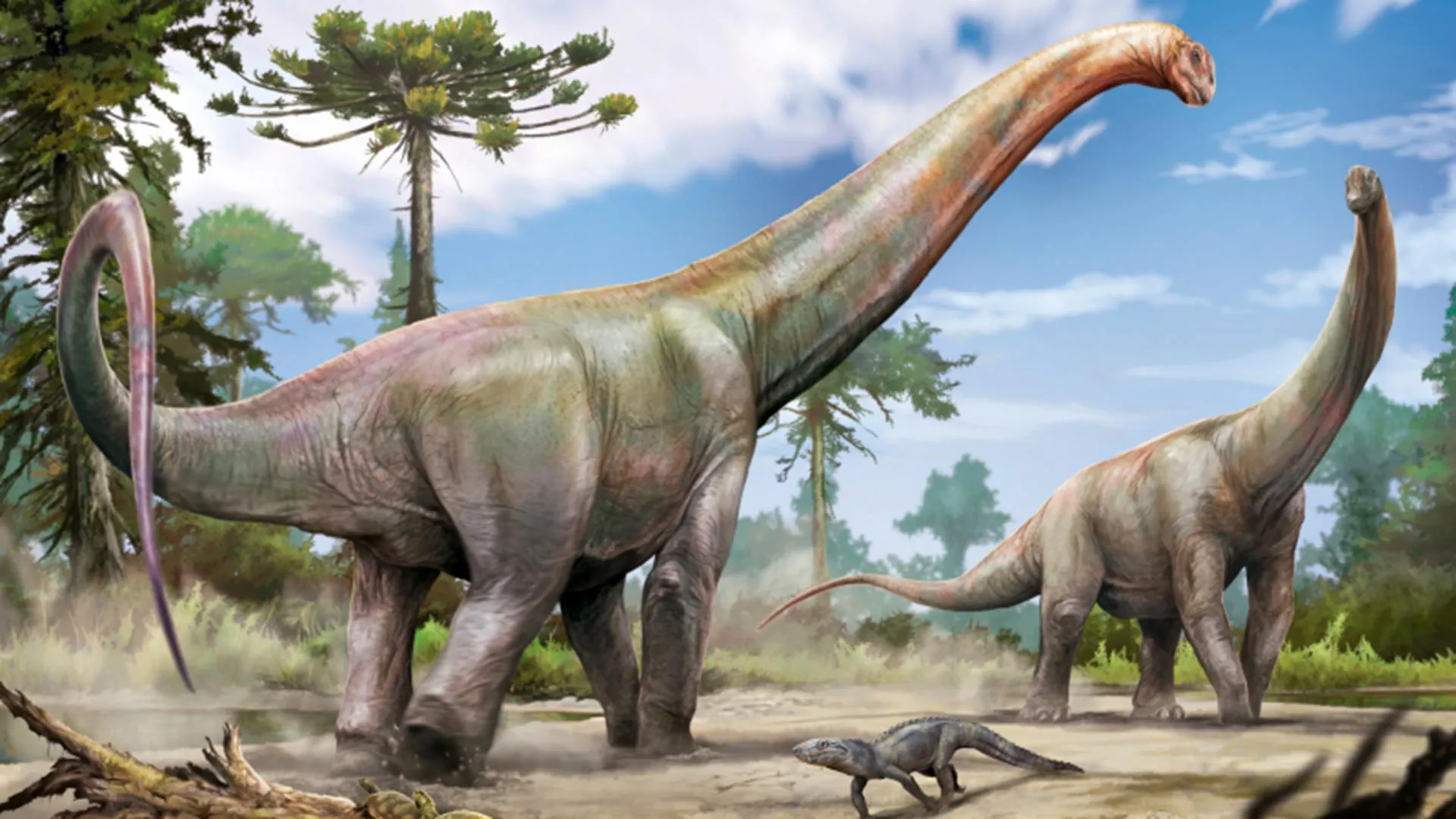
A newly identified dinosaur species discovered during construction work in northeastern Brazil is providing new insights into how giant sauropods spread across the ancient supercontinent of Gondwana.
The newly named species, Dasosaurus tocantinensis, is described in a study published in the Journal of Systematic Palaeontology. The dinosaur measured approximately 20 meters long and lived about 120 million years ago during the Early Cretaceous. Its fossilized remains were discovered at a road and railway terminal construction site in Davinópolis, Maranhão, Brazil.
One of the most remarkable aspects of the discovery is the dinosaur’s evolutionary connection to Europe. Its closest known relatives have been identified in what is now Spain, suggesting that this lineage once inhabited a much broader region before the Atlantic Ocean separated South America from Africa and Europe.
According to the researchers, Dasosaurus tocantinensis may have traveled through North Africa before reaching South America between 140 million and 120 million years ago. At that time, the continents were still connected as part of the Gondwana supercontinent, allowing large dinosaurs to move across land bridges that no longer exist.
Largest known dinosaur discovered in Maranhão
“This is the largest dinosaur known from Maranhão. Although other dinosaur species have been found in the state, there are no other sauropods of this size. Instead, researchers have identified smaller dinosaurs, including Amazonsaurus maranhensis, which was approximately 10 meters long,” said Elver Ruiz Mayer, a professor at the Federal University of the São Francisco Valley (UNIVASF) in Bahia.
Mayer typically studies Quaternary mammals, which lived far more recently than the dinosaurs. He became involved in the discovery in 2021 while working in São Félix do Xingu, Pará, where he was then a professor at the Federal University of Southern and Southeastern Pará (UNIFESSPA).
Archaeologists monitoring the Davinópolis construction project discovered the fossils as part of the environmental licensing process. The remains were initially thought to belong to large prehistoric mammals that may have lived alongside early humans.
Mayer quickly suspected that the bones were much older.
“Because the remains were found about eight meters below the surface, we realized they were likely much older. Previous geological studies had already dated the surrounding layers to the transition between the Lower and Upper Cretaceous, approximately 120 million years ago,” Mayer explained. He then contacted specialists and assembled an interdisciplinary team to study the fossil.
An unusually complete dinosaur fossil
The fossilized bones underwent an extensive preparation process before being analyzed in Pará. The specimen was later returned to Maranhão. It is currently housed at the State Center for Natural History and Archaeological Research in São Luís, the state capital, which also contributed to the study.
The preserved skeleton includes several important bones, making it an unusually informative specimen for a dinosaur of this type.
“This is considered a relatively complete specimen because it includes caudal vertebrae, a 1.5-meter femur, ribs, foot bones, and bones from the forelimbs and hind limbs. Many additional fossils from the same individual may still remain at the original site,” said Max Langer, a professor at the University of São Paulo’s Ribeirão Preto School of Philosophy, Sciences and Letters (FFCLRP-USP), who participated in the research.
Langer coordinates the project “Exploring the Diversity of Cretaceous Dinosaurs and Associated Animals in South America,” which is supported by FAPESP.
Why the dinosaur was named Dasosaurus tocantinensis
The species name reflects both the landscape of Maranhão and the location where the fossil was found.
“Daso” means “forest” and refers to the region’s wooded environment. Early Portuguese settlers described these forests as dense and tangled. The second part of the name, “tocantinensis,” refers to the Tocantins River, as the fossil site is located near its eastern bank.
The researchers also examined the microscopic structure of the dinosaur’s bones. The analysis, led by Tito Aureliano and Aline Ghilardi of the Federal University of Rio Grande do Norte (UFRN), revealed a growth pattern combining characteristics found in ancient sauropods and titanosaurs, a closely related dinosaur group.
The findings suggest that some patterns of bone growth and remodeling may have evolved earlier in dinosaur history than previously believed. This could help scientists understand how certain sauropods evolved the ability to reach enormous body sizes.
Construction projects can reveal hidden dinosaur fossils
The discovery of Dasosaurus tocantinensis also highlights the complex relationship between paleontology and large-scale construction. Infrastructure projects can damage or destroy fossil deposits, but they can also expose layers of rock that would otherwise be difficult for scientists to access.
“Brazil is a tropical country with dense vegetation. Geologists and paleontologists often depend on human activity to expose rocks and fossils. When we map Brazil’s fossil sites, we frequently find them along highways, railways, and quarries. These projects are important for understanding our natural heritage, but professional monitoring and fossil recovery do not always take place,” Langer said.
“There is an urgent need to harmonize federal regulations governing construction projects and fossils. Closer cooperation among developers, researchers, and government agencies could encourage new discoveries while ensuring that important fossil sites are properly preserved,” Mayer added.
The researchers are negotiating with the construction company for permission to return to the site and continue excavations. Additional fossils could provide more information about Dasosaurus tocantinensis and the broader sauropod lineage to which it belonged.
The research received support from FAPESP through a PhD scholarship, a postdoctoral fellowship, and funding from the Young Investigator Program.
Source: www.sciencedaily.com