


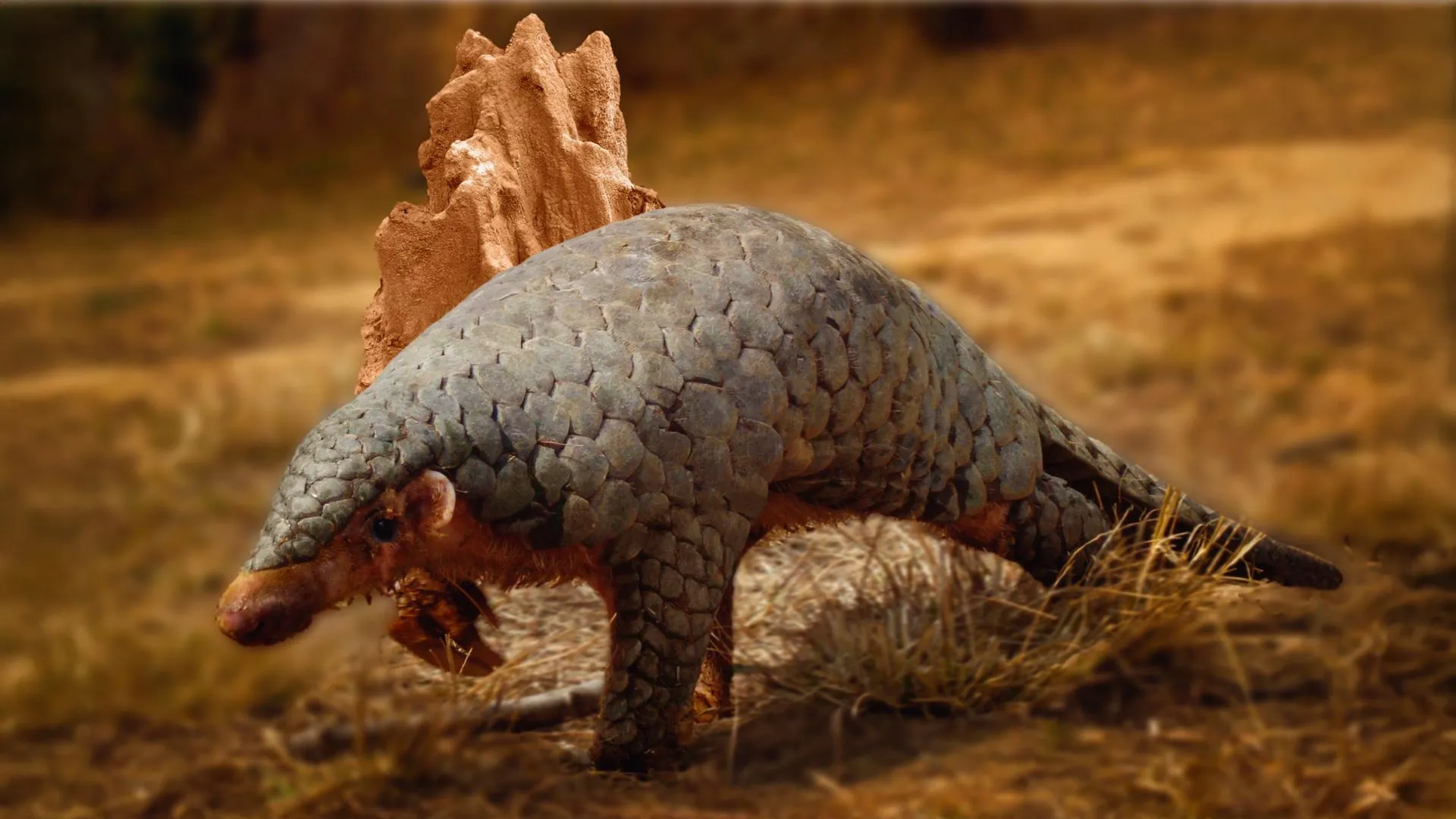
Pangolins look almost prehistoric. These medium-sized mammals live exclusively in Africa and Asia, where they are recognized by their long, powerful tails, large curved claws, and overlapping scales that resemble pine cones. Those distinctive scales are also a major reason pangolins are at risk. Poachers target them for the illegal wildlife trade, making pangolins the most trafficked mammals in the world. Several species face a serious risk of extinction.
Researchers have identified a previously unrecognized Asian pangolin species living in Nepal and northern India. The species, Manis aurita, is described in the journal Communications Biology. The study clarifies how Himalayan pangolins are related to other species, where they live, and how they can be identified. This information could help authorities determine where illegally traded pangolins were captured and strengthen efforts to stop poaching.
“You can’t protect what you don’t know, and now that we’ve confirmed that another species of pangolin exists, we can use that information to help protect these endangered animals,” says Anderson Feijo, assistant curator of Negaunee mammals at the Field Museum and a co-author of the study.
“This discovery marks the culmination of more than five years of research that began in Nepal, where we first documented evidence that Himalayan pangolins represent a distinct evolutionary lineage,” says Narayan Koju, a researcher at Pokhara University’s Nepal Faculty of Engineering and lead author of the study. “Confirmation of Manis aurita as a valid species demonstrates the importance of long-term research, international collaboration, and museum collections. Most importantly, it provides a strong scientific basis for conservation planning, wildlife forensics, and efforts to protect one of the world’s most trafficked mammals from extinction.”
Solving the pangolin family tree
The classification of Himalayan pangolins began changing in 2025. That year, researchers determined that animals previously grouped under the Chinese pangolin actually represented two separate species. One species lives primarily in China, while the other is found in the Himalayan foothills of Nepal, India, Bhutan, and parts of Myanmar. Researchers named the mountain-dwelling form the Indo-Burmese pangolin, Manis indoburmanica.
However, scientific names follow a rule of precedence. When the same species has been assigned more than one name, the oldest valid name takes priority.
Feijo and his colleagues had already spent a decade studying pangolin evolution. Their research combined DNA evidence with physical characteristics to determine how many pangolin species exist and how they are related.
During their investigation, the researchers found records of Manis aurita, a pangolin first described in 1836. The animal had later been reclassified as a subspecies of the Chinese pangolin.
“This left us with a central taxonomic mystery: What is the relationship between Manis indoburmanica and Manis aurita? Are they the same species or different species?” says Kai He, one of the study’s co-corresponding authors and a researcher at the South China Biodiversity Research Center at Guangzhou University. “The ultimate and most exciting piece of the puzzle came from the Natural History Museum in London. With their expertise and assistance, the NHM team was able to sequence DNA directly from the historical type specimen of the Nepalese pangolin. This specimen dates to 1836, making it almost 190 years old.”
1836 DNA provides answers
DNA recovered from the historic museum specimen helped resolve the mystery. When genetic material from modern Himalayan pangolins was compared with the 1836 specimen, researchers found that the animals described in 2025 as Manis indoburmanica were actually members of the previously named species Manis aurita.
As a result, Manis aurita is the correct scientific name for the Himalayan pangolin.
“This taxonomic clarification provides an important scientific basis for combating illegal poaching and lays the foundation for protecting this mysterious and endangered species,” says Yan Hua, a co-corresponding author of the study and a researcher at the Guangdong Academy of Forestry.
The Himalayan pangolin, M. aurita, previously known as M. indoburmanica, differs from the Chinese pangolin in several subtle but important ways.
“Compared with Chinese pangolins, Himalayan pangolins have larger bodies, longer tails, and smaller ears,” Feijo says. The revived name aurita refers to the animal’s characteristic ears.
The two species are also geographically separated, and their known ranges do not overlap. For endangered animals under intense pressure from poaching, understanding exactly which species live in which regions is essential for effective conservation.
New tools against pangolin trafficking
Pangolin scales are sometimes promoted as an aphrodisiac in traditional Chinese medicine, helping fuel the large-scale illegal wildlife trade. Preventing this trafficking is difficult because authorities often seize scales rather than complete animals.
“On the market, you basically only find pangolin scales, not the whole animal, so it’s difficult to know which species were hunted and where they came from,” Feijo says.
The DNA techniques used in the new study could make these seizures much more useful. Conservation scientists may be able to analyze confiscated scales, identify the pangolin species they came from, and determine the regions experiencing the greatest poaching pressure.
This approach could allow conservationists and law-enforcement agencies to work backward from illegal wildlife products to the populations being targeted.
A clearer understanding of pangolin species boundaries could also improve reintroduction programs. When conservationists return pangolins to areas where they once lived, they must ensure that the correct species is released within its natural geographic range.
“Previously, we might have brought Chinese pangolins to Nepal because we didn’t know the difference,” Feijo says. “By defining the differences between species and identifying the boundaries of their ranges, we can make better conservation decisions.”
Museum collections reveal hidden biodiversity
Researchers say these conservation advances would be much more difficult without natural history museums. Museum collections contain pangolin specimens collected more than a century ago, giving scientists access to animals from populations and locations that may be difficult or impossible to sample today.
“Museum collections give us access to more individuals from every species,” Feijo says. “This animal is so rare in the wild that relying only on fresh material severely limits the information we can gather. We used museum collections to create a more complete sample of the species. Having this material available as a resource that we can continue to study and learn from is a huge benefit.”
The research was carried out in collaboration with scientists from Guangzhou University, the Nepal Institute of Engineering, Pokhara University, the Chinese Academy of Sciences, the University of Washington, the Smithsonian National Museum of Natural History, the University of Seville, the Guangdong Academy of Forestry, Tribhuvan University, Aspect Ecology Oxfordshire, the China Wildlife Forensic Administration, Chengdu University of Traditional Chinese Medicine, and the Field Museum.
Source: www.sciencedaily.com