


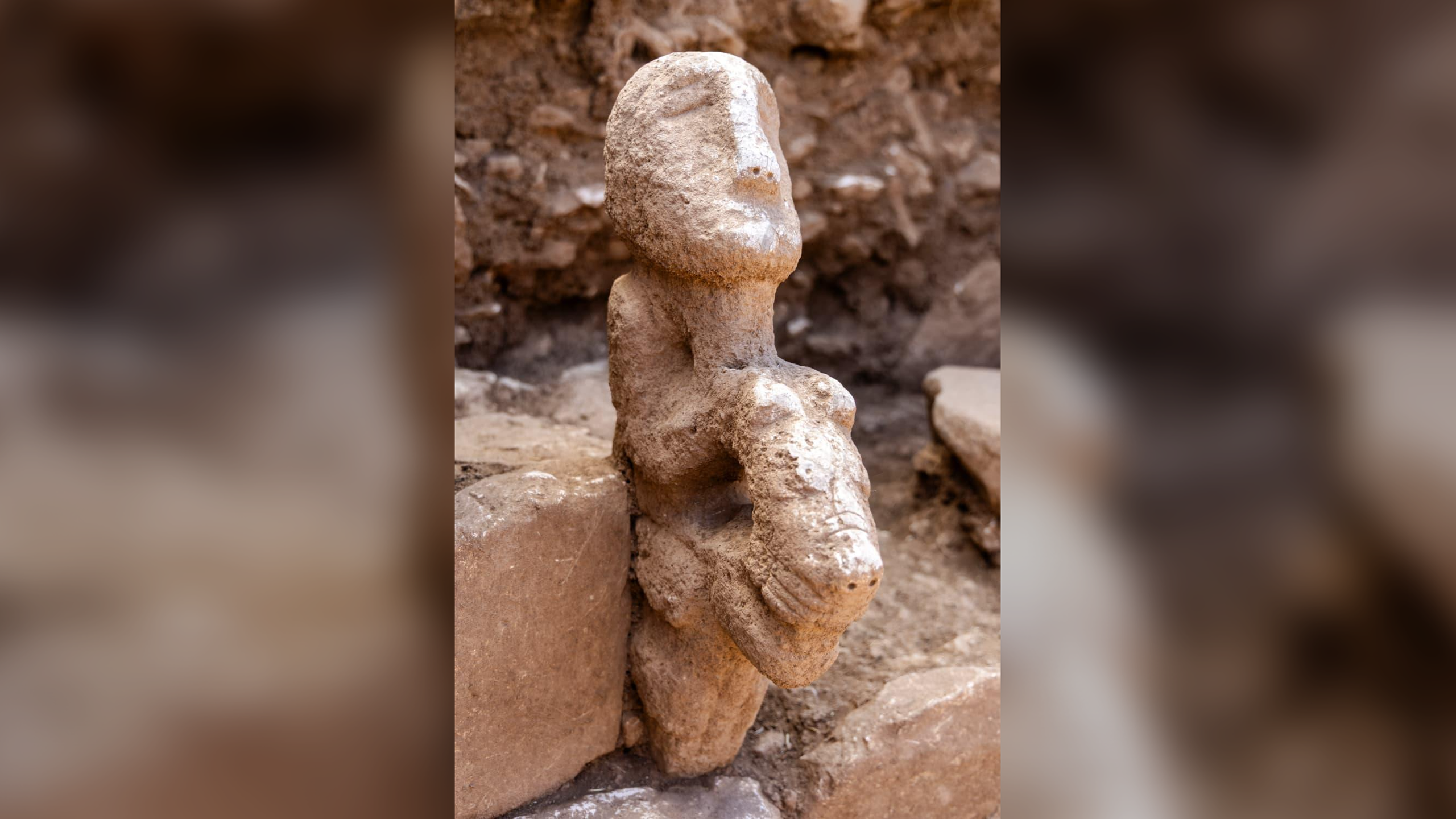
11,000-Year-Old Statue of a Figure Riding a Leopard Discovered in Türkiye
Archaeologists excavating the Neolithic settlement of Karahantepe in southern Türkiye have uncovered a remarkable 11,000-year-old statue depicting a human figure seated on the back of a leopard.
The discovery, announced in an August 25 statement by the Turkish Ministry of Culture and Tourism, offers new insight into the beliefs, symbolism and artistic traditions of one of the world’s earliest settled communities.
The approximately 70-centimeter-tall sculpture was created in a style officials described as unprecedented. Mehmet Nuri Ersoy, Türkiye’s minister of culture and tourism, said the find could raise important questions about early human history.
Latest videos fromLive Science
Researchers found the statue on a platform built along the wall of a circular structure measuring roughly 10 feet, or 3 meters, across, according to the ministry’s statement.
Karahantepe, also spelled Karahantepe or Karahan Tepe, is part of the Taş Tepeler archaeological region in Şanlıurfa Province. The settlement was established around 9750 B.C. and is among the oldest known villages in the world. Nearby Göbekli Tepe was built during the same broad period, when communities produced monumental architecture and enigmatic carvings of humans and animals.
Leopards in Neolithic art
The newly discovered sculpture adds to a growing body of evidence that leopards and other powerful animals held special significance in Neolithic communities in southeastern Türkiye.
In 2023, archaeologists at Karahantepe reported an approximately 11,000-year-old statue of a person holding the figure’s genital area. A life-size sculpture known as the “Wolfman,” depicting a human figure with similar emphasis, was discovered near Göbekli Tepe in 1993. Archaeologists also found a carved scene at the nearby Sefertepe site showing a human figure associated with two leopards, a bull and a similar human motif.
Jens Notroff, a Neolithic archaeologist at the German Archaeological Institute who was not involved in the excavation, told Live Science that the new sculpture may represent a reversal of a familiar artistic theme.
“The sculpture appears to be a mirrored version of a known type of ‘animal riding on man,’” Notroff said. An earlier statue showing a human carrying a leopard on their back was discovered at Karahantepe and is now held by the Şanlıurfa Museum.
“Leopards were common feline predators in this area,” Notroff said. “They are active and dangerous animals, so they were probably challenging prey for skilled hunters. That may have increased their symbolic meaning.”
Although the exact meaning of the human-and-leopard motif remains unknown, the imagery may have been connected with courage, strength or the ability to control danger.
“Individuals shown as fearless in relation to these animals, as at Sefertepe, or appearing to have mastered them, as in this new Karahantepe sculpture, may be interpreted as symbols of power and control over vitality and danger,” Notroff said.
The discovery could provide valuable new information about the social and religious practices of the region’s earliest farming communities. Archaeologists hope that further excavation and analysis will clarify how the statue was used and what its imagery meant to the people who created it.
“This discovery opens the door to new questions about early human history and could have wide-ranging implications for the scientific community,” Ersoy said.
How much do you know about the Paleolithic, Mesolithic and Neolithic periods? Find out with our Stone Age Quiz!
Source: www.livescience.com