


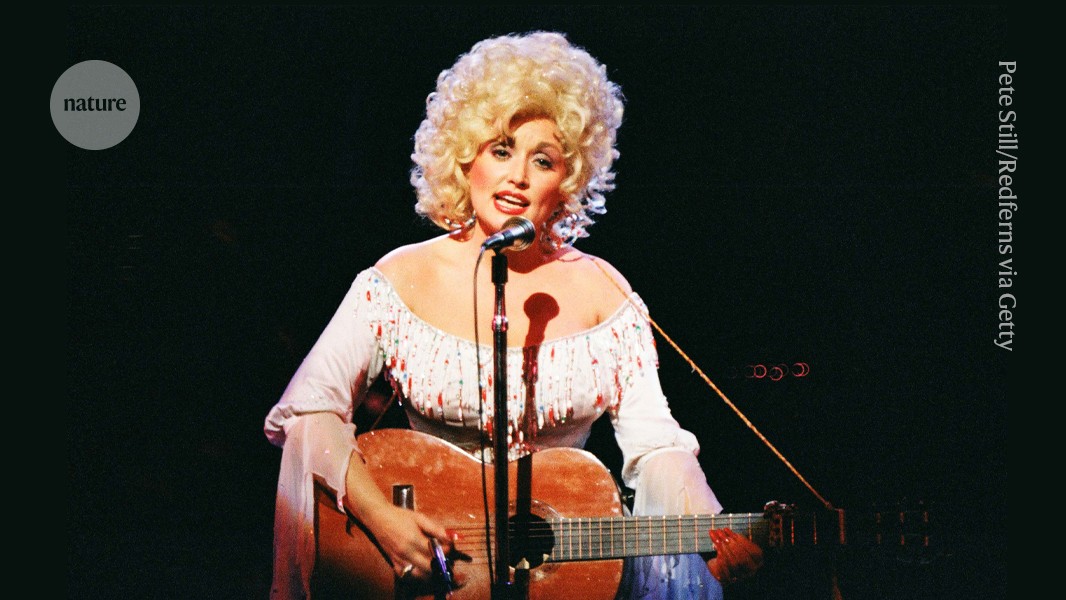
Dolly Parton on stage at the Dominion Theater in London, England, in 1983.
Credit: Pete Still/Redferns via Getty
Legendary country musician Dolly Parton has died at the age of 80 after a “short battle with cancer”, her representative announced in a statement on August 25.
Born in 1946 to a poor farming family in Locust Ridge, Tennessee, Parton began singing and performing at an early age. She went on to become one of country music’s most influential artists, winning 10 Grammy Awards during her career.
Parton also made a lasting impact on science, public health and education. Her philanthropy supported medical centers, vaccine research, disaster relief and children’s literacy. She also inspired the name of one of science’s most famous animals: Dolly, the first mammal cloned from an adult cell.
Scientists around the world paid tribute to Parton following news of her death.
“Dolly provided the soundtrack for my PhD, and thanked me for being a key contributor to my thesis! She was the best of us, and we should all strive to be more like Dolly — rhinestone included,” said Astronomer Royal of Scotland Katherine Heymans to Nature by email.
“Today is a sad day to remember an extraordinary artist, a true champion of kindness, and an ambassador for science and public health,” World Health Organization Director-General Tedros Ghebreyesus wrote on X.
Others reflected on how Parton used her fame to support important causes. “Few celebrities use their influence to support science in such a meaningful way,” cell biologist Gaurav Kansagara of the Institute of Stem Cell Science and Regenerative Medicine in Bangalore, India, wrote on Bluesky.
Here are five ways Dolly Parton contributed to science, medicine and public health.
Funding vaccine research
One of Dolly Parton’s most significant contributions to science was her support for research that helped advance a leading COVID-19 vaccine. In March 2020, she donated $1 million to Vanderbilt University Medical Center (VUMC) in Nashville, Tennessee, establishing the Dolly Parton COVID-19 Research Fund.
Mark Denison, a pediatrician and infectious-disease researcher at Vanderbilt, said the donation helped fund the critical early stages of research into an experimental mRNA vaccine. The vaccine was later developed and manufactured by Moderna, a biotechnology company based in Cambridge, Massachusetts.
The Dolly Parton COVID-19 Research Fund was acknowledged in the first published report on the vaccine’s Phase I trial in the New England Journal of Medicine in July 20201.
At least 37 research papers have acknowledged support from the Dolly Parton COVID-19 Research Fund, according to an analysis by Nature of the Dimensions database, part of Digital Science, a company operated by Holtzbrinck Publishing Group, the parent company of Nature’s publisher, Springer Nature.
Music is not a universal language, but it brings us together when words do not speak.
Promoting COVID-19 vaccination
Parton’s support for COVID-19 vaccination extended beyond funding medical research. In March 2021, she filmed herself receiving a vaccine at VUMC and encouraged the public to follow her example.
“I’m old enough to get it, and I’m smart enough to get it,” Parton joked. She also reworked the lyrics of her hit song “Jolene”, singing: “Vaccine, vaccine, vaccine, vaccine, please don’t hold back.”
After Parton’s death, Neil Stone, a clinician and infectious-disease researcher at University College London, reposted the video on X and called Parton a “legend”. “She is a great philanthropist, donating $1 million to coronavirus vaccine research and saving many lives,” he wrote.
William Schaffner, a preventive-medicine researcher at VUMC, said Parton’s decision to receive the vaccine publicly “offered a glimmer of hope and reassured many people that getting vaccinated is in the best interest of them and their families”. He said Parton “created a connection between public health and ordinary people”.
Supporting public health
Parton’s philanthropy supported a wide range of public-health initiatives. In 1994, she contributed a version of the song You Gotta Be My Baby to the charity album Red Hot + Country, which raised money to fight HIV/AIDS.
In her home county of Sevier County, Tennessee, Parton raised $500,000 at a benefit concert for LeConte Medical Center. The hospital opened in 2010 alongside the Dolly Parton Center, which provides women’s health services.
Parton also donated $1 million to pediatric infectious-disease research at Vanderbilt University. In February 2026, East Tennessee Children’s Hospital in Knoxville was renamed Dolly Parton Children’s Hospital after an undisclosed “generational” gift to support pediatric training programmes, telemedicine and the recruitment of medical specialists.
“Dolly Parton chose not to become a billionaire,” social psychologist Carly Trott of the University of Cincinnati in Ohio wrote on Bluesky. “She never forgot what it meant to be in trouble.”

Dolly the sheep was named after Dolly Parton because the cloned animal was created using mammary-gland cells. The choice later drew criticism for objectifying Parton.
Credit: Mathieu Polak/Sygma/Sygma via Getty
Inspiring science through Dolly the sheep
The country singer, who received an honorary doctorate from the University of Tennessee, Knoxville, became an inspiration throughout the scientific community. Dolly the sheep, the first mammal cloned from an adult cell, was named after Parton because researchers used mammary-gland cells in the cloning process.
Source: www.nature.com